

Most UK pool owners know the feeling: you spend the best part of a year waiting for summer, you get six decent weeks, and then the cover goes back on. If you paid £50,000 for your pool, those six weeks cost you roughly £8,000 each in capital terms. That number alone is enough to make anyone reconsider how a pool is actually being used.
The difference between an underused pool and one that earns its keep is not a bigger heater or a better chemical regime. It is almost entirely structural, and it comes down to a single decision made at the planning stage or as a retrofit.
Why Most UK Pools Sit Empty for Nine Months of the Year
The British climate is the obvious culprit, but the numbers are worth spelling out. Average summer air temperatures across England rarely exceed 20 degrees Celsius, even in July. That means outdoor water temperatures in an unheated or lightly heated pool hover in the mid-to-high teens for much of the year, which is below the threshold most swimmers consider comfortable for anything longer than a bracing dip.
The usable window for an unenclosed outdoor pool is, in practice, about twelve weeks: roughly June through August. Even within that window, the weather is not reliable. The UK averages 1,154mm of rainfall annually, and July across most of England still clocks up eight to ten rainy days per month. A family planning a Saturday afternoon swim faces a realistic chance of being rained out, and that uncertainty gradually trains people to stop planning pool time at all.
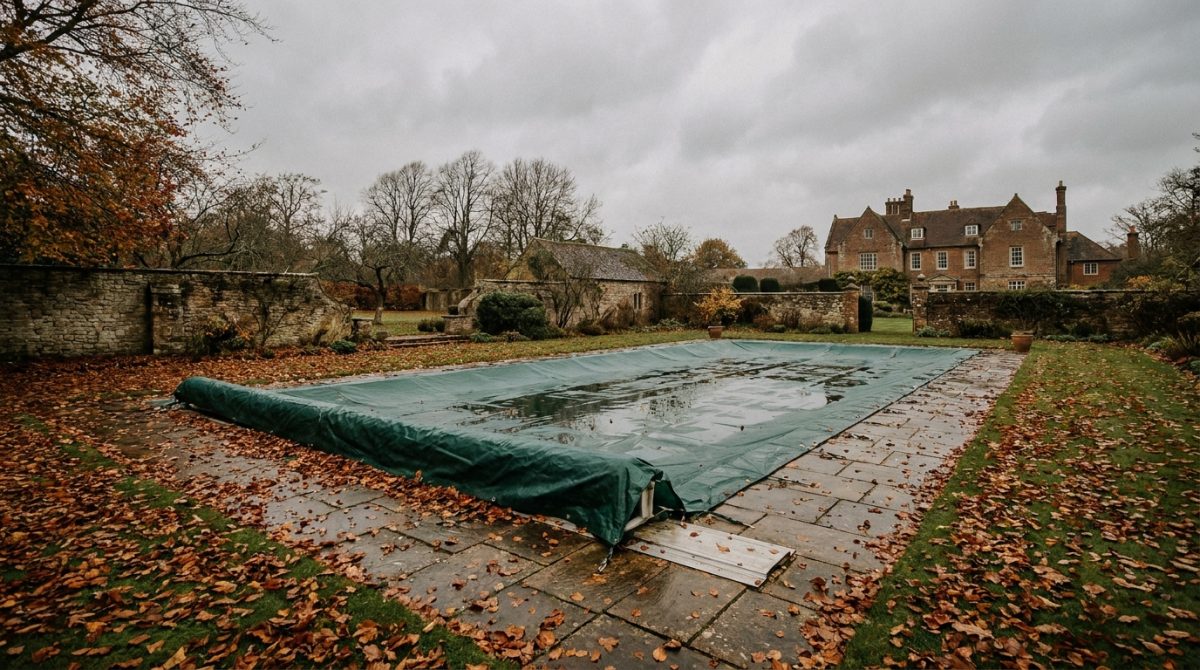
The financial case is stark. A typical domestic pool installation in the UK costs between £30,000 and £80,000. Owners who swim for three months per year are extracting less than 25 percent of the potential value from that investment. Put another way, the pool is idle and still costing money in maintenance, chemicals, and equipment wear for roughly nine months out of twelve.
Those ongoing costs are not trivial. A medium-sized domestic pool typically costs between £3,000 and £6,000 per year to run, covering chemicals, energy, and routine maintenance. If the pool is actively used for only three months, the owner is spending up to £4,500 per year to maintain a facility they use for roughly 90 days. That works out to £33 to £50 per day the pool is open, before the capital cost of the installation is factored in at all. Extending the season to nine or ten months does not increase running costs proportionally, because a heated and enclosed pool in October consumes far less energy than the same pool in June when it is open to wind and evaporation. The cost per swim day actually falls as the season extends.
But the physical barrier is only part of the problem. There is a psychological barrier that is just as stubborn. Once a pool has been mentally categorised as a summer-only amenity, most owners stop checking the water temperature in September or wondering whether a warm October afternoon might allow for a swim. The habit of non-use becomes self-reinforcing. The cover stays on not because the pool is actually unusable, but because the owner has stopped thinking of it as an option.
This article is specifically about dismantling that assumption. Year-round pool use is not a luxury reserved for commercial leisure facilities with industrial heating budgets. It is available to any domestic pool owner who makes one structural decision: enclosing the pool. Everything else follows from that.
The Greenhouse Physics That Keep Enclosed Pools Warm in October and Beyond
The mechanism is simple enough to explain in a single paragraph, but its practical consequences are significant enough to deserve a proper examination. When sunlight strikes a polycarbonate or glass panel, shortwave solar radiation passes straight through. It is absorbed by the pool water, the paving, the pool walls, and any other surface inside the enclosure. Those surfaces then re-emit that absorbed energy as longwave infrared radiation. The critical point is that longwave infrared cannot pass back out through the panels as easily as the shortwave radiation came in. Heat is trapped.
This is exactly the same physics that governs a greenhouse, and the temperature differential it creates is substantial. On a clear autumn day, a closed enclosure can raise the internal air temperature by 8 to 12 degrees Celsius above the ambient outdoor temperature. A 10-degree October afternoon becomes an 18 to 22-degree swimming environment inside the enclosure without any supplementary heating at all. October in the south of England suddenly has a usable pool again.
The pool as a thermal battery
Water has one of the highest specific heat capacities of any common substance, which means it absorbs large amounts of energy before its temperature rises noticeably, and it releases that energy slowly. A 50,000-litre domestic pool that has been absorbing solar energy through the summer months carries an enormous thermal reserve into September and October. An enclosure does not generate that warmth from scratch: it protects the warmth that is already there.
An open outdoor pool loses heat through several routes simultaneously. Convection carries warm air off the water surface. Wind accelerates that process dramatically. And evaporation is the biggest drain of all: evaporative heat loss accounts for up to 70 percent of total pool heat loss in an open outdoor pool. Every litre of water that evaporates carries a significant quantity of latent heat with it. An enclosure eliminates the wind factor almost entirely and reduces evaporation to a fraction of the open-air rate. The water that stays in the pool keeps the heat that would otherwise have left with it.
What good polycarbonate actually achieves
Not all enclosure glazing performs equally. Quality polycarbonate panels, such as those used in Arch Enclosures systems, typically achieve U-values of around 1.5 to 2.0 W per square metre per Kelvin. For context, a standard single-glazed window has a U-value closer to 5.0 to 5.8. The panels in a well-specified enclosure are genuinely insulating, not just transparent. Combined with the passive solar gain described above, this means the pool heater is working against a far smaller temperature differential than it would be in an open installation.
The real-world impact on running costs is meaningful. Consider a pool being maintained at 28 degrees Celsius in September. In an open outdoor installation, the heat pump may need to run six to eight hours per day to compensate for evaporative, convective, and radiative losses. Inside a closed enclosure, the same pool, in the same month, at the same target temperature, may require only two to three hours of heating per day. That is a reduction in energy consumption of more than half, repeated across every day of the shoulder season. For a pool owner also considering solar integration alongside their enclosure, the combined savings can be even more significant, as explored in this piece on solar integration with enclosures.
The Edge Case That Catches Owners Out: Ventilation in Spring and Early Summer
The greenhouse effect that makes an enclosure so valuable in autumn and winter can become a problem if it is not managed in spring. April and May are the months when owners most commonly make a costly mistake: they keep the enclosure fully closed on warm, sunny days because the air outside still feels cool, and they return to find the internal temperature has climbed above 35 degrees Celsius and the pool water is cloudy.
The issue is that very high air temperatures inside a closed enclosure accelerate chlorine degradation significantly. Chlorine that would last three to four days in a well-managed open pool can be exhausted within 24 hours at sustained internal temperatures above 32 degrees. The result is a rapid drop in sanitiser levels, a corresponding rise in combined chlorine (chloramines), and the kind of hazy, irritating water that is both unpleasant to swim in and expensive to correct. Shock dosing a 50,000-litre pool back to clear water typically costs between £40 and £80 in chemicals alone, and the pool is usually out of use for 24 to 48 hours while the chemistry restores.
The practical fix is straightforward but requires attention. Any retractable enclosure should be partially vented on days when the forecast exceeds 15 degrees Celsius outside and sunshine is sustained. Opening the end panels or sliding back one or two roof sections by 30 to 40 percent is sufficient to prevent thermal runaway while still providing wind protection. Most owners who fit a digital thermometer inside the enclosure, a basic unit costs under £20, quickly build an instinct for when venting is needed. Treating the enclosure like a greenhouse that also happens to contain a swimming pool, rather than a sealed box, resolves the issue entirely.
A Practical Month-by-Month Swimming Calendar for Enclosed Pool Owners
Abstract benefits are useful, but a concrete schedule is more actionable. Here is how an enclosed pool actually gets used across a full twelve months in a typical UK location.
March and April
These are the months when the gap between enclosed and open pools is most visible. An unenclosed pool in March is simply not swimmable for most people: water temperatures will typically be sitting between 10 and 14 degrees Celsius, and the combination of cool water and cold air makes any extended use uncomfortable. An enclosed pool, kept fully closed through the increasing daylight hours of late winter and early spring, tells a different story. The greenhouse effect builds steadily as the days lengthen. By mid-April, water temperatures inside a well-managed enclosure can reach 22 to 24 degrees Celsius with minimal supplementary heating. That represents a full six to eight weeks of swimming that an open pool simply cannot offer.
May and June
As outdoor temperatures climb, the enclosure shifts from a necessity to an option. This is where the sliding track system of a retractable enclosure pays dividends. On warmer afternoons, panels can be partially or fully retracted to give an open-air swimming experience. When the weather turns cool in the evening, or when one of those inevitable summer rainstorms arrives, the enclosure closes in minutes and the swim continues. Owners have genuine flexibility rather than a binary choice between swimming and not swimming.
July and August
In peak summer, the enclosure is often retracted entirely during the day. It still earns its keep, though. It provides shelter from the sharp summer downpours that can end an outdoor gathering without warning, and the ability to partially shade the pool prevents the overheating of shallow water that can occur on the hottest days. Even in its fully open configuration, the enclosure structure itself acts as a windbreak that improves the perceived comfort of the pool area.
September and October
This is the month-pair that most dramatically illustrates the value of an enclosure. Without one, September is the point at which most pool owners are draining and covering. With one, the enclosure closes again as evenings cool, the greenhouse effect takes over, and the pool continues to operate at 26 degrees Celsius while unenclosed neighbours are deflating inflatables. The pool season has not ended: it has simply moved back inside a structure that most people would barely notice from the garden.
November through February
Winter swimming with an enclosure is not a novelty or a hardship exercise. With a quality heat pump or gas heater supplementing the passive solar gain, maintaining 28 degrees throughout the winter months is entirely achievable. The enclosure also provides a benefit that is easy to overlook: it protects the pool’s mechanical equipment from frost damage. Pumps, filters, heat exchangers, and pipework that are exposed to sub-zero temperatures are vulnerable to cracking and failure. Inside an enclosure, those components remain above freezing, reducing winter maintenance costs and the risk of expensive emergency repairs.
One practical step stands out as the single most effective way to protect winter swimming continuity: book a professional service of the pool heating system in September, before the heating season begins in earnest. The most common interruption to winter pool use is not structural failure or cost: it is a heat pump or boiler that has not been serviced since the previous spring failing at the worst possible time. A September service appointment costs a fraction of an emergency winter callout and keeps the season unbroken.
