
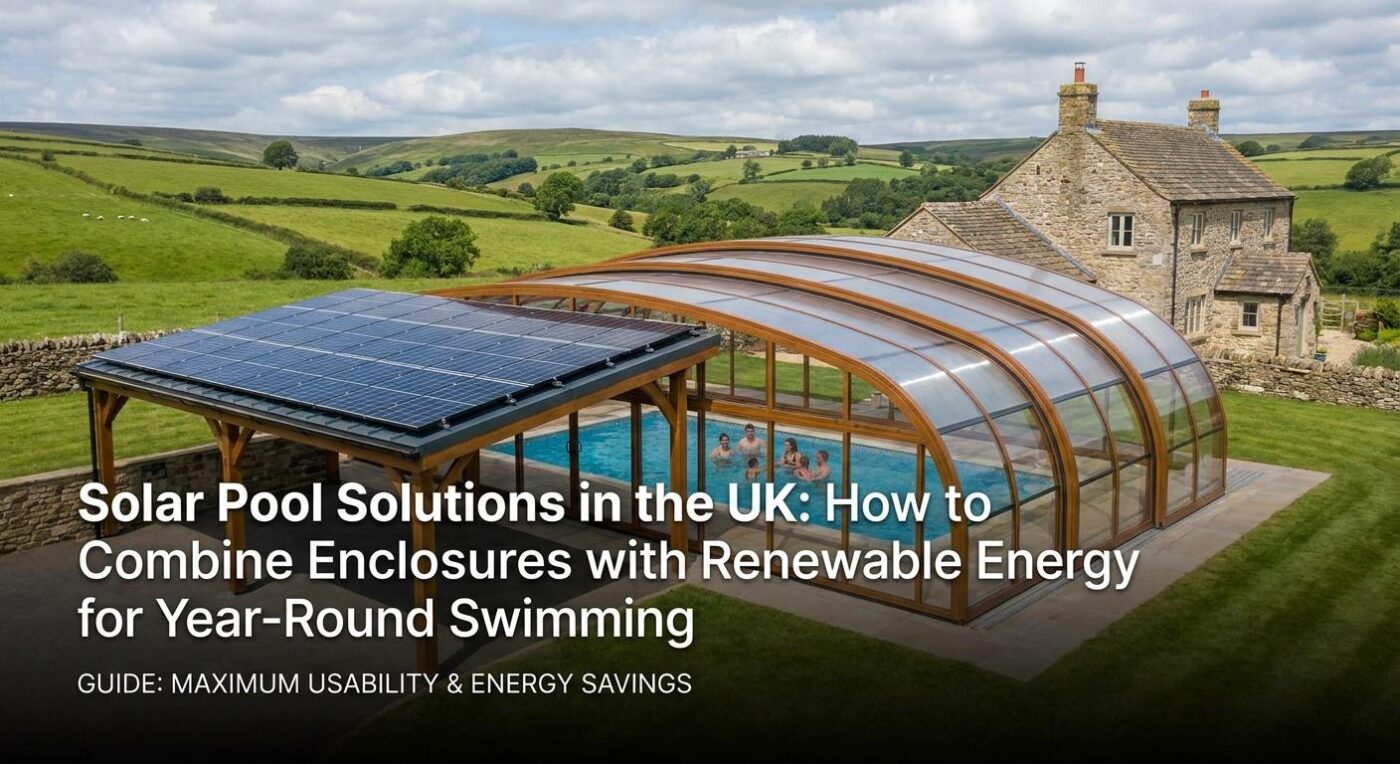
A standard bubble cover left on a UK outdoor pool overnight will reduce evaporative heat loss somewhat, but it will not keep your water warm enough to swim comfortably in October, and it certainly will not stop a cold north wind from stripping heat from the water surface the moment you peel it back. The gap between what pool owners expect from their investment and what the British climate actually allows is where most of the frustration starts.
Understanding why that gap exists, and what it takes to close it properly, is what makes the difference between a pool used for five months and one used for ten or eleven.
Why the UK Climate Demands More Than a Standard Pool Cover
Energy studies consistently show that outdoor pools lose up to 70% of their heat through evaporation alone. Wind accelerates that process considerably, and the UK is rarely still. A passive bubble cover addresses surface evaporation when it is in place, but the moment the cover comes off and a light breeze moves across the water, you are losing heat faster than almost any affordable heating system can replace it.
The result is a swimming season that, without any intervention, runs roughly from May to September, around five months at best. With an aluminium pool enclosure combined with active heating, that figure stretches to eight months or more for most UK locations, and to a full twelve months if the system is properly specified. That is not a marginal improvement; it is a fundamental change in how the pool functions as part of your home.

The UK climate creates a dual problem that a bubble cover simply cannot solve on its own. Rain and wind drive surface-level heat loss, while low solar irradiance through autumn and winter means the water receives almost no passive solar input from above. At the same time, ambient air temperatures drop steadily from September onwards, so convective losses from pool water to surrounding air increase just as the sun’s contribution falls away. These two effects compound each other.
An aluminium pool enclosure tackles both simultaneously. It blocks wind chill at the water surface, eliminating the convective stripping that accounts for a significant portion of heat loss on breezy days. The glazed panels trap residual solar gain during daylight hours, creating a microclimate around the water that can raise the water temperature by several degrees compared to an uncovered pool, even before any boiler, heat pump, or solar collector is switched on.
That distinction matters for everything that follows in this guide. The enclosure is not an optional extra that you bolt onto a solar heating system. It is the foundation. Every active heating technology you add on top of it performs better, costs less to run, and can be specified smaller and cheaper, because the baseline heat loss it has to fight has already been reduced substantially. The enclosure does the heavy lifting passively; the solar technologies then work with it to close the remaining gap.
How a Pool Enclosure Cuts the Energy You Need to Heat Your Water
The clearest documented evidence of what a bioclimatic enclosure can achieve comes from the transformation of the Arkalochori municipal sports centre swimming pool in Greece, studied by Katsaprakakis et al. and published in a review of energy efficiency interventions in public buildings. Among a package of measures that turned the facility into a zero-energy operation, adding a bioclimatic enclosure to the pool was found to reduce heating energy demand by 30 to 50%. The climate in Crete is warmer than the UK, which means the relative benefit in Britain, where baseline losses are higher, is at least as significant.
The physics behind that saving is straightforward. Heat leaves pool water in three main ways: evaporation from the surface, convection to the surrounding air, and radiation to the sky and surrounding structures. An enclosure addresses all three. It eliminates the wind-driven component of convective loss entirely. It slows evaporation by raising the humidity of the air immediately above the water. And the glazed roof and walls act as a radiation barrier, reflecting long-wave infrared back toward the pool rather than allowing it to escape to the open sky.
The glazing specification matters here. Arch Enclosures aluminium structures use thermally broken profiles and toughened glazing panels engineered to allow short-wave solar radiation to pass through during the day while retarding the escape of long-wave heat at night. This is the greenhouse effect applied deliberately and precisely. It is not accidental warmth; it is designed-in thermal performance.
Overnight retention is one of the most practical benefits. A closed enclosure on a cold UK autumn night can keep pool water temperature 4 to 6 degrees Celsius higher than an equivalent uncovered outdoor pool by morning. That difference matters enormously for a heat pump or gas heater, because the system starts its morning heating cycle from a much higher baseline. Fewer hours of run time, lower fuel or electricity consumption, and less wear on the heating equipment are the direct consequences.
Managing Condensation Without Losing Heat
One concern pool owners raise about enclosed structures is condensation. A warm, humid air mass sitting above pool water will deposit moisture on cool surfaces, and without adequate ventilation this can cause problems for the structure and for anyone swimming inside. The solution is not to ventilate aggressively, which would simply throw away the thermal performance the enclosure is delivering. It is to ventilate selectively.
Retractable or louvred roof enclosures allow panels to be partially opened at ridge level during the warmest parts of the day, releasing moist air without exposing the water surface to wind. Automated systems can manage this based on temperature and humidity sensors, keeping humidity within a comfortable range while protecting overnight heat retention. The ventilation strategy is part of the enclosure design, not an afterthought.
The Payback Calculation
The financial case for an enclosure is built on this energy arithmetic. If your air-source heat pump is running for four hours per day instead of seven because the pool starts each morning 5 degrees warmer than it would otherwise, the reduction in electricity consumption is direct and measurable. On current UK electricity tariffs, the difference between a well-enclosed pool and an unenclosed one can easily reach £600 to £1,200 per year in heating costs alone, depending on pool volume and usage patterns.
Set against the capital cost of an aluminium enclosure, that produces a payback period in the range of 3 to 7 years for most domestic installations. This sits before any solar generation is added to the system. Once you layer solar PV or solar thermal onto the enclosure, the running cost savings increase further and the payback shortens.
Choosing the Right Solar Heating Technology to Pair with Your Enclosure
Once the enclosure has reduced the pool’s base heat demand, the next decision is which active solar technology to add. There are three realistic options for UK pool owners, and they suit different budgets, usage patterns, and levels of ambition.
Unglazed Polymer Solar Collectors
Unglazed polymer solar collectors are the cheapest entry point. Typically installed on a south-facing roof or ground frame, they circulate pool water directly through black polymer tubes, absorbing solar heat and returning the warmed water to the pool. They work well during summer months, particularly when paired with an enclosure that has already raised the pool baseline temperature.
Their limitation is temperature dependency. Unglazed collectors lose efficiency rapidly below around 10 degrees Celsius ambient air temperature, which in the UK describes most of the calendar from October through to April. For a pool owner who only wants to extend the season from May through to October, they can be a cost-effective choice. For genuine year-round use, they need to be combined with a more capable technology.
Glazed Flat-Plate Solar Thermal Collectors
Glazed flat-plate solar thermal panels are a step up in both performance and cost. Systems such as those in the Roth solar systems range use a continuous-flow principle, passing a heat-transfer fluid through an insulated, glazed panel that retains warmth even on overcast days. Because UK autumn and spring days are more often overcast than clear, this characteristic matters considerably. A glazed panel producing useful heat on a grey November day in Surrey is worth far more to a year-round pool owner than an unglazed collector that only works when the sun is out.
The trade-off is cost and installation complexity. Glazed collectors require a heat exchanger between the collector circuit and the pool water, and the system needs antifreeze protection for winter operation. For a domestic pool paired with an enclosure, a roof area of 10 to 15 square metres of glazed collector can provide meaningful heat input through nine or ten months of the year.
Air-Source Heat Pumps: The Practical Year-Round Solution
For most UK pool owners aiming at genuine twelve-month use, an air-source heat pump is the most practical primary heating technology. Heat pumps do not depend on direct sunlight. They extract low-grade heat from ambient air and upgrade it to water-heating temperatures using a refrigeration cycle, delivering a coefficient of performance (COP) of 4 to 6 in typical operating conditions. This means that for every 1 kW of electricity consumed, the heat pump delivers 4 to 6 kW of useful heat to the pool water.
The synergy with an enclosure and solar PV is where the real efficiency gains appear. A heat pump consumes electricity. Solar PV panels generate electricity. An enclosure reduces the total heat demand the heat pump must meet. Put these three elements together and you have a system where solar-generated electricity powers a highly efficient heat pump to warm a pool that loses far less heat than an unenclosed equivalent.
The enclosure also affects the sizing and therefore the cost of the heat pump itself. A well-enclosed 40 square metre pool in the UK typically requires a heat pump rated at 8 to 12 kW to maintain comfortable swimming temperatures year-round. The same pool without an enclosure would typically need a unit rated at 16 to 20 kW to achieve equivalent performance. A smaller heat pump unit costs less to buy, less to install, and draws less electricity per hour of operation. The enclosure is, in effect, paying for part of its own capital cost by reducing the specification of the heating equipment required alongside it.
Choosing between these technologies is not always an either/or decision. Many well-designed systems combine glazed solar thermal collectors for daytime top-up during spring and autumn with an air-source heat pump for overnight and winter heating. The enclosure sits beneath all of it, reducing the total load every single day of the year regardless of which active system is running.
The Solar Carport Opportunity: Generating Electricity That Powers Your Pool
A solar carport is exactly what it sounds like: a canopy structure with photovoltaic panels built into the roof, which shelters one or more vehicles while generating usable electricity. Manufacturers including Alukov, whose Solar Pergola product integrates PV directly into a terrace or carport frame, and AKENA, whose connected carport range is designed around domestic self-consumption, have made these systems a practical option for homeowners rather than a niche commercial product.
The output is more meaningful than many people expect. A typical domestic installation carrying 6 to 8 panels sits in the 2.4 to 3.2 kWp range. In the UK, that generates roughly 2,200 to 2,800 kWh per year depending on location and orientation. For context, a pool heat pump running through the shoulder seasons from April to October draws somewhere between 1,500 and 2,500 kWh across that period for a standard domestic pool. The carport does not cover every kilowatt-hour, but it covers a significant slice.
The way the electricity flows is important. In a self-consumption model, generation from the carport panels feeds on-site loads first, before anything reaches the grid. Those loads include the heat pump, the filtration pump running its daily cycles, and any automation motors operating the enclosure sections. AKENA’s connected carport models support this directly via home network integration, so the system can prioritise pool and household consumption automatically rather than defaulting to export.
The carport structure can also carry a Wallbox EV charger, which means a single installation serves three functions at once: powering the pool system, contributing to household electricity needs, and charging an electric vehicle. The civil work and electrical connection are done once, which changes the cost calculation considerably compared to treating each element as a separate project.
pool energy costs fall noticeably when a solar carport is in the picture. Market data indicates that solar carports can reduce household electricity costs by up to 30%, and the pool system becomes a direct beneficiary of those savings rather than the appliance pulling your bill upward every month.
One planning note UK homeowners need to keep in mind: solar carports attached to or within the curtilage of a dwelling may fall under permitted development rights if they stay within applicable size and height limits. However, the rules vary, and properties in conservation areas or those with listed building status require a formal check with the local planning authority before any work begins. Getting that confirmation in writing early avoids delays later in the project.
Designing an Integrated System: Enclosure, Solar Thermal, and PV Working Together
Abstract descriptions of integrated systems are only useful up to a point. A worked example makes the numbers real. Consider a 10-metre by 4-metre domestic pool in the Midlands, enclosed with a low-profile retractable aluminium enclosure. The heating package consists of four glazed solar thermal collectors feeding a 300-litre insulated buffer tank, backed up by a 10 kW air-source heat pump. Sitting alongside the pool area is a 3 kWp solar carport providing PV generation. This is not a theoretical configuration: it represents a mid-specification installation that a growing number of UK pool owners are commissioning now.
The system operates in a clear hierarchy. On a sunny spring or early summer day, the solar thermal collectors provide enough heat to maintain the pool at 28 degrees Celsius with minimal input from anything else. The buffer tank absorbs surplus heat so it is not wasted. On overcast days, the heat pump takes over, drawing electricity from the carport PV array where generation is available, and from the grid only for the shortfall. The enclosure sits across all of this as a constant advantage: because it dramatically reduces overnight heat loss and wind-driven evaporation, the heat pump rarely operates at full load even in poor weather.
Smart controls are what stop this from becoming three systems that occasionally interfere with each other. A single controller monitors pool water temperature, ambient outside temperature, the position of the enclosure (open or retracted), and live solar generation figures. Based on that data it decides which heat source to activate, whether to close the enclosure sections overnight to conserve heat, and when to run the filtration pump to coincide with peak PV output. The result is that grid electricity purchase is minimised without the homeowner needing to manage anything manually.
Getting the Positioning Right
Physical layout decisions made at the design stage have a disproportionate effect on system performance. The pool enclosure should be oriented to maximise south-facing glazing, which allows low winter sun to enter and contribute passive heat gain. The solar carport, by contrast, should be positioned to the north or east of the pool area wherever the site allows. This keeps it from casting shade across the enclosure glazing during the morning and midday hours when solar contribution is most valuable.
The buffer zone between the two structures also matters. A carport sited too close to the pool risks increasing humidity around the PV panels and creates maintenance complications. A separation of four to six metres is typically sufficient to avoid both problems while keeping cable runs short.
Why Aluminium Is the Correct Material for Both Structures
Material choice is not a styling decision here, it is a durability one. Aluminium is the appropriate structural choice for both the enclosure frame and the carport frame because it does not corrode in the humid, chlorine-laden environment that exists around any outdoor pool. Steel framing, even galvanised, will show surface rust within a few years in that environment and requires ongoing maintenance. Aluminium carries a realistic design life of 25 years or more, which aligns directly with the warranty periods offered on quality PV panels and solar thermal collectors. Building both structures from the same material family also simplifies maintenance schedules and keeps the visual language of the installation coherent.
The full cost envelope for an integrated system of this type in the UK currently sits between £25,000 and £55,000, depending on pool size, enclosure specification, collector area, and whether battery storage is included. That range is wide because the variables are significant, but the lower end of it, covering a modest pool with a well-configured enclosure and a basic carport, is within reach for a homeowner who treats the pool as a genuine investment rather than an impulse purchase. Running cost savings across heating, filtration, and household electricity work to offset that capital outlay meaningfully over a ten-year horizon.
UK Incentives, Planning Rules, and Getting Your Project Started
The financial case for an integrated pool and solar system is stronger in the UK right now than it has been for some years, because several incentive schemes stack on top of each other rather than competing.
The Smart Export Guarantee (SEG) pays households for surplus solar electricity exported to the grid. Any PV generation from the carport that the pool system and household do not consume in real time earns a tariff from the energy supplier rather than being lost. Rates vary by supplier but the principle is the same: generation that exceeds on-site demand becomes a small revenue stream rather than a wasted resource.
VAT on solar panels and heat pumps for residential use is currently zero-rated in the UK until 2027 under the government’s existing scheme. On an installation costing £40,000, that is a material saving compared to the standard 20% rate that would otherwise apply.
The Boiler Upgrade Scheme offers £7,500 toward an air-source heat pump installation. The scheme applies where the heat pump serves whole-property heating, but where a pool heat pump is part of an integrated renewable heating package for the property, it is worth discussing eligibility with an installer registered with the Microgeneration Certification Scheme (MCS), as the scheme’s application depends on how the system is configured and what it serves.
On planning, a pool enclosure that sits within the permitted development envelope of the dwelling and does not extend beyond the original curtilage generally does not require a full planning application. That said, each project is different, and a brief pre-application conversation with the local authority costs nothing and removes uncertainty before design work begins.
The practical starting point for any project is a heat loss calculation for the pool, which quantifies exactly how much energy the system needs to deliver and in what conditions. Pair that with a solar irradiance report for the specific site, which the free EU PVGIS calculator provides at postcode level without any cost or commitment. Those two documents give a specialist enough information to design the enclosure, solar thermal, and PV as a coordinated package from the outset. That coordination is the thing that separates a system that genuinely performs from three separate purchases that happen to be installed near each other. If you are at the early stages of planning, speak to a supplier who can take the whole picture into account at once rather than treating each element in isolation.
