
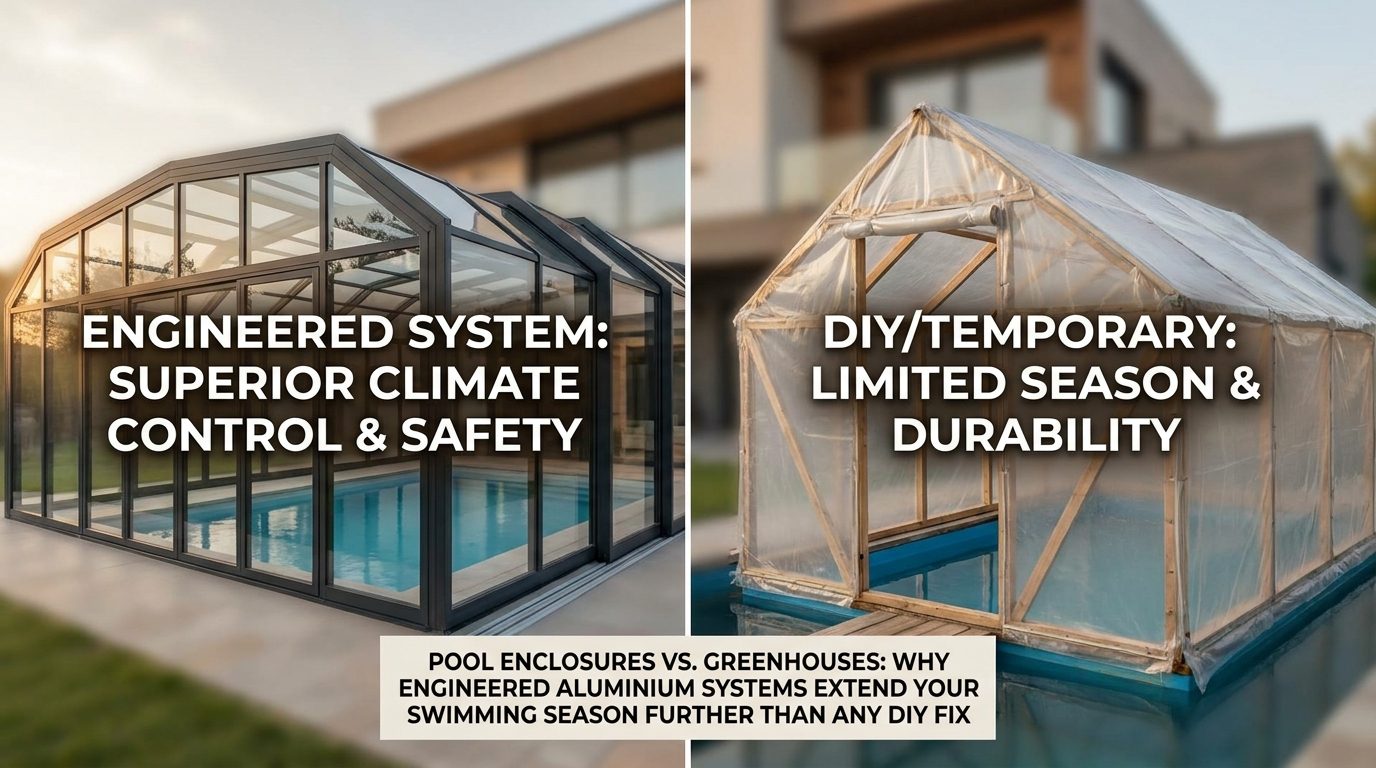
Most UK pool owners discover the same uncomfortable truth about six weeks into summer: they spent tens of thousands of pounds on a pool they can realistically use for perhaps three months of the year. The water is cold, the weather is unreliable, and by mid-September the cover goes on and stays on until June. That is not a pool problem. It is a climate problem, and it has a solution that most people do not consider seriously enough.
The question worth asking is not simply how to heat the water, but how to extend the entire usable season from both ends. Heating alone does not fix wind chill, rain on the surface, or the psychological barrier of stepping outside in October. What follows looks at that problem honestly, including the solutions that seem sensible but fall short in practice.
Why the UK Swimming Season Feels Shorter Than It Should
Without any protective structure, the outdoor swimming season in the UK runs roughly 12 to 16 weeks. In practical terms that means June through to early September, and even within those months, usable days are patchy. A typical British June delivers an average of only 6 to 7 hours of sunshine per day in the south, dropping significantly further north.
Water temperature compounds the problem. An unheated outdoor pool in the UK sits at around 17 to 19 degrees Celsius through midsummer. That sounds reasonable until you compare it to the 28 degrees that most recreational swimmers find genuinely comfortable. At 17 degrees, swimming laps is possible but not particularly pleasant. It discourages children, puts off older swimmers entirely, and makes casual leisure use feel like a cold-water endurance test.
Even when air temperatures are technically warm, UK summer weather creates additional barriers. A 20-degree day with a 15-knot wind and overcast skies produces a wind-chill effect that makes poolside sitting uncomfortable and discourages people from getting into water that already feels cold. Rain hitting the pool surface, beyond the practical issue of diluting chemical balance, creates an atmosphere that simply does not feel inviting.
This frustration is one that greenhouse gardeners recognise immediately. The UK climate imposes a narrow productive window that does not reflect what the asset is actually capable of. A well-planted garden can theoretically produce from February to November, but without protection, the same cold, wind, and unpredictability that shortens the pool season also limits the growing season. The parallel is not accidental. In both cases, the asset is there, the infrastructure is in place, and the only limiting factor is the exposure to an uncooperative climate.
That recognition raises the central question this article addresses: what is the most effective method for extending the pool season, and do all protective structures perform equally well? The honest answer is that they do not, and the differences matter more than most buyers realise before they have committed to a solution.
The Greenhouse Analogy: What It Gets Right and Where It Breaks Down
The greenhouse comparison is worth taking seriously because it captures something genuinely useful. A greenhouse solves the short-season problem for gardeners by trapping solar gain through glazing, moderating temperature to create a stable microclimate, and blocking wind and rain. Those three mechanisms translate directly to what a pool enclosure does. Glass or polycarbonate panels admit sunlight, the enclosed air mass heats up and retains warmth, and the structure eliminates the wind-chill and rain-exposure problems that make outdoor swimming unpleasant even on nominally warm days.
The analogy also does something culturally important. It normalises the idea of enclosing an outdoor asset to make it productive across more of the year. Nobody thinks it is excessive to build a greenhouse for a kitchen garden. Framing a pool enclosure in the same terms, as a rational infrastructure investment rather than an extravagance, helps pool owners think clearly about the decision.
However, the comparison reaches its limits quickly once you look at what each structure is actually built to do. A greenhouse is designed for plants. It does not need to carry snow loads, resist wind forces generated around a large open water surface, or manage the specific humidity conditions created by an indoor pool environment. It has no safety provisions for human access to a body of water. These are not minor omissions.
Consider the structural differences in concrete terms. A standard domestic polycarbonate greenhouse weighs under 50 kg in total and is secured to the ground with small anchor spikes. It is designed for calm garden conditions and modest wind exposure. An engineered pool enclosure, by contrast, must be specified to handle wind loads of up to 120 km/h and snow loads calculated under EN 1991 Eurocode standards. The aluminium profiles, the glazing retention systems, and the foundation fixings are all designed around those loads. The two categories of structure are not comparable in engineering terms, and the gap between them is not one that can be bridged by buying a larger greenhouse.
Humidity is another fundamental difference. An enclosed pool generates substantial evaporation, and without properly designed ventilation, that moisture will condense on every cold surface inside the structure. In a greenhouse-style enclosure with no humidity management, you would see condensation pooling on the glazing, corrosion beginning on any ferrous fasteners within a single winter, and potentially structural degradation of timber or low-grade aluminium sections within two to three seasons.
There are also regulatory and insurance considerations that make the greenhouse-over-pool idea unworkable in practice. Repurposing a greenhouse-style structure over a swimming pool would void most home insurance policies, since the structure would not meet the standard expected for a permanent building containing a body of water. It would also breach building regulations in most UK local authority areas, where any permanent structure over a pool requires approval demonstrating compliance with structural, fire, and drainage standards that a greenhouse cannot meet. The planning application itself would be difficult to support without engineering documentation that simply does not exist for domestic horticultural buildings.
The greenhouse analogy, then, is genuinely useful as a way into the conversation. It explains the logic of enclosure and makes the investment feel intuitive. But it also reveals, on inspection, why pool enclosures occupy a completely distinct engineering category, one that requires purpose-built design rather than adaptation of an existing product type.
How Temporary and DIY Solutions Actually Perform in Practice
Before most pool owners reach the decision to invest in a permanent enclosure, they typically try at least one cheaper alternative. Three solutions come up repeatedly: floating thermal bubble covers, DIY timber-framed enclosures with polycarbonate panels, and inflatable pool domes. Each has a genuine use case. Each also has specific failure modes that are worth understanding before committing time or money.
Solar Bubble Covers
A quality solar bubble cover is a legitimate tool for temperature management. The bubble layer traps a thin air cushion between the pool surface and the cover, reducing overnight heat loss by up to 75 percent and adding 6 to 8 degrees Celsius to the water temperature over a period of days through passive solar gain. For the money, typically £150 to £400 for a well-made cover, those numbers represent good value.
The practical limitation is operational. The cover must be completely removed before anyone enters the pool, and reinstalled afterwards to maintain its thermal benefit. On a standard 8 by 4 metre pool, rolling and unrolling the cover with a reel takes 10 to 20 minutes per swim session. For a family using the pool daily, that adds up to over 100 hours of cover management across a season. Many owners simply stop bothering, leave the cover off, and lose most of the thermal benefit. The cover also does nothing about wind chill, overcast skies, or the psychological experience of being outside in marginal weather. It extends the season by a few degrees, not by weeks or months.
There is also a safety issue that is not always clearly stated. A floating bubble cover is not load-bearing. It cannot support the weight of a child who steps or falls onto it, and in some cases it creates a drowning risk because it can wrap around a person in the water. It fails entirely as a safety barrier and should never be treated as one.
Timber-Framed DIY Enclosures
The appeal of building a timber-framed enclosure with polycarbonate sheets is obvious. The materials are available from any builders merchant, the construction logic seems straightforward, and the upfront cost can appear competitive with a professional installation. In practice, the problems arrive quickly and accumulate steadily.
Timber in a pool environment faces the worst possible conditions: constant humidity, intermittent wetting from splash and rain, and freeze-thaw cycles through winter. Even pressure-treated structural timber will begin to show rot, warping, and joint failure within 3 to 7 years in the UK climate. The polycarbonate panels themselves yellow and become brittle with UV exposure, typically within 5 to 8 years. The fasteners rust. The whole assembly gradually becomes less watertight, less structurally sound, and less attractive.
Planning permission presents an additional obstacle. Any permanent structure over a pool requires consent in most cases, and a DIY timber build lacks the engineering documentation, structural calculations, and certified compliance that support a planning application. A professional aluminium enclosure from an established manufacturer comes with that documentation as standard. A homemade timber frame does not, making the application significantly harder to progress and easier for a local authority to decline.
Inflatable Pool Domes
Inflatable domes appeal to pool owners who want full enclosure without the capital cost of a permanent structure. A mid-range inflatable dome for a domestic pool costs between £2,000 and £6,000, which looks manageable against the alternative. The ongoing costs tell a different story.
An inflatable dome requires a continuous electric blower to maintain pressure. That blower typically draws 500 to 800 watts and runs 24 hours a day throughout the period the dome is deployed. At UK average electricity rates, that adds £500 to £800 per year in running costs before any heating is considered. The dome itself is vulnerable to puncture from debris, overhanging branches, or simply the slow degradation of the PVC material under UV exposure and wind stress. Most inflatable domes need replacing every 3 to 5 years, meaning the capital cost recurs regularly rather than being a one-time investment.
Security is also absent. An inflatable dome has no lockable perimeter, no fixed access control, and no way to prevent unauthorised entry to the pool area. For families with young children or properties where pool access needs to be managed, this is a meaningful gap that the dome cannot address by design.
Across all three temporary solutions, the cumulative cost picture over 15 years tells its own story. Replacing a bubble cover every 4 to 5 years, rebuilding or replacing a timber enclosure after 7 years, or cycling through inflatable domes every 3 to 5 years while paying continuous running costs quickly accumulates to a total that exceeds the capital cost of a permanent engineered enclosure. For pool owners who are serious about year-round use rather than marginal season extension, the economics of temporary solutions look less compelling the longer the time horizon extends.
