

The global swimming pool enclosure market is no longer a niche corner of the outdoor living industry. Demand is rising sharply, new competitors are entering from across Europe, and buyers are more informed than ever. In that environment, design quality, structural innovation, and genuine after-sales support are the factors that actually separate one manufacturer from another.
Arch Enclosures has spent years building a position at the top of the UK market, not through marketing spend alone, but through a patented structural approach that competitors are still trying to replicate. Understanding what that means in practice requires an honest look at how the competitive landscape has evolved and where the genuine points of difference now sit.
A Market That Is Getting More Crowded
The polycarbonate pool enclosure sector is moderately fragmented, with a handful of European names holding meaningful slices of global revenue. Alukov, celebrating 30 years in custom enclosures, holds roughly 12% of the global polycarbonate enclosure market, making it one of the sector’s most visible names. French manufacturer Abrisud holds an estimated 8 to 10% global revenue share and is credited with pioneering the low-profile retractable segment. Libart from Denmark focuses on commercial-scale structures, while a range of smaller operators fill regional gaps.
That list tells you something important: the market is large enough to support many players, but not so standardised that every product is interchangeable. The buyers who spend serious money on a permanent, architecturally integrated enclosure are not buying a commodity. They are making a long-term decision about how their home functions, how their garden looks, and how much use they actually get from a significant investment.
Arch Enclosures operates squarely in that premium, permanent segment. The competition it faces is not from budget imports but from well-funded European brands with established product ranges and growing UK distribution ambitions. Meeting that competition requires more than good branding.
What a Patent Actually Means in This Industry
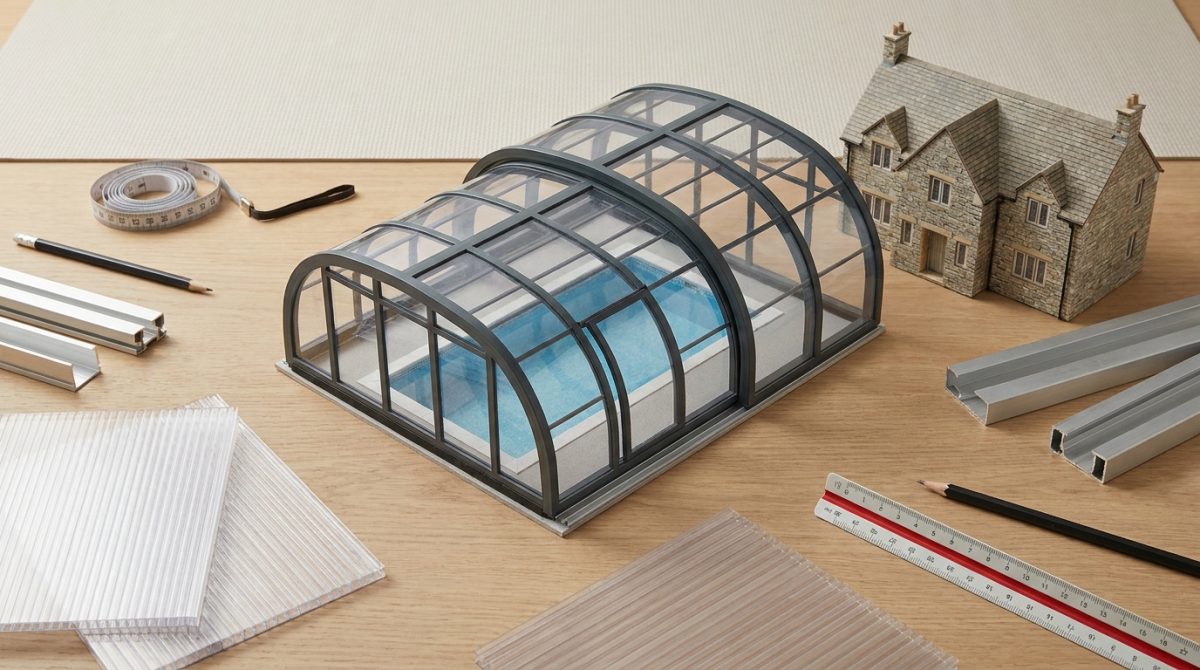
The word patent gets used loosely in manufacturing marketing, but a genuine structural patent is a meaningful thing. It means an independent examination process has confirmed that the design is novel and inventive, not just a variation on what already exists. For a pool enclosure, that matters because the structural principles governing how a retractable or telescopic system moves, seals, and bears load are the aspects that determine real-world reliability.
Arch’s patented structures address the specific engineering challenges of the UK climate: wind loading from exposed garden positions, thermal expansion across aluminium extrusions, water ingress at sliding joints, and the visual weight of a structure that has to sit alongside a family home without dominating it. These are not problems that a generic European product line, designed for continental conditions and then shipped to Britain, automatically solves well.
The patent is not a marketing asset. It is the evidence that Arch’s engineers identified a problem, designed a specific solution, and had that solution verified as genuinely new. That distinction matters when a buyer is comparing quotes and trying to understand why one price is higher than another.
Bespoke vs. Configurable: A Real Distinction
Most European enclosure manufacturers offer a configurable product range. You choose from a set of widths and lengths, select a profile height (low, medium, or high), pick a colour from a standard palette, and the factory produces a kit to your specification. Products like Alukov’s Elegant Neo or Laguna Neo work on exactly this principle, and they are well-executed within those constraints. The system is efficient, lead times are predictable, and the output is consistent.
Arch operates differently. The custom enclosure range starts from the site survey rather than from a product catalogue. Dimensions, roof pitch, panel configuration, sliding mechanism, access points, and integration with adjacent landscaping or building fabric are all determined by the specific installation, not by the nearest available module size. That means an Arch enclosure can address an irregular pool shape, an awkward boundary condition, or a specific architectural style in ways that a catalogue product genuinely cannot.
For domestic buyers with a considered brief, this is a substantial practical advantage. For commercial operators managing a hotel pool, a spa complex, or a leisure facility, the ability to design around an existing building rather than modify the building to accept a standard structure is often the deciding factor.
The UK Market Requires UK Expertise
There is a structural reason why strong European brands do not automatically dominate the UK market despite their scale and product quality. UK planning requirements, building regulations, and the specific demands of British weather create a distinct operating environment. An enclosure that performs beautifully in southern Germany or the Czech Republic may face challenges when installed in an exposed Cornish garden or a frost-prone Scottish Highland property.
Arch’s manufacturing and design operation is based in the UK. Site visits, structural calculations, and after-sales service all happen within a domestic business context, with response times and accountability that an overseas manufacturer managing UK distribution through a reseller network cannot consistently match. When something needs adjusting after installation, or when a buyer wants to modify a structure five years down the line, local ownership of the relationship matters.
The pool enclosure market’s research consistently highlights that buyer confidence in after-sales support is a primary factor in premium purchase decisions. A structure designed to last 20 or more years needs a manufacturer that will still be accessible and responsive well beyond the date of installation.
Engineering at the Detail Level
Premium enclosure buyers increasingly understand that the quality of an aluminium structure lives in its details. The extrusion profiles used for the main frame determine stiffness and longevity. The quality of the polycarbonate glazing affects heat retention, UV protection, and how the structure looks as it ages. The seals and gaskets at sliding joints determine whether a telescopic section stays weathertight after years of movement. The hardware used for locking and positioning segments affects everyday usability.
Arch’s approach to these details reflects the engineering rigour that a patented design demands. The specification is not driven by what is cheapest to produce but by what is required to meet the performance standards the structure is designed to achieve. That means working with high-grade aluminium alloys, selecting polycarbonate panels for thermal performance as well as optical clarity, and specifying hardware that functions reliably in the wet and often cold conditions of a UK pool environment.
Competing manufacturers have strong products, and it would be reductive to suggest otherwise. But the specific combination of bespoke design capability, UK-based manufacturing, patented structural thinking, and hands-on project management is what creates genuine differentiation at the premium end of the market, rather than positioning alone.
Where the Market Is Heading
The pool enclosure sector is growing. Rising energy costs have made pool heating a more significant concern, increasing the economic argument for an enclosure that reduces heat loss and extends the usable season. Climate unpredictability has made year-round shelter more appealing to buyers who previously saw open-air swimming as acceptable for six or seven months. Domestic garden development has accelerated, with homeowners investing more heavily in outdoor living spaces that function whatever the weather.
These trends benefit all quality manufacturers, but they particularly benefit those who can deliver structures that justify a premium price point through demonstrable engineering advantage. As the market grows, buyers become more sophisticated. They research more thoroughly, ask harder questions, and make more direct comparisons between competing products. In that environment, having a patented design backed by genuine technical documentation, a portfolio of completed UK installations, and a directly accessible team is a more durable competitive advantage than a wide standard product catalogue.
Arch Enclosures has built its market position on exactly those foundations. As the competitive landscape intensifies with new entrants and expanding European brands, the case for working with a manufacturer whose differentiation is structural and verifiable rather than purely aesthetic becomes stronger, not weaker. That is what genuine market leadership looks like in a sector that is no longer small.
For buyers weighing their options, the practical question is whether they want a well-executed product from a catalogue or a structure designed specifically for their site, their brief, and the specific demands of building well in Britain. Award-winning enclosure design does not happen by accident. It comes from the kind of engineering discipline and commitment to detail that a patent represents in its clearest form.
