

A pool enclosure that looks pristine at installation and starts showing chalky residue, pitted frames, or clouding panels within three years is not a maintenance failure. It is a specification failure. The wrong material, the wrong alloy grade, or a single poorly sealed joint can turn an engineering structure into a slow-motion chemistry experiment, and the pool environment is one of the most chemically aggressive settings any outdoor structure will ever face.
Understanding why degradation happens, and how to engineer against it from the outset, is the difference between a structure that lasts two decades and one that needs replacing before a second generation of swimmers ever uses it. This guide works through the science in practical terms, starting with the four forces that cause almost all premature failure.
The Four Silent Killers That Destroy Pool Enclosures Before Their Time
Most people think of weathering as a single process. In reality, a pool enclosure faces four chemically distinct attack vectors, each operating on its own timeline, each exploiting different material vulnerabilities, and each amplifying the damage caused by the others.
UV Radiation
Ultraviolet radiation is the fastest of the four. It begins breaking down polymer bonds in coatings, sealants, and glazing panels within the first few months of exposure. You will not see this damage immediately. What you will see, after twelve to eighteen months of unprotected exposure, is chalking on painted surfaces, yellowing or micro-crazing in polycarbonate panels, and the progressive loss of colour depth in powder-coated frames. UV does not corrode metal directly, but it degrades the protective layers sitting on top of it, opening the surface to everything that follows.
Airborne Salt
Salt damage works more slowly than UV but is ultimately more structurally dangerous. Chloride ions carried on sea air or pool-area aerosols settle on surfaces and migrate into microscopic surface defects. Over one to three years, this process initiates pitting corrosion in inadequately specified metals, and once a pit forms it becomes a local concentration point for further chemical attack. A frame component that looks sound from the outside can be developing internal voids that only become visible when structural integrity is already compromised.
Chlorine Off-Gassing
The chlorine used to sanitise pool water does not stay in the water. It off-gasses continuously, and inside an enclosed structure that gas accumulates. For poorly specified materials, specifically standard-grade polymers used in cheaper sealants, gaskets, and even some glazing units, chlorine exposure creates stress-cracking within eighteen months. The mechanism is chemical embrittlement: chlorine compounds attack polymer chains, reducing flexibility until the material fractures under the thermal expansion cycles that any outdoor structure experiences daily.
Trapped Moisture
Moisture is the enabling medium for nearly all the other attack mechanisms. On its own, it causes little damage to correctly specified materials. But moisture trapped in joints, behind poorly sealed fasteners, or in the micro-gaps between dissimilar materials creates the electrochemical conditions that allow corrosion to proceed even when surface coatings appear intact. The pool environment generates condensation on interior frame surfaces during temperature transitions, meaning the moisture source is permanent rather than seasonal.
The critical point is that these four forces do not take turns. They act simultaneously, and their combined effect is not additive but multiplicative. A surface already degraded by UV is far more permeable to chloride ion penetration. A joint already holding trapped moisture corrodes faster when chlorine is present in the atmosphere. Specifying a pool enclosure correctly means engineering a response to all four threats at once, which is fundamentally a question of material selection before it is a question of anything else.
Why Steel Fails Here and Wood Never Belonged in the First Place
Choosing a structural material for a pool enclosure is not a choice between options of roughly equivalent merit. Steel and timber each fail under pool-environment conditions in ways that are predictable, well-documented, and not solvable through maintenance alone. Understanding why they fail clarifies exactly what a correct specification needs to achieve.
The Problem With Steel
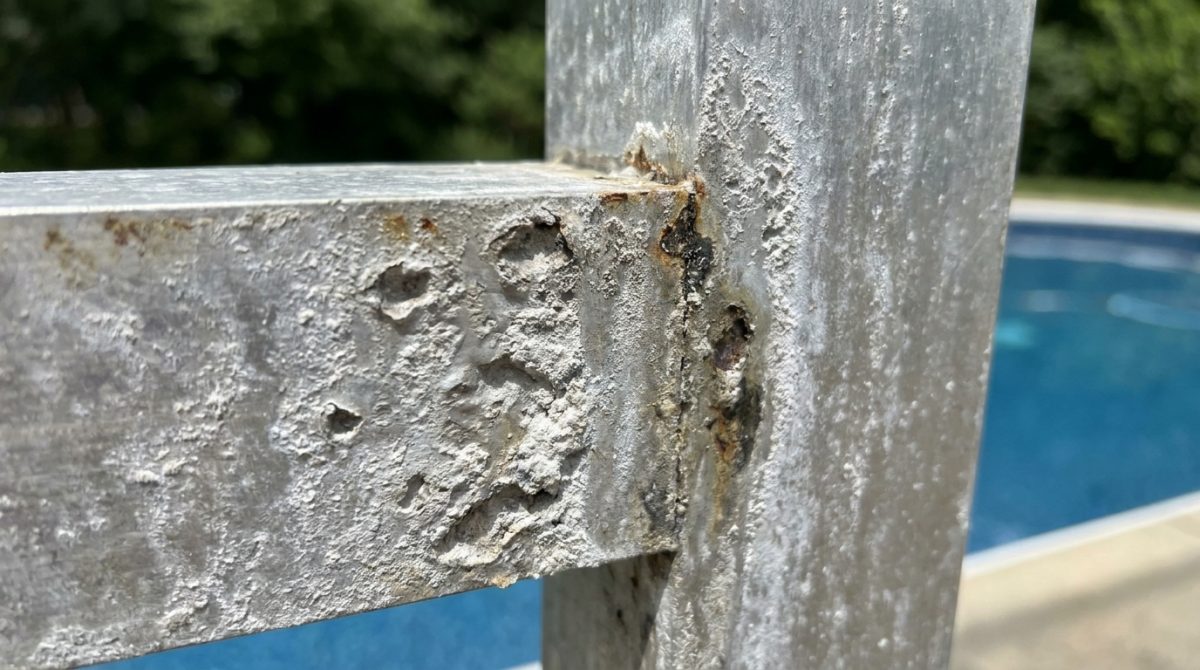
Steel corrodes through a process called electrochemical oxidation, producing iron oxide, which most people know simply as red rust. The critical characteristic of rust is that it is not self-limiting. When aluminium oxidises, the oxide layer seals the surface and stops further reaction. When steel oxidises, the rust that forms is porous and expansive. It physically lifts away from the metal surface beneath, constantly exposing fresh steel to further attack. This is why rust, once started, accelerates rather than stabilises.
In a pool enclosure environment, the timeline is unforgiving. corrosion in indoor pool environments is well-documented, with steel enclosure frames in salt-air coastal settings showing structural rust within three to five years even when factory-painted on installation. The paint provides a barrier, but any breach, whether from installation damage, UV degradation of the paint layer, or the expansion of a joint under thermal cycling, becomes an entry point for chloride ions. Once moisture and salt are in contact with bare steel, the electrochemical process is essentially impossible to stop without complete surface preparation and recoating.
Galvanised steel delays this process but does not eliminate it. In a pool enclosure, where the internal atmosphere is persistently humid and chlorine-rich, galvanised coatings are attacked by the same mechanisms that affect paint, just over a slightly longer timeframe. The engineering community largely moved away from steel for pool enclosure applications specifically because the maintenance cost over a ten-year period approaches the cost of a correctly specified aluminium replacement.
The Problem With Timber
Wood in a pool environment faces a degradation mechanism that is even more fundamental than surface corrosion. Timber absorbs moisture at a cellular level, expanding as it does so and contracting as it dries. In a pool enclosure, that cycle happens daily, driven by the temperature transitions between morning, midday, and evening. This mechanical fatigue alone would eventually open joints and crack coatings. Add the chlorine-laden humidity that characterises the interior of any enclosed pool space, and the process accelerates sharply.
Chlorine compounds in humid air break down lignin, the biological binding agent that holds wood fibres together and gives timber its structural strength. This is not surface staining or cosmetic discolouration. It is degradation of the material at a molecular level, reducing the load-bearing capacity of members in ways that are not visible until the failure is already advanced. Even naturally durable species like cedar, which perform well in general outdoor applications, are not formulated to resist the specific chemistry of a chlorinated pool environment.
Why Resin and uPVC Are Not the Answer Either
Resin and uPVC profiles avoid corrosion entirely, which makes them attractive at face value. They do not rust, they do not absorb moisture, and standard chlorine concentrations do not attack them. The limitation is structural. Polymer profiles lack the stiffness-to-weight ratio of aluminium, and for any enclosure span above roughly four metres, matching aluminium’s deflection performance requires section sizes that become visually dominant and commercially unworkable. A uPVC structure with the rigidity needed for a full-length domestic pool enclosure would require sections so deep that the profile itself becomes the dominant visual element, and the additional dead load creates its own foundation and fastening challenges.
The conversation about pool enclosure materials is therefore not simply about which material resists corrosion best in isolation. It is about which single material provides an engineering answer to all four degradation forces simultaneously, while also delivering the span capability, the achievable section sizes, and the design flexibility that a quality enclosure demands. That framing points clearly in one direction, and the following sections explain the science behind why. For context on long-term aluminium durability, the engineering principles go deeper than most buyers initially expect.
How Aluminium Builds Its Own Defence: The Oxide Layer Explained
Aluminium’s corrosion resistance is not a coating applied after manufacture. It is a property of the metal itself, built into its chemistry at the atomic level. Understanding how this defence mechanism works, and where its limits are, is the scientific foundation for every treatment and specification decision that follows.
The Passive Layer
When aluminium is exposed to atmospheric oxygen, a reaction begins within minutes. Aluminium atoms at the surface bond with oxygen to form aluminium oxide, a compound with a ceramic-like hardness and a density that is greater than the aluminium beneath it. This oxide layer is extremely thin on untreated aluminium, typically around four nanometres, but it is continuous, adherent, and dense enough to prevent oxygen molecules from reaching the metal surface below it. The reaction is essentially self-limiting: once the oxide layer forms, it cuts off the oxygen supply that would be needed to continue the reaction.
This is the defining difference from iron oxide. Rust forms at a lower density than the steel it replaces, so it occupies more volume, generates mechanical stress in the surface, and physically spalls away to expose fresh metal. Aluminium oxide forms at a density slightly higher than aluminium, creating a compressive fit to the substrate. It does not flake, it does not lift, and it does not create the self-feeding corrosion cycle that makes steel so problematic in aggressive environments.
Where the Passive Layer Faces a Genuine Challenge
The oxide layer is not invulnerable. In pool environments, it faces two specific threats. Chloride ions, whether from salt in coastal air or from chlorine chemistry at the water surface, are small enough to penetrate the oxide layer through microscopic surface defects. Once a chloride ion reaches the underlying aluminium, it disrupts the local oxide formation and initiates a pit. That pit creates a differential concentration cell, a small electrochemical system where the metal inside the pit becomes anodic relative to the surrounding surface, accelerating further dissolution. This is pitting corrosion, and it is the primary failure mode for aluminium in high-chloride environments when the material is not specified correctly.
UV radiation contributes to this vulnerability indirectly. On bare aluminium, UV does not attack the oxide layer chemically, but it energises surface molecules enough to accelerate the reactions that allow chloride penetration, particularly at higher temperatures. This is why the combined action of coastal UV and salt air is more aggressive than either factor alone.
Why Alloy Grade Is Not a Detail
Not all aluminium is equivalent in its resistance to pitting. The composition of the alloy determines both the density of the natural oxide layer and the material’s behaviour when that layer is compromised. For structural pool enclosure extrusions, two alloy grades have become industry benchmarks. The 6063-T5 grade is a magnesium-silicon alloy optimised for extrudability and surface finish, making it the standard choice for architectural extrusions where complex profile shapes are required and corrosion resistance is paramount. The 6061-T6 grade offers higher tensile strength, making it appropriate for structural members carrying significant loads. Both grades achieve their corrosion resistance through their magnesium-silicon composition, which produces a more uniform and complete oxide layer than purer aluminium or alloys with higher copper or iron content.
Specifying the correct grade for each component in an enclosure structure is not over-engineering. It is the baseline that makes every subsequent treatment, whether powder coating, anodising, or sealant selection, work as intended. Additional surface treatments function as layers working with the metal’s own chemistry rather than compensating for an inadequate substrate.
Powder Coating: The Engineered Barrier That UV Cannot Simply Bake Away
Powder coating is not paint in the conventional sense. It is an electrostatically applied dry polymer that is oven-cured at around 200 degrees Celsius, fusing the particles into a continuous film that bonds mechanically and chemically with the aluminium surface beneath. The result is a finish typically 60 to 100 microns thick. Compare that to liquid paint, which rarely exceeds 25 microns in a single applied coat, and the structural difference becomes clear: powder coating is not a decorative surface, it is a genuine protective barrier.
The curing process matters because it eliminates the solvent porosity that liquid paints carry. A solvent-borne paint film dries by evaporation and always leaves microscopic channels where the solvent escaped. A powder-coated film has no such pathways. Chlorine vapour and moisture have far less to work with from the outset.
Quality pool enclosure coatings specify either PVDF (polyvinylidene fluoride) or high-durability polyester powder rated to QUALICOAT Class 2, a European standard that requires demonstrated resistance to UV-induced chalking and gloss loss under accelerated weathering protocols. Class 2 is not the default for general architectural aluminium; it has to be explicitly specified, which is one of the first questions worth asking any enclosure supplier.

UV degrades coatings through a process called photolysis. High-energy photons, particularly those in the UV-A band between 315 and 400 nanometres, break the polymer chains in the coating matrix. Over time this produces chalking on the surface, progressive colour fade, and eventually micro-cracking. Once micro-cracks form, the coating no longer acts as a sealed barrier: moisture and chloride ions track down through the crack, reach the oxide layer, and the enclosure starts aging from the outside in.
PVDF-based coatings resist this process far more effectively than standard polyester. When tested to ASTM G154 accelerated UV weathering protocols, PVDF formulations show less than 5 percent gloss reduction after 3,000 hours of exposure. In practical terms that maps to roughly 10 years of UK outdoor conditions, meaning a correctly specified PVDF coating should still look and perform close to its original state at the end of a decade without any remedial treatment.
Inside an enclosed pool structure, the threat shifts. Chlorine vapour, constantly off-gassing from the water surface, attacks coatings through oxidative bleaching rather than photolysis. The mechanism is different but the outcome is the same: a degraded surface that loses adhesion to the substrate. Specifying a minimum coating build depth of 60 microns, combined with a sealed topcoat rather than an open-pore texture, physically prevents vapour penetration to the depth required to cause adhesion failure.
Practically speaking, inspect powder-coated surfaces annually for two early indicators: chalking (a dull, powdery residue you can wipe off with a damp cloth) and micro-blistering (small raised areas where moisture has already crept beneath the film). Both are visible before bare metal appears. Re-coating at this stage is a straightforward maintenance job. Waiting until bare aluminium is exposed means the oxide layer has been compromised and remediation costs rise sharply. The coating is doing its job until it visibly cannot, so catching the transition early is the entire game.
Joints, Fasteners, and the Hidden Corrosion That Starts in the Gaps
The powder coat and the oxide layer protect the exposed faces of a pool enclosure’s aluminium profiles. The joints are a different problem entirely. Corrosion that begins in the gaps between components is almost invisible until it has already done structural damage, and it operates through two distinct mechanisms: crevice corrosion and galvanic corrosion.
Crevice Corrosion
Crevice corrosion occurs wherever moisture becomes trapped in a tight space and cannot drain or evaporate freely. Overlapping extrusion sections, the edges where rubber gaskets contact the frame, and the annular gap around a fastener hole are all classic sites. The problem is concentration: as water evaporates from the open surface, chloride ions in the trapped moisture become progressively more concentrated. The local chloride level at the base of a crevice can reach multiples of the surrounding environment, and aluminium oxide is not impervious to chloride attack at high concentrations. Pitting starts at the crevice base and progresses inward.
The engineering solution is to eliminate standing moisture rather than trying to coat your way out of the problem. Glazing gasket channels should be fully drained and ventilated so that any water entering the channel exits at the base rather than pooling at mullion joints. This is a detail that is easy to specify and easy to omit; checking that your enclosure supplier includes drained glazing systems is a basic quality gate.
Galvanic Corrosion
Galvanic corrosion is triggered when two dissimilar metals are in electrical contact through a conductive electrolyte. A stainless steel bolt passing directly through an aluminium frame, in a chlorinated and humid atmosphere, creates a classic electrochemical cell. Aluminium sits lower in the galvanic series than stainless steel, so it becomes the anode and corrodes preferentially. In a pool enclosure environment, where the electrolyte (condensate or splashed water with dissolved chlorine) is almost always present, this process runs continuously. The result is a ring of pitting around every unprotected fastener hole.
The fix is electrical isolation rather than material substitution. Protective sleeves and caps that isolate the fastener from the aluminium frame break the galvanic circuit while maintaining full structural load transfer. Nylon-sleeved stainless steel fixings or A4-grade (316 stainless) bolts fitted with EPDM isolating washers are the standard solution. A4 stainless is specified rather than A2 because its molybdenum content gives additional resistance to chloride pitting in its own right.
Sealant and Profile Choices
Sealant selection is not a minor detail. The default choice for many installers is a general-purpose silicone, but acetic-cure silicones off-gas acetic acid during their curing period, typically 24 to 72 hours. Acetic acid attacks aluminium oxide directly, undermining the very surface you are trying to protect at the point of joint formation. The correct specification is neutral-cure silicone, which cures through a moisture-reaction mechanism that produces no acidic byproduct. It costs marginally more and the packaging will state the cure chemistry if you look for it.
There is one further structural detail worth noting: thermal-break extrusion profiles. A thermal-break extrusion separates the inner and outer aluminium faces of a profile with a continuous polyamide strip. The primary function is thermal, reducing heat loss through the frame, but the secondary benefit is condensation control. When the inner aluminium face is not in direct thermal contact with the colder outer face, its surface temperature stays above the dew point, and condensation does not form on interior surfaces. Less condensation at joints means less moisture cycling through gasket edges and fastener holes, which directly reduces the crevice corrosion load. It is a design detail that compounds in benefit over the life of the structure.
Polycarbonate Glazing Panels: Matching the Frame’s Durability or Undermining It
A pool enclosure’s glazing panels carry more responsibility than is immediately obvious. They are not simply the transparent parts of the structure. They manage solar gain, thermal insulation, UV transmission, impact loads from wind and hail, and the moisture seal at every panel edge. If the glazing specification falls short of the frame’s engineering quality, the weakest link in the system is not the aluminium at all.
Polycarbonate is the material of choice for most high-quality enclosures rather than glass, and the performance case is straightforward. It transmits up to 88 percent of visible light, comparable to float glass, while blocking virtually all UVB radiation below 385 nanometres. That UV cutoff protects both swimmers from sunburn and the internal components of the enclosure, including any rubber seals, foam insulation strips, and the interior face of the frame’s powder coating, from the most energetic UV wavelengths. The glazing is doing protective work that extends to the whole system.
The critical qualification is that polycarbonate without a UV-stabilising co-extruded cap layer degrades rapidly. The base polymer absorbs UV radiation and undergoes yellowing through photo-oxidation. The yellowing index, measured to ASTM E313, can increase by 15 to 20 units within five years on uncoated sheet exposed to full sun. At that level of yellowing the panel transmits noticeably less light, looks aged from outside, and has typically become brittle enough that impact loads cause cracking rather than deflection. A cracked panel is an immediate moisture ingress point at every edge.
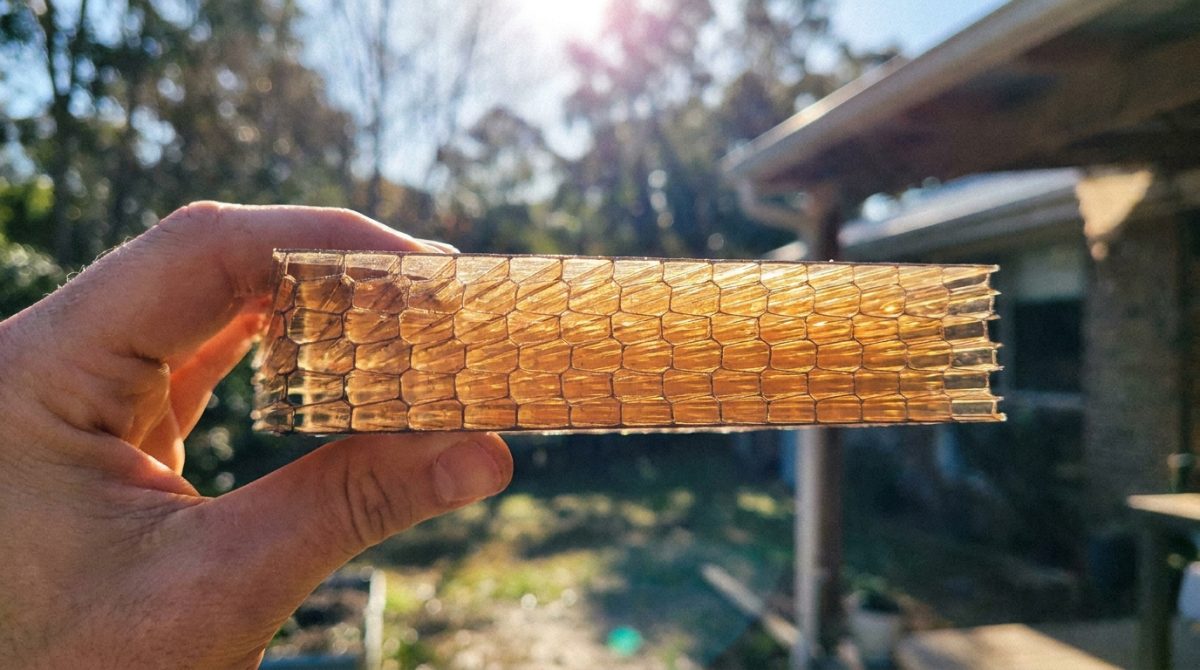
A UV-stabilising cap layer, co-extruded as an integral part of the sheet rather than applied as a coating, prevents this degradation. It absorbs UV energy and dissipates it as heat before it reaches the polycarbonate substrate. Panels with this feature are sold with extended weathering warranties precisely because the performance is predictable. Uncoated sheet has no such warranty.
Thermal Performance
Multiwall polycarbonate, in twinwall or triwall configurations, adds a thermal insulation function that matters significantly in a pool enclosure context. The trapped air cells within the panel produce a U-value of roughly 1.9 to 2.8 W/m2K depending on cell configuration and panel thickness. Single-skin glass sits at around 5.8 W/m2K. That difference translates directly into reduced pool heat loss through the roof and walls, lower heating costs, and less condensation forming on the interior surfaces because the inner face of the panel stays warmer. For a structure designed to extend the swimming season year-round, thermal performance in the glazing is not secondary to aesthetics.
On impact resistance, polycarbonate offers approximately 200 times the resistance of an equivalent glass thickness. In practical pool enclosure terms this means hail, windborne debris, and accidental contact from pool equipment are unlikely to cause breakage. This matters not only for safety but for water integrity: a cracked panel creates an immediate path for rainwater to enter at the panel edge and track down inside the frame channel, exactly the kind of standing moisture that drives crevice corrosion at mullion bases.
Installation Details That Determine Longevity
Two installation details determine whether good-quality polycarbonate panels actually deliver their rated performance over time. First, the UV-protective cap layer must face outward. The cap layer is typically marked, but it is not visually distinct, and incorrectly oriented panels are a known installation error. An inward-facing cap layer means the base polymer is directly exposed to full UV from day one, and the degradation timeline collapses.
Second, gaskets sealing panels within the frame must be EPDM rubber, not PVC. PVC gaskets contain plasticisers that migrate out of the material under sustained UV exposure, causing the gasket to shrink, harden, and pull away from the panel edge. The result is panel rattle under wind load, and more seriously, an open path for water ingress at every affected joint. EPDM does not plasticise under UV, retains its compression set over decades, and is chemically stable in the chlorinated atmosphere inside an enclosed pool structure. It is a specification choice that costs almost nothing extra at the point of installation and prevents a category of maintenance problems that are otherwise difficult to remedy without removing and reseating panels.
Salt-Air Coastal Installations: Why Standard Spec Is Not Enough
The British coastline is one of the most corrosively demanding environments an aluminium structure can face. Wind-driven salt particles deposit on every surface, drainage channels collect salt-saturated water, and the combination of moisture and sodium chloride creates an electrochemical environment that attacks protective coatings from the outside in. A pool enclosure specified to inland standards and installed within sight of the sea will show the consequences within a few years.
BS EN ISO 9223 gives designers a structured way to think about this. It classifies atmospheric corrosivity into categories running from C1, which covers dry heated interiors, through to C5, which covers industrial coastal zones with high humidity and significant salt deposition. Any pool enclosure installed within one kilometre of the UK coastline should be designed to at least C4 and ideally to C5 specification. That is not a cautious overreach; it is the category the salt-spray data from those locations actually places them in.
The practical implication matters immediately when specifying the coating system. At C5 corrosivity, standard polyester powder coating can have its expected service life halved compared with inland performance. A coating that would give twenty years of protection in Birmingham may show chalking, adhesion loss, and substrate attack within eight to ten years on a Cornwall seafront. The appropriate upgrade is either PVDF (polyvinylidene fluoride) powder coating, which has significantly better UV and chemical resistance than standard polyester, or an anodise-then-powder-coat process applied to the extrusions before assembly.
Anodising before powder coating creates a genuine two-layer defence rather than a single coating relying on adhesion alone. The anodic layer, typically 20 to 25 microns on architectural-grade aluminium, is not a surface film applied to the metal. It is a controlled conversion of the aluminium itself into a deep, hard aluminium oxide that is integral to the substrate. When the powder coat is then applied over this anodised surface, any future breach of the outer layer encounters an anodic barrier that continues to resist ion penetration rather than exposing bare metal.
The visible warning sign of salt-induced degradation on aluminium is white rust, technically aluminium hydroxide. It appears as white powdery deposits at cut edges, around drainage holes, and at scratches where the coating has been breached. Caught early, it is arrestable: a phosphoric acid wash neutralises the hydroxide layer, and re-sealing with a compatible aluminium primer stops the attack progressing. Left for a season or two, it works its way into the section wall and creates micro-pitting that no surface treatment can reverse.
Even in the most demanding coastal conditions, aluminium dramatically outperforms steel. Comparative salt-spray testing conducted under ISO 9226 conditions shows aluminium losing less than 5 grams per square metre per year to corrosive attack, while uncoated mild steel loses 200 grams or more over the same period. That is a forty-fold difference, and it is why steel has no place in a coastal pool enclosure regardless of how it is painted.
One design detail is straightforward to specify and often overlooked: drainage holes of at least 6 mm diameter at the lowest point of every hollow section. Salt-saturated standing water inside an extrusion is a far more concentrated corrosive environment than salt spray on the outside surface. Free drainage eliminates the problem at source.
Chlorine Off-Gassing Inside Enclosed Pool Structures: The Internal Threat
The corrosion threats discussed so far all originate outside the enclosure. Inside, there is a chemically distinct and equally persistent attack that pool owners and specifiers often underestimate until the damage is already visible on the frame.
Chlorinated pool water does not keep its chemistry neatly below the surface. As chlorine reacts with organic matter introduced by swimmers, it forms chloramines: combined chlorine compounds that off-gas continuously from the water surface. In a partially ventilated enclosure, chloramine concentrations in the air can reach 0.5 to 1.5 milligrams per cubic metre. That range is enough to cause respiratory irritation in sensitive swimmers and, over time, is chemically aggressive to every metal surface inside the structure.
The reason chloramines are more damaging to the frame than free chlorine is their persistence. Free chlorine is highly reactive and breaks down relatively quickly once airborne. Chloramines are more stable; they travel further from the water surface, deposit on warm aluminium framework above the waterline, and sit there as dry residues rather than being washed off by splash or condensation cycles. The aluminium above the pool level, particularly horizontal members and the underside of glazing channels, tends to accumulate the heaviest deposits.
The surface presentation is a white-to-grey residue that looks superficially similar to salt deposit. The attack mechanism beneath it is micro-pitting of the aluminium oxide layer and, in advanced cases, of the substrate itself. This is chemically distinct from salt corrosion: chloramine attack is driven by hypochlorous acid and nitrogen compounds rather than sodium chloride, so the two problems require different responses even though they look similar at first glance.
Ventilation design is the primary control measure, and it needs to be built into the enclosure specification rather than treated as an optional extra. Retractable sections that open along the ridge or at the end walls allow chloramine-laden air to exhaust upward and be replaced by fresh air from outside. This reduces both the chemical burden on the frame and the health risk to swimmers. A well-ventilated enclosure that flushes thoroughly on warm days will accumulate a fraction of the chloramine residue of a sealed one, and the difference in frame condition after ten years is visible to the naked eye.
The secondary control is a regular maintenance wash. A diluted pH-neutral detergent applied every 8 to 12 weeks and rinsed off thoroughly removes chloramine deposits before they have dwelt long enough to breach the powder coat. The timing matters: chloramine residue that has sat on a surface through a full summer heating cycle is harder to remove and more likely to have already initiated micro-attack than residue removed on a quarterly schedule. One product category to avoid entirely is acid-based pool cleaners used anywhere near the frame. They are formulated for pool surfaces and will strip powder coat and attack the anodic layer if they contact the aluminium extrusions.
A Practical Maintenance Schedule That Keeps Degradation at Zero
The engineering choices made at specification stage do most of the protective work, but they are not a substitute for routine maintenance. A high-quality aluminium enclosure with powder-coated extrusions, stainless fasteners, and EPDM gaskets will still degrade faster than it should if maintenance is irregular or uses the wrong products. The schedule below is based on what the chemistry and physics of corrosion actually require, not on a conservative manufacturer’s recommendation designed to minimise warranty claims.
Monthly
A visual inspection of all powder-coat surfaces takes about fifteen minutes and costs nothing. The surfaces to prioritise are south-facing faces and any framework directly above the pool waterline, because these receive the highest combined dose of UV radiation and chemical splash. You are looking for chalking (a dull, matte surface where the binder in the coating has broken down), any visible scratches that expose bare aluminium, and early-stage blistering where the coating has lifted from the substrate. Catching a scratch or chip at this stage and treating it with a compatible touch-up primer prevents what would otherwise become a corrosion site by the next inspection.
Quarterly
Wash all aluminium surfaces with a pH-neutral detergent and a soft brush. The aim is to remove chloramine residue, atmospheric salt, and organic debris before any of them have had long enough to initiate surface attack. Rinse completely, because detergent residue left in joints is itself a mild contaminant. While the frame is wet and clean, inspect all drainage channels for blockage by leaf debris or accumulated silt. A blocked channel traps moisture against the aluminium for weeks at a time; that is the condition under which corrosion accelerates fastest.
For coastal installations, the quarterly inspection should specifically include cut edges, screw entry points, and the inside surfaces of drainage holes. These are the locations where the coating system is thinnest or absent entirely, and where white rust deposits appear first. Any deposits found should be treated immediately with a phosphoric acid-based aluminium primer rather than left for the annual inspection. The window between first appearance and structural involvement is narrow in a C5 environment.
Annual
Check all EPDM glazing gaskets along their full length. A gasket in good condition feels slightly elastic under finger pressure and returns to shape. One that has undergone compression set feels hard, does not spring back, and may show surface cracking. A gasket in this condition no longer exerts sealing pressure against the glazing panel, which means there is a capillary path for chlorinated water to travel into the glazing channel. Water sitting inside an aluminium channel is far more aggressive than surface exposure, and the resulting corrosion is invisible until the panel is removed.
Also check the torque on structural fasteners. This is a step that feels unnecessary until you understand why it is needed: aluminium has a thermal expansion coefficient of approximately 23 microstrain per degree Celsius, compared with 12 for steel. Over a full UK seasonal cycle, the difference in expansion and contraction between an aluminium extrusion and a stainless steel fastener is enough to work fixings progressively loose. A fastener that was correctly torqued at installation and has had three or four years of thermal cycling behind it may be measurably less tight. Checking and re-torquing to specification takes minutes and maintains the structural integrity the design assumed.
For a broader perspective on what these maintenance steps protect over the long term, the long-term durability of aluminium enclosures depends on exactly this combination of good specification and consistent upkeep working together.
Five-Year Milestone
Commission a formal engineering inspection of the extrusion profiles at their midspan points. The inspector is looking for any permanent deflection, a condition where a member has taken a set and no longer returns to its design geometry under load. Permanent deflection can indicate either fatigue from repeated loading cycles or, more seriously, section loss from internal corrosion that has reduced the effective wall thickness of the extrusion. Neither is visible from a routine walk-around inspection. An experienced engineer with a straightedge and, if warranted, an ultrasonic thickness gauge can identify section loss well before it reaches the point of structural concern, and remediation at that stage is straightforward. Waiting until the deflection is visible to the untrained eye means waiting until the problem is significantly advanced.
Specifying a Pool Enclosure That Will Still Look and Perform Like New in Twenty Years
Every decision made at the specification stage compounds over time. A well-chosen material becomes more reassuring as the years pass. A poor one becomes more expensive. The gap between a 25-year enclosure and a 12-year enclosure is not luck or climate: it is a series of specification choices that were either made deliberately or left to chance.
The Material Specification Checklist
Start with the aluminium itself. Extrusions should be 6063-T5 or 6061-T6 alloy, both of which offer the combination of corrosion resistance, structural stiffness, and surface finish quality that pool environments demand. General-purpose aluminium profiles used in window or shopfront construction are not the same thing, even if they look identical on a drawing.
For the coating, the minimum acceptable standard is QUALICOAT Class 2 PVDF powder coat applied at 60 microns dry film thickness. Anything thinner will begin showing UV-induced chalking within five to seven years in a southern UK coastal or poolside environment. Class 1 polyester coatings are cheaper and widely used, but they are not designed for the combination of UV intensity, chlorine vapour, and condensation cycling that a pool enclosure faces daily.
Fasteners should be A4 (316 grade) stainless steel throughout, fitted with nylon isolation sleeves wherever they contact the aluminium frame. This breaks the galvanic circuit that would otherwise drive electrolytic corrosion at every fixing point. It is a small component with a disproportionate effect on long-term structural integrity.
Glazing panels should be UV-stabilised multiwall polycarbonate with a factory-applied co-extruded cap layer, not a field-applied coating. The cap layer is bonded at manufacture and cannot peel. Sealants used at every joint and glazing interface should be neutral-cure silicone, not acetoxy-cure. Acetoxy-cure silicone releases acetic acid as it cures and over its service life, which attacks aluminium oxide and undermines the very protection you are trying to preserve.
Ask for the Test Data
Any supplier worth specifying will be able to confirm the corrosivity category their system has been designed and tested to, using the ISO 9223 classification scale. More specifically, ask for ISO 9227 salt-spray test certificates for their specific extrusion and coating combination, not generic material data sheets. A reputable manufacturer tests their finished product, not just the constituent materials. If a supplier cannot produce that documentation, that absence is itself a specification signal.
Design Features That Signal a Serious Product
Beyond materials, look for these design details as indicators of genuine engineering depth:
- Fully drained glazing gasket channels that route condensation and rain away from the frame interior rather than trapping moisture against the seal
- Thermal-break extrusion profiles that prevent the cold outer face of the frame conducting temperature to the warm interior surface, which is a primary driver of condensation cycling
- Ventilating ridge sections that allow warm, chemically loaded air to escape rather than recirculate against the glazing and frame
- Retractable arches that allow the enclosure to be opened fully and aired, rather than remaining permanently sealed and accumulating chlorine off-gas and humidity over weeks at a time
Each of these features reduces the chemical and moisture load on every other component. They are not luxury additions. They are mechanisms that extend the service life of the coating, the sealant, the fasteners, and the polycarbonate simultaneously.
The Total Cost of Ownership Argument
A correctly specified aluminium enclosure with a 25-year design life costs significantly less per year than a cheaper alternative that requires re-coating at year seven and structural assessment or partial replacement at year twelve to fifteen. If a quality enclosure costs 30% more at the point of purchase but lasts twice as long without remedial work, the annual cost of ownership is roughly 35% lower. Add the disruption of scaffolding, pool closure, and re-specification, and the arithmetic becomes even more stark. The lower upfront number is rarely the lower number over time.
Why Aluminium Is the Only Material That Answers All Four Threats
Aluminium is not simply a material of convenience for pool enclosures. It is the only structural material that simultaneously addresses UV degradation through a stable, coatable surface, salt-air attack through its natural oxide chemistry, chlorine off-gassing through chemical inertness, and moisture ingress through the design precision that aluminium extrusion enables. Steel corrodes from the core outward. Timber absorbs, swells, and decays. Resin resists but lacks the structural stiffness to span pool-scale openings without deflection under snow or wind load.
That is why every Arch Enclosures system is built around aluminium, specified to the standards described above, and engineered to still look and perform correctly two decades after installation. The chemistry works, the engineering is proven, and the specification is documented. That is the reassurance a 25-year structure deserves.
