
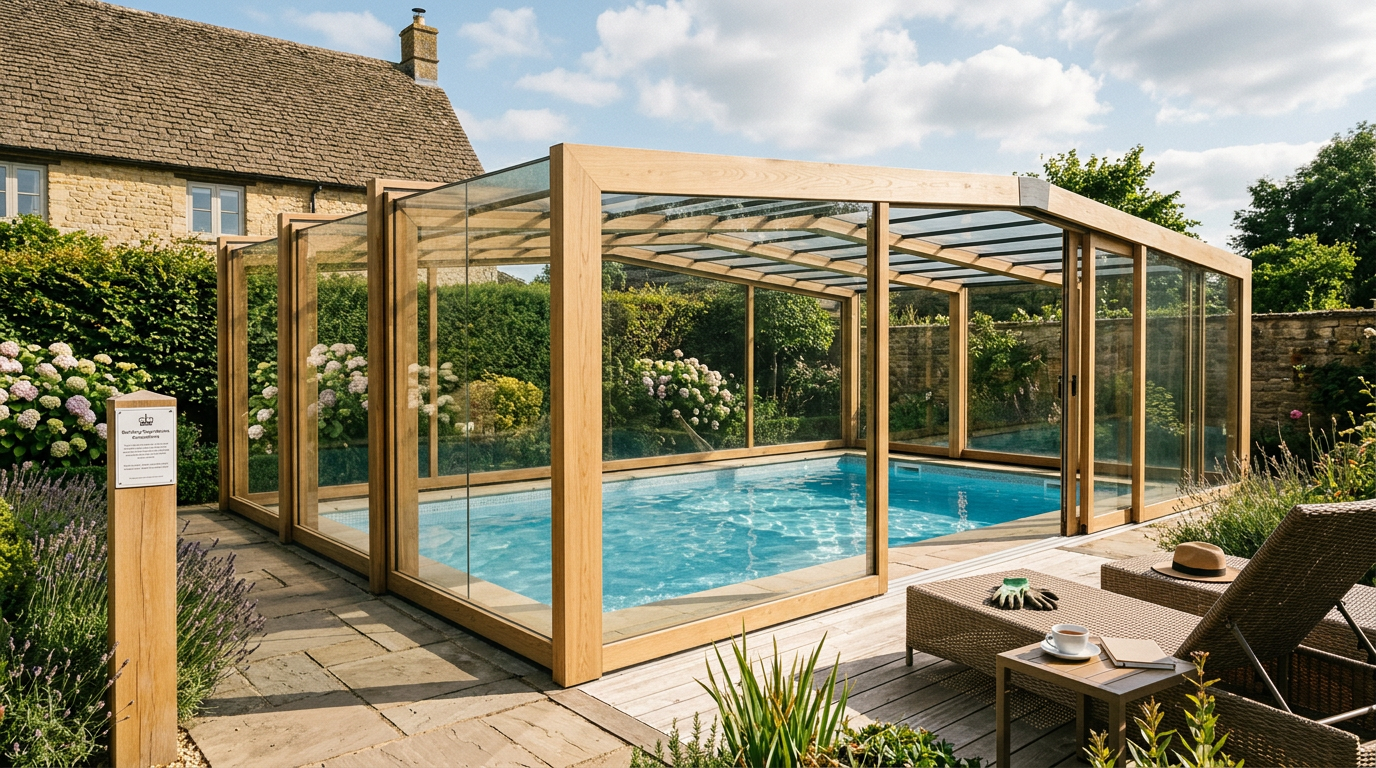
Installing a pool enclosure is one of the most sensible upgrades a UK pool owner can make. It extends your swimming season, reduces running costs, and protects the structure itself from the elements. But before a single aluminium profile goes into the ground, there are regulatory boxes to tick. Getting this right from the start saves time, money, and the headache of retrospective applications.
The good news is that the regulatory picture in the UK is relatively clear and, in most cases, entirely workable for both homeowners and professional installers. Here is what you need to understand before committing to a project.
Building Regulations: When They Apply and Why They Matter
Not every pool enclosure automatically triggers a full Building Regulations application, but most will. The key factors are size, permanence, and how the structure connects to an existing building.
Under the Building Regulations 2010 (as amended), any structure that is not a temporary or easily removable installation will typically require approval. For a fixed aluminium enclosure, particularly one attached to a dwelling, you are almost certainly in scope. The relevant parts of the regulations include:
- Part A (Structure) covering the structural integrity of the frame and fixings
- Part L (Conservation of Fuel and Power) if any heating or glazing elements are involved
- Part K (Protection from Falling) which addresses glazing safety standards
- Part N (Glazing) requiring safety glazing in critical locations
A competent enclosure manufacturer will provide the structural calculations and specification documents your building control body needs. At Arch Enclosures, every installation package includes the technical documentation required to support a Building Regulations submission, which streamlines the process considerably for both the homeowner and the installer.
Planning Permission: The Permitted Development Question
Planning permission and Building Regulations are two separate processes and it is worth being clear on the distinction. Building Regulations concern how something is built. Planning permission concerns whether it can be built at all.
For many domestic pool enclosures, Permitted Development rights may apply, meaning you do not need to submit a formal planning application. However, this is not a blanket rule. Your project will likely need full planning permission if any of the following apply:
- The property is in a designated area such as a National Park, Area of Outstanding Natural Beauty, or Conservation Area
- The enclosure would extend beyond the rear wall of the original house by more than 8 metres (detached) or 6 metres (semi-detached or terraced)
- The structure covers more than half of the total garden area
- The enclosure exceeds 4 metres in height at the ridge
- The property is a listed building
The simplest way to get certainty is to apply to your local planning authority for a Lawful Development Certificate before work begins. This is a relatively inexpensive process and provides documented confirmation that your project falls within Permitted Development. It also protects you if you ever come to sell the property.
Commercial Installations and Additional Considerations
For hotels, leisure centres, schools, and other commercial operators, the regulatory framework is more detailed. Compliance with the Workplace (Health, Safety and Welfare) Regulations 1992 is relevant, as is the Health and Safety at Work Act 1974 more broadly. Pool enclosures in commercial settings need to consider:
- Adequate ventilation to manage humidity and air quality
- Slip-resistant flooring around the pool perimeter
- Emergency egress from the enclosed space
- Safe access for cleaning and maintenance of the enclosure itself
A well-engineered enclosure system makes meeting these requirements considerably easier. Aluminium profiles with integrated drainage channels, modular glazing that opens for ventilation, and low-threshold door systems all serve both user safety and regulatory compliance at the same time.
Water Safety and Barrier Requirements
The UK does not currently have a single mandatory pool fencing law equivalent to those found in Australia or parts of North America. However, local authorities can impose conditions through the planning process, and for commercial pools, risk assessments under health and safety law will almost always lead to barrier requirements being identified.
For domestic pools where children are regularly present, an enclosure with lockable access points serves as a genuine safety barrier. Many insurers will also look favourably on this when calculating premiums, which is worth discussing with your provider before installation.
Working with a Manufacturer Who Understands Compliance
The regulatory process is straightforward when you work with a manufacturer who treats compliance as part of the product, not an afterthought. There are a few things worth asking any enclosure supplier before you commit:
- Do they provide full structural calculations for Building Regulations submissions?
- Can they supply CE-marked or UKCA-marked components with the appropriate declarations of performance?
- Do they have experience working with local planning authorities across different regions of the UK?
- Is the glazing specified to BS EN 12150 or equivalent safety standards?
These are not bureaucratic niceties. They are the evidence trail that protects your investment, satisfies your insurer, and gives you confidence in the longevity of the structure.
Starting Your Project on Solid Ground
The regulatory landscape for pool enclosures in the UK is manageable. It rewards preparation and the right partnerships, and it is not a barrier to getting the enclosure you want. Most projects, when handled correctly from the outset, move through Building Regulations and planning with minimal friction.
If you are at the early stages of planning a pool enclosure, the best first step is a conversation with a supplier who can look at your specific site, assess the planning context, and give you an honest picture of what the approvals process will involve. At Arch Enclosures, that conversation costs nothing and typically answers most of the questions homeowners and developers have before they are even sure they have them.
