
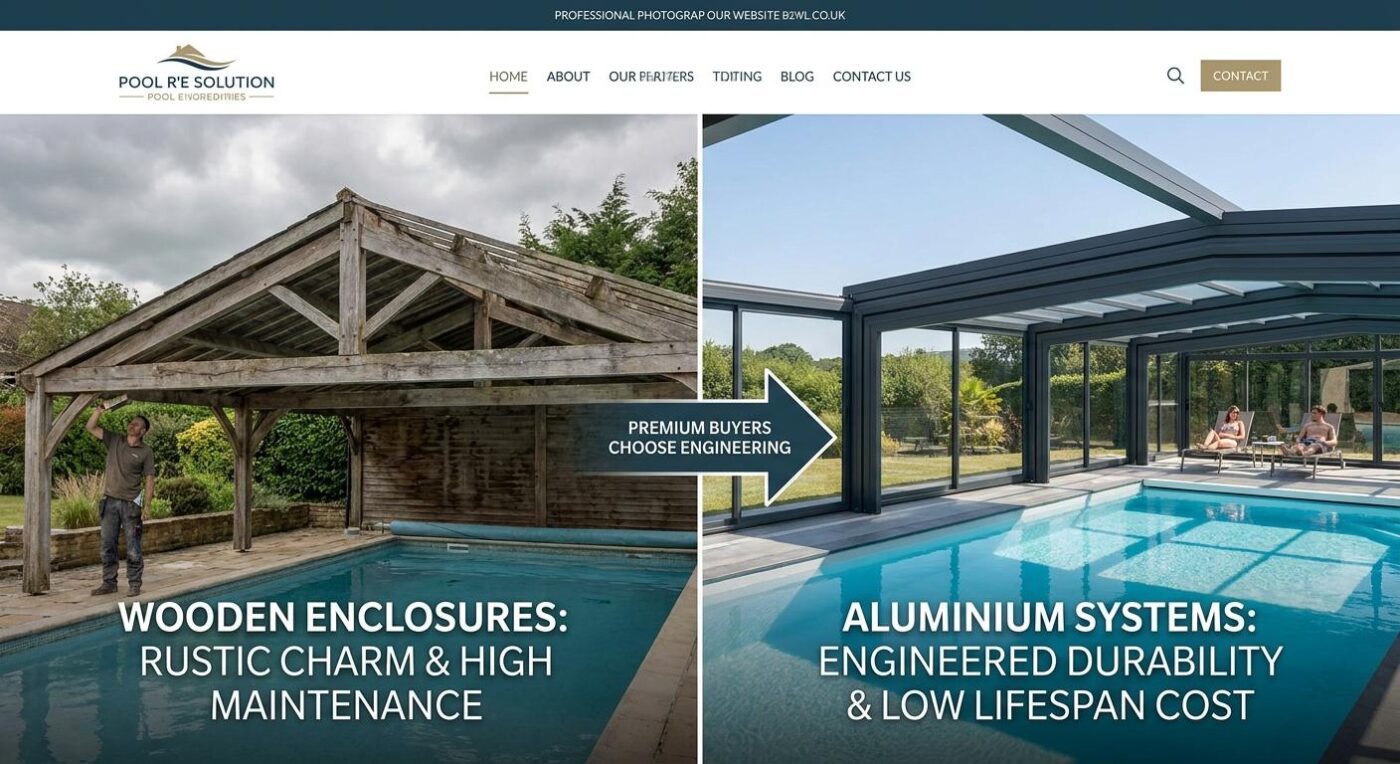
Spend an afternoon on Instagram searching for garden pool inspiration and you will find a particular aesthetic dominating the premium end: cedar-clad walls, warm timber decking, clean Scandinavian lines. It looks extraordinary. It also tells you almost nothing about how that structure performs eighteen months after installation in a British garden.
That gap between the photograph and the reality is worth examining carefully, because the buyers who end up disappointed are rarely people who bought cheap. They are people who bought premium timber products at premium prices, and found that the material itself carries obligations the marketing rarely spells out.
The Rustic Appeal That Started This Debate
The appetite for timber pool structures has grown alongside a broader shift in garden design. Scandinavian-influenced outdoor spaces, with their emphasis on natural materials, honest craftsmanship, and the idea of bringing the forest into the garden, have made handcrafted timber pools feel genuinely aspirational. Suppliers such as Arcus Products, whose Sunsoka range markets itself explicitly as premium handcrafted timber pools built for style and endurance, have positioned wood not as an economy choice but as the choice of the discerning buyer.
The natural material argument is persuasive on its own terms. Timber is warm to the touch, visually soft, and carries associations of quality craftsmanship that extruded aluminium simply does not trigger in most people. When buyers hear the word aluminium, they often picture a commercial leisure centre, a municipal changing room, something utilitarian rather than something beautiful. That association is understandable and, as later sections of this article address, increasingly outdated.

What makes this comparison genuinely interesting is that timber pool structures are not a budget alternative. A well-specified hardwood or engineered timber enclosure structure can cost as much as a mid-range aluminium pool enclosure. These products occupy the same price bracket and compete for the same buyer. This is a like-for-like comparison between two premium options, not a case of weighing luxury against economy.
The central tension this article examines is the distance between the emotional logic of buying timber and the engineering reality of living with it. A purchase decision made on aesthetic grounds is entirely legitimate, but only if the buyer understands what they are also purchasing in terms of maintenance commitment, lifespan, and long-term cost. What follows is the information that lets you make that decision with full clarity.
What Each Structure Actually Is: Materials and Engineering Explained
The materials used in these two types of structure are different in ways that go well beyond appearance. Understanding what they are, not just what they look like, is the foundation of any meaningful comparison.
Aluminium enclosure systems
A quality aluminium pool enclosure uses structural-grade extruded aluminium profiles as its primary framework. Extrusion means the aluminium is forced through a shaped die to produce a consistent cross-section along the full length of each member, with tolerances that can be held to fractions of a millimetre. Those profiles are then powder-coated, a process that bonds a durable polymer finish to the metal under heat, producing a surface that is far more resistant to chipping, fading, and corrosion than paint.
The infill panels that complete the structure are either toughened polycarbonate or tempered and laminated safety glass. Glass enclosures have become the dominant premium choice: according to Dataintelo’s 2025 swimming pool enclosure market research, glass material enclosures represent approximately 34.6 percent of total market revenue, occupying the top tier of the market where architectural aesthetics and a sense of luxury are the primary purchasing criteria. Glass panels sit within powder-coated aluminium frames, producing a structure that is transparent, architecturally refined, and structurally robust.
Patented systems, such as those designed and manufactured by Arch Enclosures, take this further. Purpose-engineered profiles can integrate multiple functions into a single extruded section: drainage channels to handle condensation and rainwater, glazing retention systems that grip panels securely under wind load, and load-transfer geometry that distributes forces through the structure predictably. No part of that functionality is possible to replicate in timber, because timber does not extrude. You cannot design a complex functional cross-section into a length of wood the way you can into an aluminium profile.
Timber enclosure structures
Timber pool structures use either solid timber or engineered wood products for their frame, cladding, and in some cases their pool shell. Solid timber options include cedar, larch, and various treated softwoods. Engineered options include thermally modified wood, which has been heat-treated to reduce its moisture absorption, and various laminated products.
The critical distinction is that there is no standardised structural specification for timber pool enclosures across the industry. Each supplier approaches the engineering differently, using different species, different treatment processes, and different jointing methods. When you buy an aluminium enclosure system from a manufacturer with certified profiles, you are buying a product that has been load-tested and documented. When you buy a timber structure, the specification varies widely and the structural assumptions are often implicit rather than declared.
Natural variation in timber compounds this. Grain direction, knot placement, moisture content at the time of manufacture, and density all vary between pieces of the same species from the same supplier. Aluminium extrusion eliminates that variability entirely. Every metre of profile from a given die is structurally identical to every other metre. That consistency matters particularly in glazing retention, where uneven pressure on a glass panel is a safety concern. You can read more about what this consistency means for long-term performance in this piece on aluminium enclosure durability.
None of this means timber structures are structurally unsafe if built well. It means the structural quality of a timber enclosure is far more dependent on the individual craftsperson building it, far less predictable across the range of a supplier’s output, and far harder to verify independently. That matters when you are making a decision that will sit in your garden for the next two or three decades.
The Maintenance Calendar Wood Suppliers Rarely Show You
No responsible timber supplier will tell you their product is maintenance-free. But the maintenance requirements are often framed in the most optimistic terms possible, and the specific demands of a pool environment are not always central to those conversations. The pool environment is one of the most aggressive settings you can put a timber structure into.
What timber faces beside a pool
A pool enclosure structure is exposed to UV radiation for large portions of the day, often concentrated by reflective water and glass surfaces. It faces chlorine-laden condensation, because the humid air inside an enclosure carries traces of pool chemicals that deposit on every surface as moisture evaporates. In the UK, it cycles through freeze-thaw conditions every winter, which stresses timber joints and causes any absorbed water to expand and contract repeatedly within the wood fibres. And it operates in near-constant humidity, because even a well-ventilated enclosure retains more moisture in the air than a typical garden structure.
Each of these factors individually degrades unprotected timber. Together, they accelerate deterioration substantially. The UV breaks down the lignin that gives wood its structural coherence at the surface, creating a grey, fibrous texture that is more porous and more vulnerable to moisture ingress. The humidity and condensation deliver that moisture continuously. The freeze-thaw cycles work it into joints and cracks. Chlorine compounds the chemical degradation of surface treatments.
What the maintenance schedule actually looks like
A well-maintained softwood structure in a pool environment needs re-oiling or re-staining every one to two years. That means stripping or sanding back the previous treatment, applying new product, and allowing adequate drying time before the structure is back in regular use. For a hardwood or thermally modified timber, the interval extends to every two to three years at minimum, but the treatment process is no simpler.
What this means in practice is a recurring commitment of time, cost, and disruption. A treatment product for a large enclosure structure costs money. The labour, whether hired or personal, costs more. And the structure needs to be dry and relatively warm to accept treatment properly, which in a UK climate narrows the available window considerably.
The more serious risk is what happens when a maintenance cycle is missed or delayed. Timber rot does not announce itself at the surface immediately. Once a joint or end grain loses its moisture seal, water enters the timber and fungal degradation begins from the inside. That process can continue for an entire season, or longer, before any visible sign appears on the surface. By the time a soft spot or surface discolouration is detected, the structural member may already be compromised through a significant portion of its cross-section.
A single missed treatment on a garden bench is an inconvenience. A single missed treatment cycle on a load-bearing enclosure member beside a pool is a different category of problem entirely.
What aluminium actually requires
Powder-coated aluminium requires periodic washing with mild detergent and water. That is the complete maintenance requirement for the frame of the structure. There is no stripping, no sanding, no resealing, no seasonal treatment, and no narrow weather window during which the work must be completed. The aluminium itself does not absorb moisture, does not rot, and does not respond to UV radiation by degrading structurally. The powder coat protects the surface, but even if the coating were scratched, the aluminium beneath would oxidise to form aluminium oxide, a stable, hard layer that protects against further corrosion rather than accelerating it.
This is not maintenance that is merely deferred to some future point. It is maintenance that is genuinely absent from the calendar. The maintenance burden of an aluminium enclosure is structurally lower than that of a timber one, not lower in a relative sense that still implies ongoing effort, but lower in the sense that the tasks requiring significant time and cost simply do not arise.
For commercial pool operators, this distinction has direct financial implications. The staff-hours required to treat, inspect, and re-treat a large timber enclosure structure annually can exceed the cost of replacing a damaged aluminium panel outright. When maintenance time has an hourly cost attached, as it does for any business, the economics of timber become considerably less attractive than the initial price comparison suggests.
Lifespan by the Numbers: 15 Years Versus 30
Industry data from retractable enclosure specialists is consistent on this point: a well-maintained structural-grade aluminium pool enclosure can last 25 to 30 years. That is not a best-case scenario figure drawn from ideal conditions. It reflects the material’s inherent resistance to corrosion, UV degradation, and the mechanical stress of repeated opening and closing cycles.
Timber pool structures operating in the UK climate face a fundamentally different picture. Damp winters, freeze-thaw cycles, and UV exposure during summer months work on wood continuously. A realistically maintained timber structure in this environment typically requires significant structural intervention, or outright replacement, somewhere between the 10 and 15-year mark. That is not a failure of the material in warm, dry climates. It is simply what UK weather does to organic materials under sustained load.
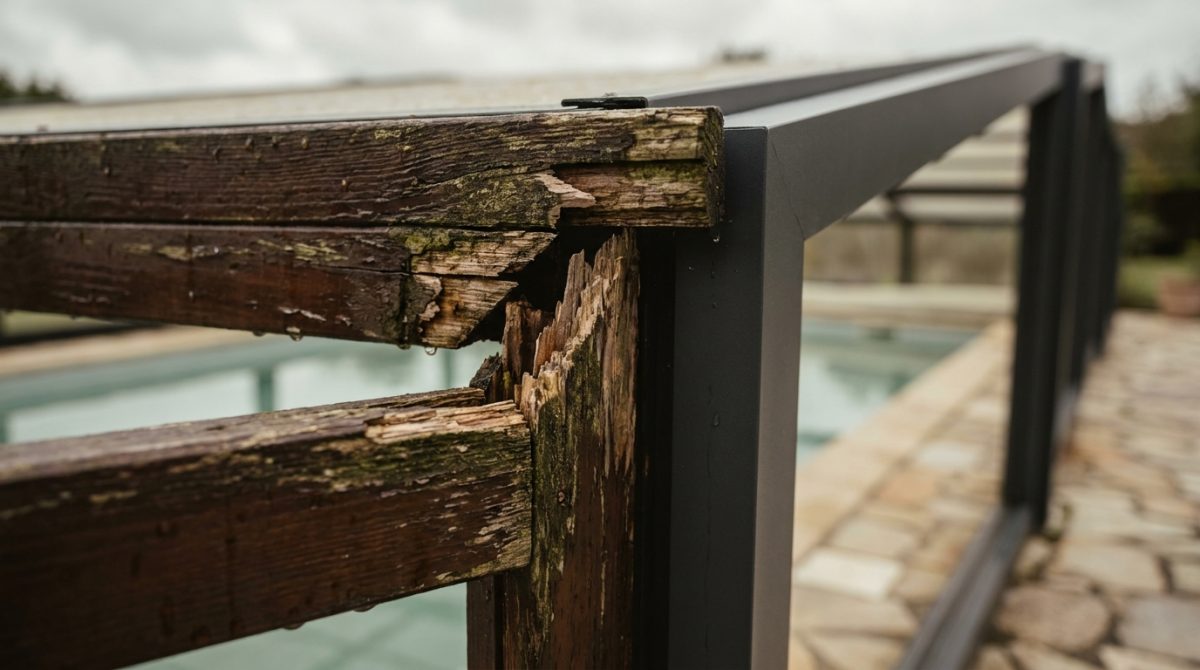
The lifespan gap creates a compounding problem for the buyer who chooses wood. If an aluminium enclosure lasts 30 years, a timber structure installed on the same day may require full replacement before the aluminium system has reached its halfway point. That means the timber buyer faces two purchase decisions, two installation projects, and two sets of associated costs within the same period the aluminium buyer experiences one.
Replacement costs are rarely limited to the price of the new structure. Pool downtime during the removal and reinstallation period can run to several weeks. Groundwork disturbed by the removal of fixing points or base frames needs reinstatement. Landscaping around the pool, whether paving, decking, or planted borders, is frequently disrupted and must be restored. In some cases, particularly where the original installation required permitted development notification, a planning reapplication may be necessary. None of these costs appear on the original quote from a timber supplier.
A quality aluminium enclosure also carries a structural warranty that reflects genuine material confidence rather than a marketing gesture. Because aluminium does not corrode, rot, or suffer from moisture ingress in the way wood does, the manufacturer can stand behind a long-term guarantee with reasonable certainty. That warranty is a meaningful data point when evaluating true value, not a number to be glossed over in a brochure.
True Cost of Ownership: Building the 20-Year Budget
Any honest comparison between wood and aluminium has to move beyond the initial purchase price and work through what ownership actually costs over time. The headline figures for aluminium enclosures span a wide range. Entry-level aluminium and polycarbonate systems start at around £3,000 to £6,000. Mid-range retractable models occupy a higher band. Bespoke architectural systems from manufacturers like Arch Enclosures sit at the premium end, where full custom engineering, structural certification, and integration with specific pool designs are part of what you are buying.
Premium handcrafted timber pool structures from specialist suppliers are not cheap, either. Comparable units from quality-focused makers can sit in a similar price bracket to mid-range aluminium systems, sometimes higher. The entry-level price point for both materials, at a quality level worth comparing, is closer than buyers often assume going in.
Where the divergence becomes stark is in the 20-year running total. For a timber structure, the budget needs to account for the following:
- Biennial treatment products and labour, estimated at £300 to £800 per cycle depending on the structure’s size and accessibility
- One or two structural repairs across the lifespan, covering warped or cracked members, failed joints, or compromised fixings
- A partial or full replacement somewhere around year 12 to 15, which as noted above carries costs well beyond the new structure price alone
Running those numbers conservatively: eight treatment cycles at an average of £500 each comes to £4,000. Add a mid-life structural repair at £1,500 to £3,000. Then add the replacement cost, including groundwork, landscaping reinstatement, and associated disruption. The 20-year expenditure on a timber structure that opened at the same price as a mid-range aluminium system will typically exceed it by a considerable margin.
The aluminium 20-year model looks quite different. Periodic washing with a mild detergent, checking fixings annually, and inspecting polycarbonate panels for impact damage covers the maintenance requirement. If a panel is damaged, it is individually replaceable without touching the frame. That modularity matters because it eliminates the scenario where localised damage forces a disproportionate structural response. You replace the panel, not the enclosure.
There is a secondary cost saving that buyers sometimes overlook: chemical and water efficiency. An enclosed pool loses significantly less water to evaporation than an outdoor pool. Less evaporation means the chemical balance in the water is more stable, requiring fewer corrective additions of chlorine, pH adjusters, and stabilisers. Across a 20-year period, these savings are not trivial. Pool chemical costs for an unenclosed outdoor pool in regular use can run to several hundred pounds per year. Even partial reduction of that figure compounds over time into a meaningful number. For a deeper breakdown of how enclosures reduce long-term pool costs, the figures involved across heating, chemicals, and maintenance are laid out in full.
The property value dimension is also worth building into this model. Estate agents and property valuers treat a permanent, well-maintained aluminium enclosure as a home improvement asset in the same category as a quality extension or kitchen renovation. It adds usable square footage, extends the functional season of an existing pool, and signals that the property has been maintained to a high standard.
A deteriorating timber structure tells a different story entirely. If the wood is visibly weathered, stained, or structurally compromised at the point of sale, it becomes a liability that requires disclosure. A buyer’s surveyor may flag it as a defect. A prospective purchaser may request a reduction in asking price to cover the cost of removal and replacement. What began as a design choice becomes a negotiating problem at the worst possible time.
The 20-year budget exercise is not designed to make aluminium look artificially attractive. It is designed to put both options on the same honest footing. When you do that, the premium end of the aluminium market stops looking expensive and starts looking like rational capital allocation.
Year-Round Swimming: Where Timber Structures Fall Short Functionally
The entire premise of investing in a pool enclosure is the extension of the swimming season. In the UK, an unenclosed outdoor pool is realistically usable for perhaps three months of the year without heating intervention, and even then, the ambient conditions make it an uncomfortable experience beyond midsummer. The functional promise of any enclosure is to push that three months toward twelve.
Achieving genuine year-round use is not simply a matter of putting a roof over the water. The enclosure needs to retain heat efficiently, handle the condensation that forms when warm pool air meets cooler surfaces, and resist the wind and snow loads that UK winters routinely deliver. These are engineering requirements, not aesthetic ones.
Timber frames expand and contract substantially with shifts in temperature and humidity. Wood absorbs moisture and swells; it dries and shrinks. In a pool environment, where temperature differentials between the water surface and the exterior can swing dramatically across a single day, this movement is constant. Over time, it causes gaps to open between the frame and the glazing or cladding panels that seal the enclosure. Those gaps compromise thermal retention directly. The enclosure stops working as a controlled environment and becomes, in effect, a leaky greenhouse.
A timber structure that develops seal failures in its second or third year is no longer delivering the extended-season benefit that justified the original purchase. The pool owner is still managing a pool that loses heat to the outside, still spending on additional heating to compensate, and still facing the same shortened usable season that the enclosure was supposed to solve. The aesthetic decision has undermined the functional one.
Aluminium profiles engineered specifically for pool enclosures address this through thermal break technology. A thermal break is a section of low-conductivity material built into the aluminium profile that interrupts the cold bridge between the exterior face of the frame and the interior. Without it, the aluminium itself conducts heat outward, chilling the inner surface and encouraging condensation. With it, the interior temperature is maintained more effectively, and the enclosure performs as a genuine climate buffer between the pool and the outside world.
Structural-grade aluminium systems are also tested and certified to defined wind and snow load standards. That certification means the structure performs predictably under the conditions UK winters actually produce, not just the conditions specified in an optimistic brochure. When a January storm brings 60mph gusts or a February snowfall leaves significant accumulation, a certified aluminium enclosure handles it within its design parameters.
Aesthetics Revisited: What Aluminium Actually Looks Like in 2025
The idea that aluminium equals a factory roof or a bus shelter is about fifteen years out of date. Modern powder-coating technology means any RAL colour is available as standard, and the finishes have matured considerably. Warm wood-effect coatings, deep matt blacks, and anthracite greys are among the most popular choices right now, and they hold their colour far better than stained timber because the coating is applied to a dimensionally stable substrate that does not expand, contract, or crack.
Arch Enclosures designs structures specifically for domestic gardens, which means the proportions are deliberately residential in scale. Low-profile options sit close to pool level rather than rising up to dominate the garden, and the sightlines through the glazing keep the visual weight low. The result from thirty metres away is often a structure that reads as part of the garden rather than something imposed on it.

Glazing is where aluminium enclosures pull away from timber structures entirely. Clear polycarbonate and toughened glass panels transmit natural light in a way that no timber-clad building can replicate. The pool water is visible from the garden, the sky is visible from inside, and the enclosure does not feel like a shed. That quality of light is something photographs struggle to convey, which is why buyers who visit a well-designed aluminium installation in person almost always revise their initial preference. The material quality and the spatial feel only become clear when you are standing inside one.
High-end aluminium enclosure systems have been featured in architectural publications and have picked up design awards, placing them firmly in the same category as contemporary garden architecture rather than pool equipment. If your aesthetic benchmark is a well-designed orangery or a considered garden room, a premium aluminium enclosure belongs in that conversation. enclosure design finishes have reached a point where the default assumption should be reversed: the burden of proof on aesthetics now rests with the alternative materials, not with aluminium.
Making the Decision: Questions That Separate the Right Buyer from the Wrong Product
Before you compare any two pool structures on price, ask the timber supplier for two specific things: an independently verified lifespan figure and a detailed maintenance schedule covering every year of that lifespan. Not a brochure claim, not a testimonial, but a documented figure with conditions attached. If those documents do not exist or arrive vague, you are being asked to take a significant financial risk on trust.
The single most revealing question you can put to any supplier is: what happens in year twelve? Most buyers do not ask it. They focus on the installation cost and the look on day one, which is exactly the framing a supplier with a short-horizon product wants to encourage. A timber structure that looks beautiful at handover may require significant structural intervention by year ten to twelve, and the supplier who sold it to you will not necessarily still be in business to help.
For Commercial Buyers
If you are procuring for a hotel, leisure club, or residential development, the due diligence requirements go beyond personal preference. You need to account for maintenance staff costs over the operational life of the structure, because a timber enclosure or timber-adjacent structure requires skilled labour at regular intervals that cannot be deferred without accelerating deterioration. You also need to consider insurance implications: a structure showing signs of structural degradation will attract scrutiny from underwriters, and a claim on a facility that has not been maintained to schedule is a claim that can be disputed. The reputational cost of a visibly deteriorating facility is harder to quantify but real.
For Domestic Buyers
Three questions cut through most of the noise for homeowners. First, how much time do you realistically want to spend on maintenance each year? Be honest about this. If the answer is less than a weekend per season, a high-maintenance structure will disappoint you regardless of how appealing it looks in a catalogue.
Second, do you intend to sell the property within the enclosure’s lifespan? A well-specified aluminium enclosure is documented in research as a permanent home improvement that adds measurable value at sale. A timber structure mid-way through a refurbishment cycle is a harder conversation with a surveyor.
Third, is year-round swimming a genuine goal or an aspirational one? There is no wrong answer, but it matters. If you want to swim in January with the same ease as July, you need an engineered enclosure built for thermal retention and weather resistance. If you mostly want to extend the season by six weeks, the engineering requirements are different and the budget conversation changes accordingly.
Arch Enclosures offers bespoke consultations that work through exactly these questions. Rather than directing you to a catalogue and asking you to choose a size, the process models the enclosure against your specific pool dimensions, garden orientation, and realistic usage pattern. What comes back is a specification, not a product code. That distinction matters because a pool enclosure is not a commodity purchase, and a specification built around your actual garden and your actual habits will serve you better over two decades than one chosen from a brochure.
Wood can be genuinely beautiful. In the right application, a well-crafted timber structure is a legitimate design choice and nobody should pretend otherwise. But a pool enclosure is an engineering product first and a decorative one second. It must manage condensation, resist wind loading, maintain structural integrity through freeze-thaw cycles, and hold its weather seal for years without specialist intervention. Buyers who weight the aesthetics heavily and treat the engineering as secondary pay for that misjudgement incrementally across twenty years, in maintenance bills, in replacement costs, and in the opportunity cost of a pool they cannot use for half of them.
