
How Enclosures Change the Risk Profile Entirely
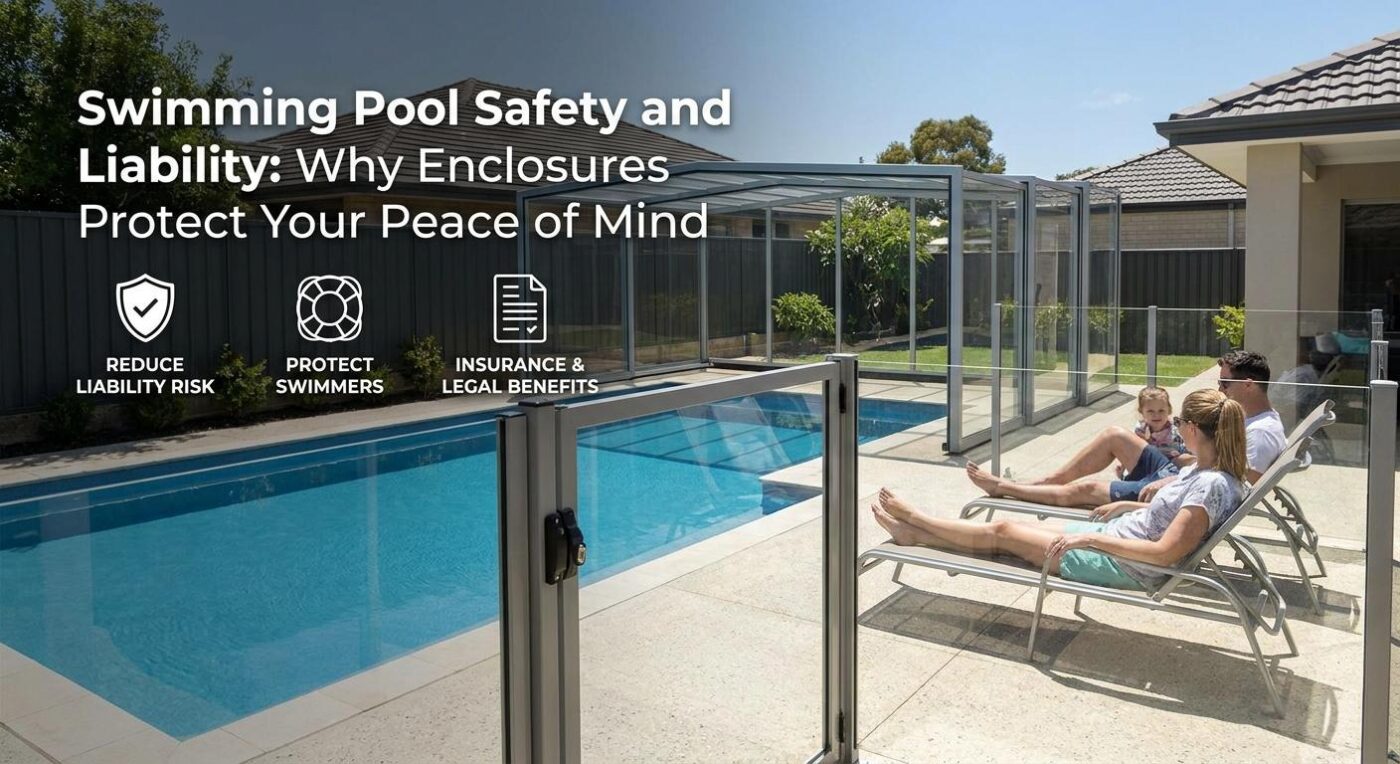
A pool fence is a deterrent. A locked aluminium enclosure is a barrier. That distinction sounds like semantics until you think about who a fence fails to stop: a determined five-year-old who has watched adults climb it, a teenager looking for an after-hours swim, a neighbour’s child who wanders in during a party. Fences rely on height and the assumption that no one will try hard enough. A full enclosure with no climbable external surface and a keyed or coded entry point removes that assumption entirely.
Arch Enclosures’ patented aluminium systems are engineered so the structure itself provides the access barrier. There is no separate fencing required, no secondary gate that gets left unlatched, no gap between fence and pool surround that a small child can squeeze through. The enclosure is the perimeter, and the perimeter locks.
That single-point-of-access design does something a fence physically cannot: it converts the pool from a 24-hour exposure to an asset with controlled operating hours. Pool enclosure ownership changes how families govern access, and commercial risk-reduction literature consistently cites restricted operating hours as one of the most effective mechanisms for lowering incident probability. When unauthorised access is structurally impossible, after-hours incidents stop being a statistical likelihood and become an engineering problem that has already been solved.
Environmental conditions inside an enclosure also shift the risk calculation. In open pools, winter ice forms on surrounding paving, UV radiation degrades non-slip surfaces over time, and wind-driven leaves or debris settle on pool surrounds overnight to create slip hazards by morning. Inside an enclosed structure, ambient temperature stays above freezing through passive heat retention, surfaces degrade far more slowly because UV exposure is filtered, and debris simply does not enter. The hazards that make open pools genuinely dangerous in autumn and winter are mostly absent.

Lighting is another area where enclosures deliver a safety advantage that is easy to underestimate. Low-light accidents at dusk or after dark are a consistent feature of pool incident data. Open pools depend on external lighting that casts shadows at the water’s edge, and that lighting often fails or is simply switched off. Inside an enclosure, lighting is controlled, uniform, and fixed to the structure. There are no shadows at the pool edge, no dark corners near the steps, no ambiguity about where the water starts.
The net effect is a risk profile that looks fundamentally different to an insurer, a local authority, or a court. A fence reduces access somewhat. An enclosure with a locking entry point, controlled lighting, consistent internal conditions, and no climbable surface reduces unauthorised access to as close to zero as passive engineering allows. That is not a marginal improvement. It is a categorical one.
Insurance Premiums, Policy Conditions, and the Enclosure Advantage
Adding a pool to a domestic property changes the conversation with your insurer immediately and usually not in your favour. Many UK home insurers apply a premium loading when a pool is present, and the range most commonly cited by brokers is 15 to 25 percent on the relevant liability components of the policy. That figure reflects actuarial reality: a pool increases the probability of a serious injury claim, and a serious injury claim involving a private pool can run into six figures quickly.
The loading is not flat. Insurers assess the specific risk presented by each pool, and the factors they examine include barrier type, pool depth, lighting arrangements, supervision protocols, and whether anyone outside the immediate household uses the pool. A pool with no barrier beyond garden fencing at the back of a property used as a holiday let sits at one end of that spectrum. A pool inside a professionally installed, lockable enclosure used only by the owner’s family sits at the other. The premium loading reflects the distance between those two situations.
A documented, professionally installed enclosure with a locking mechanism gives you something concrete to put in front of your insurer: evidence that the most significant unauthorised-access risk has been physically addressed. Presenting that documentation at renewal or when first declaring the pool is not a guarantee of a lower loading, but it gives your broker a basis for negotiation that a fence alone does not. The key word is documented. Verbal descriptions of what you have installed carry little weight. A specification sheet, installation certificate, and photographs of the locking entry system carry considerably more.
To make that concrete: a homeowner declaring a newly installed 8-metre by 4-metre pool to their insurer, with nothing more than a 1.2-metre timber garden fence as a barrier, might face a liability loading in the upper part of the 15 to 25 percent range, potentially an additional £300 to £500 per year on a mid-range policy. The same homeowner presenting a professionally installed, CE-marked aluminium enclosure with a keyed entry point, full specification documentation, and an installation certificate is giving the underwriter material evidence of a fundamentally different risk. Brokers who regularly place properties with pools report that this kind of documentation can move a case from the standard pool loading to the lower end of that band, or in some cases to a flat rate with no additional loading at all. That saving, compounded over the life of the enclosure, contributes meaningfully to the overall return on the capital investment.
Property owners who let their homes face a separate and more acute exposure. Letting a property with a pool to paying guests typically requires additional public liability cover, and the cost of that cover is directly influenced by the risk profile of the pool. An enclosure reduces that profile. Some specialist leisure and holiday let insurers go further, listing pool enclosures as a preferred or required risk control in their policy schedules. If your policy schedule contains language about pool barriers, a properly installed enclosure is the most defensible way to satisfy that condition.
The practical step most pool owners skip is this: once your enclosure is installed, write to your insurer and ask for written confirmation that the installation satisfies any pool safety conditions in your policy. Keep that letter on file. If a claim ever arises, the paper trail showing that you proactively sought and received confirmation of compliance is the kind of evidence that changes outcomes. Risk management specialists consistently advise this approach for any capital improvement intended to reduce liability exposure. The improvement itself matters, but the documented acknowledgement from the insurer is what converts physical safety into financial protection.
One further point worth addressing: if you upgrade your enclosure, change the locking mechanism, or alter access arrangements, notify your insurer again and repeat the process. A confirmation letter issued for a previous configuration does not automatically cover modifications, and a gap between what you told your insurer and what is actually installed is exactly the kind of discrepancy that gets used against claimants.
Commercial Pools: Where Liability Stakes Are Highest
Hotels, health clubs, holiday parks, and schools operate under a fundamentally different risk profile from domestic pool owners. A single public liability claim arising from a slip on a wet pool deck, a near-drowning during an unsupervised period, or a child accessing a pool outside operating hours can run well into six figures before legal costs are even counted. The reputational damage that follows an incident at a commercial facility often outlasts the financial settlement.
The Reporting of Injuries, Diseases and Dangerous Occurrences Regulations 2013 (RIDDOR) places specific obligations on commercial pool operators. Certain incidents at managed facilities must be reported to the Health and Safety Executive, and failure to do so compounds the regulatory exposure significantly. An HSE investigation following a reportable incident will look immediately at whether the operator had a documented safe system of work in place, and whether physical controls were used to enforce it.
This is where the absence of an enclosure becomes a concrete legal problem, not just a theoretical one. A commercial operator without physical barriers that enforce operating hours has no mechanism to demonstrate that access was controlled outside those hours. A padlock on a gate is one thing; an electronically controlled access system integrated into an aluminium enclosure is another entirely. The latter generates time-stamped entry and exit logs, which can be produced as evidence of due diligence in the event of a claim or HSE investigation.
The commercial case for enclosures in Europe reflects exactly this reasoning. Europe accounts for 33.2 percent of global pool enclosure revenue in 2025, equivalent to approximately 930 million USD, and part of that dominance is structural: European commercial operators, particularly in hospitality and leisure, have adopted enclosures as a compliance tool alongside their function as a weather solution. The two benefits reinforce each other, which is why uptake among commercial operators tends to outpace the domestic market in percentage terms.

For UK holiday parks and hotels specifically, the enclosure also addresses a commercial problem that sits alongside the liability one. An outdoor pool that closes in September and reopens in May generates revenue for roughly five months. An enclosed pool operates year-round. The capital investment in an enclosure is therefore justified on two separate grounds simultaneously: it extends the revenue-generating season and it reduces the risk of a claim that could cost multiples of the enclosure’s purchase price to settle. Those two arguments together tend to make the investment straightforward to approve in a commercial context.
The key operational point for commercial operators is that the enclosure must be part of a documented system, not just a physical addition. Logging access electronically, maintaining records of inspections, and integrating the enclosure into formal risk assessments are what convert the physical structure into genuine legal protection. An enclosure that is installed but not managed properly still leaves gaps. One that is woven into the operation’s safe system of work closes them.
Child Safety Specifics: What Statistics and Standards Say
The World Health Organisation identifies drowning as the third leading cause of accidental injury death globally. Within that figure, children under five are disproportionately represented, and the majority of those incidents do not happen at public beaches or supervised leisure facilities. They happen in and around private residential pools, in the moments when adult attention is elsewhere.
Royal Life Saving Society UK data makes a point that is often uncomfortable for pool owners to sit with: most child drowning incidents in private pools occur during unsupervised periods, not during family swim sessions. The child was not supposed to be in the water. Nobody planned for it. The adult was inside for two minutes, or talking to a neighbour, or answering a phone call. This is not negligence in any dramatic sense. It is ordinary domestic life, and it is exactly the condition that pool safety measures must account for.
Supervision alone cannot be the primary safety layer, because supervision is inherently intermittent. The measure that actually works is one that functions when an adult is momentarily absent or distracted. This is the foundational argument for physical barriers, and it is what drives the specific standards referenced in UK safety guidance.
A self-latching gate set at a minimum of 1.5 metres, with no climbable surface on the pool side, is the baseline physical standard referenced in UK pool safety guidance for residential barriers. The self-latching mechanism matters because a gate that must be consciously closed and latched will, at some point, be left open. A mechanism that closes and latches automatically removes that human failure point.
An aluminium enclosure with a key-operated or coded entry door goes beyond this standard in a specific and meaningful way. It adds a cognitive barrier on top of the physical one. A young child who can climb a 1.5-metre fence still cannot operate a key lock or enter a code. The two layers together do not merely double the protection; they address two different categories of risk simultaneously, the physical (height, climbability) and the cognitive (knowledge required to operate the entry mechanism).
Pool covers rated to EN 13451 are sometimes presented as an equivalent solution. They are not equivalent. A compliant pool cover can support a child’s weight and allow a rescue to take place, which is genuinely valuable. But a cover only prevents a drowning once the child has already reached the water’s edge. An enclosure prevents the child from reaching the water in the first place. The distinction is the difference between a secondary safety net and a primary barrier, and in child safety, primary barriers are always preferable.
It is also worth being precise about what EN 13451-compliant covers actually require in practice. A cover rated to that standard must support a minimum load of 100 kilograms per square metre and must be capable of being removed by a rescue team within 30 seconds. Meeting those criteria demands a motorised, rigid cover system, which carries its own significant capital cost, typically between £8,000 and £20,000 for a domestic pool. A homeowner who installs a basic manual cover and assumes it provides equivalent protection to a rated product is compounding the underlying risk. The enclosure, by contrast, acts before any of those cover-related questions even arise.
For families thinking carefully about water safety culture around a pool, the enclosure changes the daily habits of the whole household in ways that a cover alone does not. It creates a defined threshold, a point of entry that requires conscious action, which shifts the child’s relationship with the pool from something accessible to something that requires adult involvement to enter.
Structural Integrity and Weather: Why Material Choice Matters for Safety
A barrier that looks intact but has quietly lost structural integrity is not a safety feature. It is a false sense of security, and in some respects it is more dangerous than no barrier at all, because it creates confidence that is not warranted. This is not a theoretical concern in the UK’s climate. It is a practical one that affects every material choice in pool safety infrastructure.
Mild steel corrodes. Timber rots. Both processes accelerate in the wet, chemically active environment immediately surrounding a pool, where water splash, chlorine vapour, and ground moisture combine to attack materials continuously. A mild steel gate that was correctly installed and adequately sized in year one may have lost a significant proportion of its load-bearing capacity by year seven or eight, without any visible indication from a casual inspection. Timber fencing in a similar environment typically shows serious structural degradation within five to ten years, with the joints and base sections failing first.
Marine-grade aluminium behaves differently. It does not corrode in the conventional sense. The oxide layer that forms on its surface is self-limiting and actually protects the metal underneath rather than consuming it. The alloy grades used in Arch Enclosures systems maintain dimensional stability across a temperature range from minus 20 to plus 60 degrees Celsius, which covers every condition a UK pool enclosure will realistically face across decades of use. The load-bearing capacity at year twenty is not materially different from year one.
The profile design of Arch Enclosures structures also addresses a specific climbing risk that standard fencing does not. Conventional fencing, including many pool fences, includes horizontal rails that function as footholds for a determined child. The patented profile used in Arch Enclosures systems eliminates those horizontal surfaces on the pool-facing side. There is no ladder built into the structure. The enclosure cannot be scaled in the way a standard fence or railing can, which means the physical barrier remains a genuine barrier rather than a mild inconvenience.
Wind and snow loading are not incidental engineering considerations for a structure that doubles as a safety barrier. An enclosure that deforms under a heavy snow load, or that suffers frame distortion after a significant wind event, may no longer close or latch correctly. Arch Enclosures structures are engineered to UK and European standards for both wind and snow loading, which means the structure’s safety function is maintained through weather events, not just in calm conditions.
There is also a direct legal dimension to material degradation. The Occupiers Liability Act does not evaluate the condition of a barrier at the time it was installed. It evaluates whether the occupier took reasonable steps to maintain a safe environment at the time of an incident. A barrier that was compliant when new but has since corroded, warped, or weakened may not satisfy that standard years later. Choosing a material that does not degrade under the conditions it will face is not just a practical decision. It is a long-term legal one.
What Routine Maintenance Must Actually Cover
Even the best-specified aluminium enclosure will underperform as a safety barrier if maintenance is treated as optional. Most pool owners understand they should inspect the structure periodically, but the inspection needs to be systematic rather than a general visual sweep. There are specific failure points that matter from a safety and liability perspective, and missing any one of them in a log creates the kind of evidentiary gap that an insurer or court will notice.
The locking mechanism deserves a dedicated check at every inspection visit. Test it under load, not just by turning the key in an open position. Push firmly against the closed door while the lock is engaged to confirm the mechanism resists lateral force. A lock that passes a visual check but yields under moderate pressure is not providing the access control it appears to. Record the result of that test in writing, with a date and the name of the person who carried it out.
Glazing panels, whether polycarbonate or toughened glass, should be checked for micro-fractures, crazing, and edge seal integrity. Polycarbonate in particular can develop surface crazing after prolonged UV exposure, which does not immediately compromise structural integrity but signals that the material is approaching the end of its service life. Replacing a panel at the crazing stage, before it becomes a fragmentation risk, is straightforward and inexpensive. Replacing it after a breakage event that has already caused an injury is not.
Track and roller systems on retractable and telescopic enclosures are a high-wear component that directly affects whether the enclosure can be fully closed. A track that has accumulated grit and debris over a season may allow the sections to sit slightly out of alignment when closed, leaving a gap at floor level. For an adult that gap is inconsequential. For a toddler it is not. Clean and lubricate tracks at least twice a year, and measure the seal at the base of each section as part of the annual inspection record.
Anchor points at the base of the structure, where the aluminium frame meets the pool surround, should be inspected for any movement or loosening. Ground settlement, thermal expansion cycles, and frost heave can each work anchor fixings loose over time. A frame that has shifted at its base may appear visually unchanged while the locking geometry of the door has moved just enough to prevent a clean, fully latched close. Torque-test the anchor fixings annually and record the result alongside the rest of the inspection log.
Documentation, Due Diligence, and the Paper Trail That Wins Claims
In any liability dispute, the burden of demonstrating reasonable care falls squarely on the pool owner or operator. Physical safety measures matter enormously, but if you cannot prove those measures were in place, properly specified, and regularly maintained, they may count for very little when a claim is made. Documentation is how that case gets built, and without it, even a well-protected pool can look negligent on paper.
The core documents every pool owner should hold include:
- The installation certificate and full technical specification for the enclosure
- Maintenance records showing inspection dates, findings, and any remedial work carried out
- Any third-party safety audit or inspection report
- Written acknowledgement from the insurer confirming the enclosure satisfies their preferred risk controls
For commercial operators, the documentation requirements go further. HSE guidance in Managing Health and Safety in Swimming Pools (HSG179) requires a written Pool Safety Operating Procedure (PSOP) and an Emergency Action Plan (EAP). These documents define how the facility operates under normal conditions and what happens when something goes wrong. Their absence is not merely a paperwork oversight; it is evidence that the operator failed to plan for foreseeable risk, which is precisely what courts and insurers look for when apportioning liability.
One of the underappreciated benefits of a properly specified enclosure is that it provides a verifiable audit trail. A structure that is CE-marked and built to defined engineering standards was designed, tested, and verified to a specification. That is categorically different from an ad hoc arrangement of fencing and tarpaulins. The product itself carries a record of compliance that pre-dates any incident, which is exactly what an investigator needs to see.
Arch Enclosures provides full technical documentation with every installation, including load calculations, specification sheets, and certification records. This gives owners a ready-made foundation for their compliance file rather than having to reconstruct evidence after the fact.
Post-incident investigations repeatedly reveal the same pattern: it is not always the absence of physical safety measures that loses a case, but the absence of evidence that those measures were in place and properly maintained. A gap in a maintenance log, a missing installation certificate, or an insurer notification that was never made in writing can each be enough to undermine an otherwise defensible position. The documentation closes that gap before it becomes a problem.
The Hidden Costs of Getting Pool Safety Wrong
The financial exposure attached to a pool safety failure is considerably larger than most homeowners and small commercial operators assume. A successful public liability claim involving serious injury can exceed £500,000, and in cases involving death, the figures are higher still. Legal costs, expert witness fees, and settlement negotiations can add substantially to that total, and the process can take years to resolve.
The situation becomes significantly worse when an insurer can argue that the owner failed to maintain adequate safety measures. At that point, the policy may not pay out at all, leaving the homeowner personally liable for the full amount. This is not a theoretical edge case. Insurers scrutinise the circumstances of pool incidents closely, and any evidence that basic precautions were ignored or that documented risk controls were not maintained gives them grounds to contest the claim.
For commercial operators, the consequences arrive faster and more visibly. A prohibition notice from the HSE closes the facility immediately. The financial impact is immediate and compounds quickly:
- Lost revenue for the duration of closure
- Staff costs that continue regardless of whether the pool is open
- Remediation costs to satisfy the conditions of the notice
- Legal and consultancy fees associated with the investigation
Reputational damage is harder to quantify but no less real. In the age of online reviews, a single high-profile incident at a hotel, holiday park, or leisure centre creates a searchable, permanent record. Research in the hospitality sector has consistently shown that serious safety incidents reduce forward bookings in the following season, often by a measurable percentage that can take two or three years to recover. That compounding effect on revenue sits entirely outside what a liability policy covers.
Against this backdrop, the cost of a quality aluminium enclosure looks very different. Depending on pool size and specification, a professionally installed structure typically ranges from £15,000 to £50,000. Set against a liability exposure in the hundreds of thousands, and a reputational exposure that can affect a commercial operation for years, that figure is proportionally modest. Framing the enclosure as risk mitigation infrastructure rather than a luxury upgrade is not just a rhetorical shift; it reflects an accurate accounting of what the investment actually protects against.
Choosing an Enclosure That Actually Delivers on Safety
Not all enclosures offer the same level of protection, and the difference matters both physically and legally. Buyers should insist on CE marking as a baseline, along with compliance with relevant structural European Norms, including EN 13659 and applicable load-bearing standards. A manufacturer that provides full technical load calculations with the specification is demonstrating that the structure has been engineered for the actual conditions it will face, not simply assembled to look the part.
Anti-slip flooring deserves specific attention. Managing drowning risk is the most visible safety benefit of an enclosure, but slip and fall incidents inside a pool area remain one of the most frequent causes of injury and subsequent liability claims. A pool deck that becomes wet and slippery underfoot can generate exactly the kind of incident that an enclosure was supposed to prevent. Anti-slip surfacing should either be integrated into the enclosure design or specified explicitly alongside it, with the choice of material confirmed in writing as part of the overall installation record.
Locking mechanisms are another area where specification quality varies significantly. The minimum acceptable standard is a key-operated or coded lock that resists external force. A slam-latch that can be forced open, or a simple push-button mechanism accessible to a young child, does not meet the standard that most insurers expect from a risk control. When a supplier specifies the locking system, ask directly whether it has been tested for forced entry resistance, and request that confirmation in writing. A useful reference point is the PAS 24 standard for enhanced security performance, which, while written for domestic doors and windows, sets a benchmark for impact and manipulation resistance that provides a meaningful comparison when evaluating pool enclosure locking systems.
Retractable and telescopic enclosures represent the fastest-growing segment in the market, with a projected CAGR of 8.1 percent through 2034. Their growth reflects a practical advantage beyond aesthetics: a telescopic structure can be fully closed at night or during any unsupervised period, then opened fully for summer use. That means the barrier is in place precisely when supervision is absent, which is when most incidents occur. For owners who want to use their pool openly during the day without feeling enclosed, a retractable system genuinely resolves the tension between enjoyment and protection.
Arch Enclosures offers bespoke design consultations that assess site-specific risk factors before any specification is finalised. That includes evaluating planning requirements, local wind and snow loading, sightlines from the property, and any access constraints that might affect how the enclosure is used day to day. Safety is not a feature that gets added at the end; it is built into the design from the first conversation.
The right question to ask any supplier is not just whether the finished enclosure will look good, but what standard it meets and whether that can be certified in writing. A confident, straightforward answer to that question, backed by documentation you can hold in your hands, is the difference between a structure that protects you and one that simply appears to. When a claim arises, appearance counts for very little. Certification, specification, and a complete installation record are what actually stand up.
