

A typical outdoor pool in the UK loses between 800 and 2,000 pounds worth of heat every season, and most of that loss has nothing to do with the efficiency of the boiler or the tariff on your energy bill. It is a physics problem. The pool is a large body of warm water sitting in a cold, windy, often wet environment, and every hour it goes unprotected it is fighting conditions that are designed to cool it down as fast as possible.
Understanding exactly where that heat goes is the first step toward stopping it. Once you can name the mechanisms, you can start to see why an enclosure does far more than simply keeping the rain off.
Why Pool Heating Bills Are So High in the First Place
Heat leaves an outdoor pool through four distinct mechanisms: evaporation, convection, radiation, and conduction. Of these, evaporation is by far the most significant, accounting for roughly 50 to 70 percent of total heat loss in a typical unenclosed pool. When water molecules at the surface gain enough energy to break free and become vapour, they carry that thermal energy with them and it is gone. The pool has to be reheated to replace it, which means the pump and boiler run longer, consume more energy, and cost more to operate.
Convection handles much of the rest. Air moving across the pool surface strips away the thin warm layer sitting just above the water and replaces it with cooler ambient air. Wind makes this dramatically worse. A pool exposed to a steady 10 mph breeze loses heat three to five times faster than a sheltered equivalent. This is not a marginal difference. It is the difference between a heating bill that is manageable and one that makes owners question whether the pool is worth running at all. Siting and screening matter before any glazing choice is even considered, because no amount of engineering solves a pool installed in a wind corridor.
Radiation and conduction are smaller contributors but still meaningful. On a clear night, a pool radiates heat upward toward a cold sky in the form of long-wave infrared energy. In winter, ground temperatures around the pool walls and floor are low enough to draw heat conductively from the water, particularly in pools with older or uninsulated shell construction. The pool thermal assembly principles are well established: every surface in contact with the water or the air above it is a potential loss pathway.

A standard outdoor pool in the UK is realistically usable for only three to four months per year, roughly June to September in most regions. But even over that short season, the bills accumulate quickly. Heating a modest 8 by 4 metre pool to a comfortable 28 degrees Celsius using a traditional gas boiler typically costs between 800 and 2,000 pounds per season depending on local exposure, the number of swimming hours, and how aggressively the pool is kept at temperature overnight. Pools that are left uncovered at night sit at the expensive end of that range.
The core point is that high pool heating costs are a structural problem with open water, not a tariff problem. Switching energy supplier or fitting a more efficient boiler shaves the bill at the margins. Addressing the heat loss mechanisms directly, which is what an enclosure does, changes the underlying equation entirely. The rest of this article shows how each element of an enclosure works to do exactly that.
The Greenhouse Effect Inside a Pool Enclosure: What the Physics Actually Says
The term greenhouse effect tends to get used loosely, but in the context of a pool enclosure it describes a genuinely precise physical process. Understanding it properly helps explain why an enclosure does not just reduce heat loss but actively adds heat to the water, often without the heating system doing any work at all.
Solar radiation arrives from the sun as short-wave energy, concentrated at wavelengths below approximately 2.5 micrometres. Glass and polycarbonate are both highly transparent at these wavelengths, which means that sunlight passes through the enclosure panels largely unimpeded and strikes the pool water surface directly. Water is an excellent absorber of this short-wave energy. It converts the radiation to thermal energy, and the pool warms up.
Here is where the enclosure earns its thermal value. As the pool water warms, it radiates heat back outward, but it does so at much longer wavelengths, in the far-infrared range above 5 micrometres. Glass and polycarbonate are largely opaque at these wavelengths. The panels absorb this outgoing infrared radiation and re-emit a portion of it back inward toward the pool, rather than allowing it to escape into the atmosphere. This is the same mechanism that operates in an agricultural greenhouse, and it is why the term is physically accurate here rather than merely metaphorical.
On a sunny UK day, this passive solar gain can raise pool water temperature by 4 to 8 degrees Celsius without the heating system running at all. In practice this means that on a clear day in April or May, an enclosed pool may reach a comfortable swimming temperature entirely through solar gain, with the heat pump or boiler only needed to maintain temperature during the evening. Over a season, the cumulative effect of this free heating is substantial.
How the Enclosure Addresses Each Heat Loss Mechanism
Returning to the four mechanisms identified earlier, it is worth tracing exactly what the enclosure does to each one.
Evaporation is attacked most directly. The enclosure traps a layer of warm, humid air in the space between the water surface and the glazing panels above. As this air becomes progressively more saturated with water vapour, the rate of evaporation slows dramatically. Evaporation is driven by the difference in vapour pressure between the water surface and the air above it. When that air is already close to saturation, the driving force is weak and water molecules stay in the pool rather than escaping into the atmosphere. This single effect can cut evaporative loss by 50 percent or more compared with an unenclosed pool, which goes a long way toward explaining why modern pool enclosures reduce running costs as significantly as they do.
Convective loss is eliminated almost entirely. With no wind moving across the water surface, there is no mechanism to strip the warm surface layer away. The air inside the enclosure reaches an equilibrium temperature that is consistently warmer than outside ambient air, and it stays there because the structure prevents the constant exchange of internal and external air that an open pool experiences. On a cold October evening where outdoor temperatures drop to 8 degrees Celsius, the air inside a well-constructed enclosure may still be 18 to 22 degrees, depending on the day’s solar gain and the thermal mass of the pool water itself.
Radiative loss is reduced by the same mechanism that drives solar gain. The panels intercept the long-wave infrared radiation leaving the water at night and reflect or re-emit a portion of it back into the enclosure. The net outward radiation loss is substantially lower than it would be under an open sky, particularly on clear nights when a pool loses the most heat to sky radiation.
Conductive loss through the pool walls and floor is not directly addressed by the enclosure roof structure, but the effect is still felt. The warmer ambient air temperature inside the enclosure reduces the temperature differential between the pool water and the surrounding ground. Heat flows along temperature gradients, and a smaller gradient means slower conductive transfer. An enclosure that keeps air temperature at 18 degrees rather than 8 degrees does not eliminate ground conduction, but it does meaningfully reduce the speed at which it occurs. For pools in colder northern locations, this indirect benefit can be worth one or two degrees of retained temperature over a 24-hour period.
The result of addressing all four mechanisms simultaneously is a pool that holds its temperature far more effectively, requiring the heating system to work less frequently and for shorter periods. The heater is no longer fighting a constant losing battle against the environment. It is topping up a system that is, for much of the day, capable of looking after itself.
Glazing Choices and Their Real Impact on Thermal Performance
Not all glazing panels perform equally, and the difference between a basic specification and a well-considered one can represent 15 to 25 percent of your annual heating bill. That is a significant gap, and understanding what drives it makes the choice considerably less abstract.
The key metric for thermal performance is the U-value, measured in watts per square metre per degree Kelvin (W/m2K). A lower U-value means less heat escapes through the panel per degree of temperature difference between inside and outside. Single-skin polycarbonate, the most basic option, sits at around 5.5 W/m2K. Twin-wall polycarbonate, which traps a layer of still air between two skins, drops to roughly 2.5 to 3.5 W/m2K depending on the wall depth. Toughened glass with a low-emissivity coating can reach 1.0 to 1.4 W/m2K. These are not minor variations. A panel at 1.2 W/m2K is losing less than a quarter of the heat per square metre that a single-skin panel loses at 5.5 W/m2K.
For a structure with 80 square metres of glazed surface area, which is not unusual for a domestic enclosure, the difference between single-skin and low-e glass at a 15-degree temperature differential between inside and outside represents a continuous heat loss rate difference of over 250 watts. Over a 12-hour overnight period, that is 3 kilowatt-hours lost every night, night after night, through the glazing alone.
Solar Transmittance: The Other Half of the Equation
U-value measures how much heat escapes. Solar transmittance measures how much solar energy enters. These two properties are distinct, and optimising for one without considering the other leads to problems.
A high-transmittance clear panel lets in the maximum amount of solar energy during the day, which is generally desirable in the UK climate. However, the same transparency that admits sunlight also tends to correlate with higher radiative heat loss at night compared with a coated panel. The best glazing specifications balance both properties: high solar transmittance to capture daytime gains, combined with a low-e coating that limits overnight radiative loss.
Tinted or bronze-tinted glazing reduces solar gain by 10 to 20 percent compared with clear panels. For a south-facing enclosure in summer, this can prevent overheating, which is a genuine concern. An enclosure that traps too much heat in July creates an uncomfortable, humid environment and may cause chemical imbalances in the pool water. Energy management in an enclosure is a two-way problem: you want to capture heat when you need it and limit it when you do not. Tinted glazing is one tool, but operable roof sections and ventilation are usually more flexible solutions for the overheating problem, leaving the glazing free to maximise year-round solar capture.
The Frame: Where Thermal Bridges Hide
Aluminium is the structural material of choice for pool enclosure frames, for good reasons: it is strong, lightweight, corrosion-resistant, and indefinitely recyclable. But aluminium has high thermal conductivity, roughly 200 times higher than a polycarbonate panel. An aluminium frame without thermal treatment creates a cold bridge, a direct conductive path from the warm interior to the cold exterior that bypasses the insulating value of the glazing entirely.
The solution is thermally broken aluminium profiles. These incorporate a polyamide insulation strip, sometimes called a thermal break, pressed between the inner and outer aluminium sections of the frame. Polyamide has a thermal conductivity close to that of wood, around 0.25 W/mK, compared with aluminium at 160 W/mK. The break interrupts the conductive pathway without compromising structural integrity. The practical effect is that the overall envelope performance of the enclosure approaches what the glazing panels themselves can achieve, rather than being dragged down by poorly performing frames.
For UK climate conditions, where overcast skies are the norm for much of the year, the ideal specification combines maximum solar transmittance in a clear panel with at least twin-wall construction, thermally broken aluminium frames, and low-e coatings where the budget allows. This combination delivers strong passive solar gain on the good days, acceptable overnight heat retention on the bad ones, and a structural envelope that does not undermine the glazing’s performance through poorly insulated joints. For a detailed comparison of specific panel materials and their long-term performance characteristics, the glazing and materials guide covers the trade-offs in depth.
The upfront cost difference between single-skin polycarbonate and a twin-wall or low-e glass specification is real, but it is one of the fastest-payback decisions in the entire enclosure specification. When the cumulative annual heating cost saving is measured against the incremental glazing cost, better panels often pay for themselves within three to five seasons, with decades of reduced bills to follow.
How Pool Covers Work Inside an Enclosure and Why You Still Need One
One of the most common assumptions new enclosure owners make is that the structure itself removes the need for a pool cover. It is an understandable conclusion. The enclosure blocks wind, keeps rain off the water, and maintains a warmer ambient temperature around the pool. Surely that is enough? In practice, it is not, and acting on that assumption adds measurably to running costs every single month.
The mechanism that catches people out is evaporation. Even inside a well-glazed enclosure, the water surface is constantly releasing water vapour into the air above it. Overnight, when the pool is not in use and the air inside the enclosure cools, evaporation continues at pace. Every kilogram of water that evaporates carries with it roughly 2,260 kilojoules of latent heat. That heat came from the pool water itself, and your heating system has to replace it the next morning.
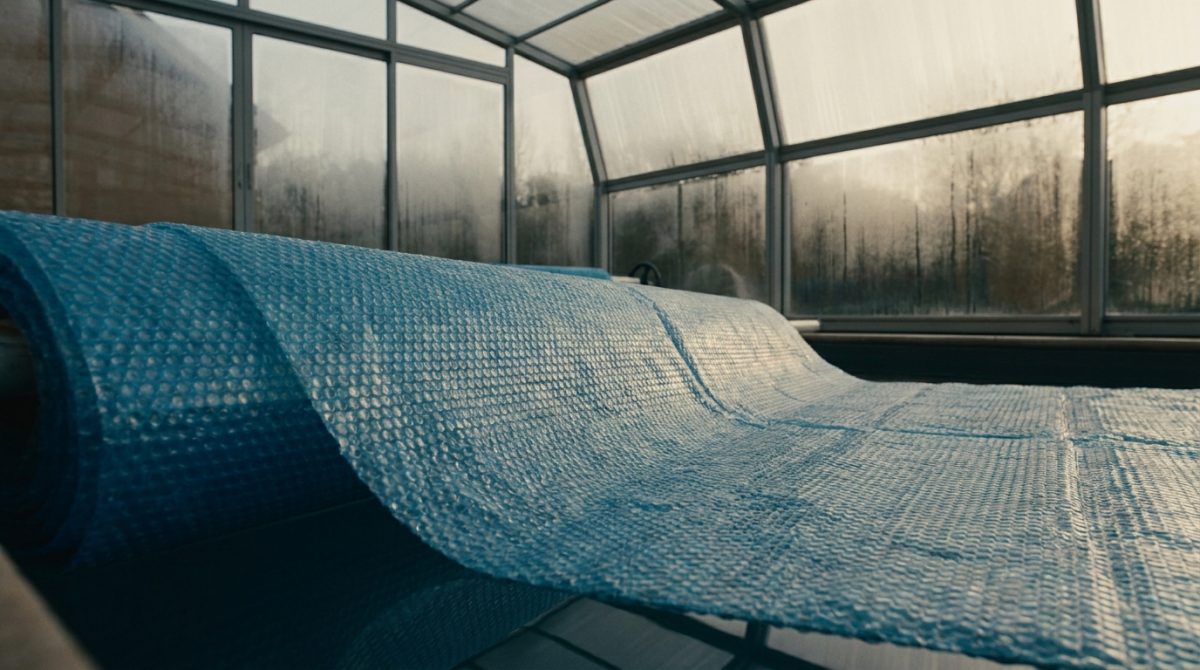
A floating thermal blanket, often called a solar cover or bubble wrap cover, physically blocks this process by sitting directly on the water surface and cutting off the evaporation pathway. Tests on enclosed pools consistently show these covers reduce overnight evaporative heat loss by 50 to 70 percent compared to leaving the surface open. The enclosure handles the external environment. The cover handles the surface. Both jobs are necessary, and neither replaces the other.
Manual versus automatic covers: the compliance problem
In theory, any cover works. In practice, the covers that actually save energy are the ones that get used consistently. A manual bubble cover folded in a corner of the pool room will be skipped on busy evenings, late nights, and any occasion where putting it on feels like extra effort. Automatic roller covers, which deploy at the touch of a button, remove that friction entirely.
The real-world energy saving from an automatic cover is significantly higher than the theoretical saving from a manual one, not because the cover itself is better, but because it is used every time. For families using the pool several evenings a week, this compliance difference alone can represent hundreds of pounds in avoided heating costs over a year.
Insulated slatted covers for longer idle periods
For pools that sit unused for several consecutive days, a standard bubble cover may not be sufficient. Insulated slatted covers, which have a rigid foam core inside each slat and sit on the water surface as a semi-rigid floating panel, offer a meaningfully higher level of insulation. Their R-value typically sits in the range of 0.5 to 1.2 m2K/W over a standard bubble cover, which matters significantly when the pool needs to hold temperature across a long weekend or a week-long absence.
These covers are also more robust under foot if someone accidentally steps on them, which is a practical consideration in domestic settings with children. They tend to cost more than bubble covers, but the payback period is short when the pool is not used daily.
What the combination actually delivers
When you combine a well-specified enclosure with a quality cover used consistently, the cumulative saving against an uncovered open pool is substantial. The enclosure tackles wind chill, rain cooling, and ambient air heat loss. The cover tackles overnight surface evaporation. Together, this layered approach can reduce heating energy consumption by 50 to 60 percent compared to an uncovered outdoor pool operating in the same climate. Each layer addresses a distinct heat loss pathway, which is why removing either one leaves a meaningful gap in the system.
Ventilation and Condensation: The Hidden Cost of Getting It Wrong
Ventilation is the part of pool enclosure design that gets the least attention in early conversations and causes the most expensive problems later. The instinct when building an enclosure is to seal it as tightly as possible. If heat is escaping through gaps, close the gaps. But a sealed or poorly ventilated enclosure creates a different and in some ways worse problem than an open pool: it traps humid air with nowhere to go.
Pool water evaporates continuously during use. Bathers add moisture through splashing and breathing. Inside a closed enclosure, relative humidity can climb to 90 percent or above within an hour of use. At that point, the dew point of the air is close to the surface temperature of the glazing panels and aluminium frames, and condensation begins to form. Water droplets appear on every cold surface: the glass, the frame sections, the pool surrounds, the furniture.
What condensation actually does to the structure
The cosmetic problem is obvious. The structural problem is less visible but more costly. Aluminium frames are corrosion-resistant, but fixings, hinges, roller mechanisms, and electrical components inside the enclosure are not always rated for continuous exposure to near-saturated air. Condensation that pools in frame channels accelerates degradation of seals and gaskets. On the pool surround itself, persistent moisture creates slip hazards and promotes algae and mould growth in the grout and decking joints.
There is also a direct thermal cost that is easy to overlook. When water vapour condenses on the inside face of a glazing panel, it releases its latent heat to the panel surface, and that heat then conducts out through the glazing to the cold external air. A dripping-wet panel is not just a sign of poor ventilation. It is actively removing energy from the enclosure, undermining the thermal performance that the glazing specification was designed to deliver.
Controlled ventilation: the correct approach
The solution is not to remove ventilation but to control it precisely. Ridge vents positioned at the apex of the enclosure allow warm, humid air to rise and escape without creating a cold draught at water level. Automated louvres or motorised ventilation panels, set to open on a humidity or temperature trigger, provide a more responsive and efficient approach: they open when the air inside reaches, say, 70 percent relative humidity, allow a controlled exchange of air, then close again once conditions normalise.
A well-designed ventilation strategy holds relative humidity inside the enclosure to 50 to 60 percent during use. That range suppresses condensation on most surfaces without requiring the heating system to compensate for large volumes of cold replacement air being drawn in continuously. It is a balance rather than a binary choice between open and sealed.
Arch Enclosures builds ventilation options into its aluminium structures at the design stage rather than treating them as optional extras or afterthoughts. The reason is practical: retrofitting adequate ventilation into a completed enclosure means cutting into frames, relocating panels, and potentially compromising the weather seal of the structure. It is expensive, it is disruptive, and the result rarely matches what an integrated solution achieves. Getting the ventilation specification right at the drawing stage costs a fraction of what correcting it later requires.
This is also a problem that simply does not exist with an open pool. No outdoor pool owner worries about condensation on their glazing. The ventilation challenge is specific to the enclosed environment, which means it is not obvious to buyers coming from an open pool background. Asking your manufacturer how they handle humidity management inside the structure is one of the most useful questions you can ask before you commit to a design.
Pairing an Enclosure with a Heat Pump: How the Two Technologies Multiply Each Other
A heat pump is already the most energy-efficient way to heat a swimming pool in most UK settings. Rather than generating heat by burning fuel or running electrical resistance elements, it extracts latent heat from the surrounding air and transfers it to the pool water. A good modern heat pump achieves a coefficient of performance (COP) of between 4 and 6, meaning it delivers 4 to 6 units of thermal energy for every 1 unit of electrical energy it consumes. At a COP of 5, your pool heating costs roughly a fifth of what they would with direct electric heating.
The limitation of a heat pump used with an open outdoor pool is that COP is not a fixed number. It falls as ambient air temperature drops. In the UK, outdoor air temperatures in October, November, and March regularly sit below 10 degrees Celsius, and at those temperatures a typical pool heat pump’s COP can drop to 2 or below. Running costs climb sharply, and many pool owners close the pool rather than pay to extend the season.
How an enclosure changes the heat pump’s operating conditions
This is where the enclosure and heat pump stop being separate products and start functioning as a single system. On a sunny day, the air temperature inside an enclosure is 3 to 8 degrees Celsius warmer than the air outside. That difference is not incidental. For a heat pump drawing its intake air from inside the enclosure rather than from the external environment, it means operating in a consistently warmer and more stable thermal band, even in autumn and spring.
A heat pump that would be running at a COP of 2.5 against 8 degree outdoor air might instead be running at a COP of 3.5 or 4 against the 15 degree air inside the enclosure on the same day. That single change, without any modification to the heat pump itself, meaningfully reduces the electricity consumed per unit of heat delivered. The enclosure is effectively doing part of the heat pump’s job by pre-warming the air the pump works with.
For a detailed breakdown of heat pump options and how they integrate with enclosure design, the guide on heating enclosed pools covers the technology comparisons in depth.
Adding solar PV to the system
The next step up in efficiency is pairing the heat pump with a solar PV system sized to cover a significant portion of its electricity demand. Dedicated pool PV setups, such as Polysolar systems designed to work alongside Polytropic heat pumps, can provide free energy to the pool system during peak solar months. The enclosure’s thermal retention then extends the benefit of that free energy into morning and evening hours, holding the heat that solar-assisted operation built up during the day rather than allowing it to dissipate overnight.
During June, July, and August in the UK, a well-specified combined system of this type can reduce the pool’s net energy cost to near zero for weeks at a time. The enclosure is essential to that outcome: without it, the heat gained during the solar hours would bleed away through evaporation and convection by the following morning.
A worked example with real numbers
Consider an 8 by 4 metre pool with a 10 kW heat pump, operated without an enclosure, targeting a water temperature of 28 degrees Celsius from April through to October. In most UK locations, that scenario involves the heat pump working hard against cold April and October air, and running for extended periods in summer to replace overnight losses. The annual electricity cost for that heating regime typically falls in the range of 900 to 1,200 pounds, depending on local tariffs and how diligently the owner covers the pool overnight.
The same pool, the same heat pump, the same target temperature, but now inside an enclosure with a consistent cover routine: the enclosure reduces ambient heat loss and raises the heat pump’s operating air temperature, the cover eliminates overnight surface evaporation, and the combined result is an annual electricity cost of roughly 400 to 600 pounds for the same April to October period. That is a saving of approximately 50 percent on the heating bill, achieved without changing the heat pump model, without upgrading the controls, and without reducing the pool temperature or shortening the season.
The enclosure does not replace the heat pump in this calculation. It makes the pool’s thermal performance stable enough that the heat pump operates less frequently and in a more favourable temperature band when it does run. These are two technologies that work better together than either does alone, and specifying them as a combined system rather than as independent purchases is the practical approach that most experienced pool designers now recommend.
Calculating Your Potential Saving Before You Buy: A Practical Framework
Most of the numbers in this article are only useful if you can connect them to your own situation. Here is a step-by-step framework you can actually work through before you speak to anyone.
Step 1: Establish your baseline cost
If you do not have a dedicated submeter on your pool system, use a manual proxy. Read your gas or electricity meter at the start of a 30-day heating period, then read it again at the end. Subtract a rough estimate of your normal household consumption for that month (your bills from the same month in a non-pool year are a good guide). What remains is a reasonable approximation of your pool’s monthly energy draw. Multiply by 12, adjusting upward for winter months and downward for summer, to get an annual figure in kilowatt-hours. Apply your current unit rate to convert to pounds.
Step 2: Apply the enclosure efficiency factor
A quality fixed enclosure fitted with twin-wall polycarbonate or low-e glazing, combined with a pool cover used during non-swimming hours, can realistically reduce heating demand by 40 to 55 percent. If you are considering a retractable enclosure that you expect to close at least 70 percent of non-swimming hours, model a saving of 25 to 35 percent. Multiply your annual baseline cost by whichever factor applies to get a gross annual saving in pounds.
Step 3: Apply a solar gain credit
For a pool with a south or southwest facing orientation in the UK, passive solar gain can raise water temperature by 4 to 8 degrees Celsius on clear days. In practical terms, this means the heater may not run at all from May through August, roughly 8 to 12 weeks of near-zero heating cost. Identify what proportion of your annual baseline falls within those months and subtract it from your gross saving, since the enclosure is effectively handing you that gain rather than your heater.
Step 4: Subtract the ventilation energy penalty
Automated ventilation fans typically draw 50 to 150 watts each. A small domestic enclosure might run one fan; a larger installation might run two or three. At 100 watts continuous operation for 10 hours per day over 200 days, that is roughly 200 kilowatt-hours per year per fan. At 28p per unit that is around £56 per fan per year. Subtract your total ventilation load from the gross saving to get your net annual saving figure.
Step 5: Run the payback calculation
Divide the installed cost of the enclosure by the net annual energy saving. A domestic enclosure costing between £25,000 and £50,000, saving £800 to £1,500 per year in energy alone, gives an energy-only payback of 17 to 35 years. That figure sounds long, and it is, on energy grounds alone. But it is not the complete picture. When you fold in the value of an extended swimming season (potentially three to four additional months of use), reduced chemical consumption because an enclosed pool requires less sanitiser to maintain balance, lower maintenance costs due to debris exclusion, and the measurable uplift to property value that a well-designed permanent enclosure delivers, the combined payback period typically falls to 8 to 15 years. That is a reasonable investment horizon for a structural improvement to a home, comparable to a kitchen extension or a loft conversion.
Use this framework as a conversation starter, not a contract. Real figures depend on your pool volume, your local climate, your chosen glazing specification, and how you actually use the pool. But working through these five steps before any sales conversation puts you in a position to ask informed questions rather than simply accept a projected saving at face value.
Specifying an Energy-Efficient Enclosure: What to Ask Your Manufacturer
Knowing what you want to achieve is one thing. Getting a structure that actually delivers it depends on the questions you ask at specification stage. Here are the ones that separate a genuinely engineered solution from a product that looks the part but underperforms thermally.
Ask for the full system U-value, including the frame. Many manufacturers will quote the U-value of the glazing panel in isolation, which can look impressive on paper. What matters is the U-value of the assembled system, panel and frame combined, because a low-e polycarbonate unit sitting in a poorly insulated aluminium frame still loses significant heat through thermal bridging at every junction. Push for the composite figure.
Request a site-specific solar gain estimate. A manufacturer who cannot tell you how much passive solar gain your particular installation will achieve, based on your pool’s orientation and any local shading from buildings or trees, is not genuinely engineering for thermal performance. They are selling a generic product. A proper estimate requires the pool’s postcode, its compass orientation, and a shading analysis. If that conversation does not happen, the projected savings are guesswork.
Confirm that ventilation is built in, not bolted on. Adjustable louvres or automated vents should be sized to the internal air volume of the enclosure and specified as part of the original design. Ventilation added as a retrofit is almost always a compromise and is frequently the reason condensation problems develop in otherwise well-built enclosures.
Ask specifically about thermally broken aluminium profiles. The aluminium extrusions that form the structural frame of the enclosure are the single biggest source of conductive heat loss where warm interior air meets cold exterior conditions. Thermally broken profiles use a polyamide insulation strip bonded within the section to interrupt that conduction pathway. It is a well-established technology and any manufacturer serious about thermal performance should be using it as standard, not offering it as an upgrade.
Verify that the design is calibrated for UK conditions. A product range developed for Spain, Italy, or central Europe is optimised for higher peak solar irradiance, lower rainfall, and lower wind loads. The UK demands a different balance: somewhat lower solar transmittance requirements in summer are offset by the need for tighter structural sealing against wind-driven rain and a greater emphasis on retaining heat through long overcast periods rather than harvesting direct sun. Ask whether the structure has been tested or thermally modelled specifically for UK climate data, not just CE-marked to a European standard that covers conditions quite different from a pool in Oxfordshire or Cheshire in November.
These questions are not aggressive or unreasonable. A manufacturer with genuine engineering depth will welcome them, because specific technical questions make it easier to demonstrate what sets a well-designed product apart. If questions about U-values and thermal breaks are met with vague reassurances, that is informative in itself.
At Arch Enclosures, the specification process starts with exactly this kind of technical conversation. The goal is to match the right structure to your pool, your site, and your expectations for energy performance, not to fit a standard product to every project. If you are at the stage of working through the numbers and want to talk specifics, get in touch for a consultation and bring your baseline energy figures with you. The more concrete your starting point, the more precise the advice can be.
