

Most pool owners think about heating as a straight swap: pick a fuel source, size the unit, pay the bills. That logic works reasonably well for an uncovered outdoor pool, but it falls apart the moment you add an aluminium enclosure to the equation. The enclosure itself does a significant portion of the thermal work, which changes the output you need from any active heating system and, by extension, the economics of every option on the market.
Understanding that shift is the starting point for a genuinely useful comparison. Get the baseline wrong and you will either overspec a boiler you never fully use or undersize a heat pump that cannot keep pace on a cold January evening.
Why the Enclosure Changes Everything About How You Heat
An uncovered outdoor pool is essentially a large evaporative cooler. Water molecules escape from the surface continuously, carrying latent heat with them, and wind accelerates that process dramatically. Fit an aluminium enclosure around the pool and you eliminate that wind exposure entirely. More importantly, you cap the evaporative surface with a warm, humid air mass that is already close to water temperature. The result is that an enclosure cuts evaporative heat loss by up to 75 percent compared to an uncovered outdoor pool, and that single figure reshapes every calculation that follows.
The enclosure functions as a passive thermal buffer. Warm air trapped above the water surface reduces the gap between your target water temperature and the ambient air temperature outside. On a 10-degree Celsius October afternoon in the UK, the air temperature inside a closed enclosure might sit at 18 to 22 degrees, meaning your heating system is working against a much smaller temperature differential than it would face outdoors. That is not a marginal improvement. It is the difference between a heat pump running comfortably within its rated efficiency and the same unit struggling at the edge of its operating range.
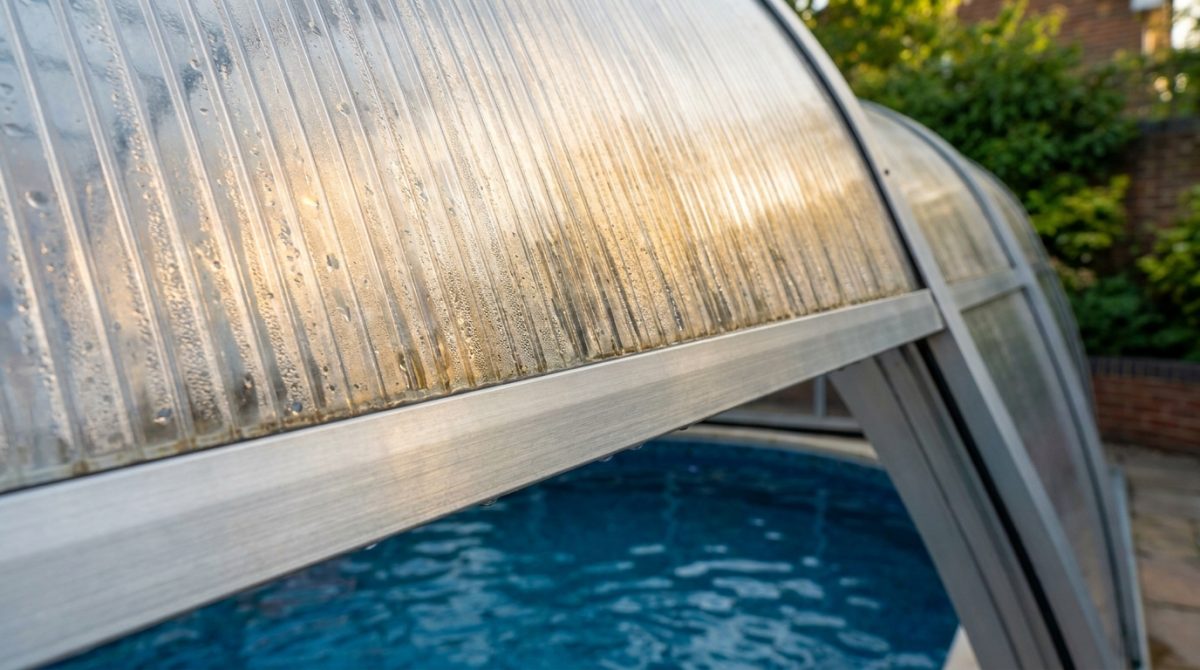
For UK pool owners without any active heating, an enclosure already extends the comfortable swimming season meaningfully. Many report swimming from April through to October without a single penny spent on a heater, simply because the enclosure holds enough passive warmth. Add a heating system to that picture and year-round use becomes genuinely realistic rather than aspirational. A pool that would need a powerful heater running constantly through winter without a cover can maintain 28 degrees Celsius with a much more modest system once an enclosure is in place.
This has a direct effect on capital costs that is easy to overlook. Because the heat demand inside an enclosure is structurally lower, you can often specify a smaller or lower-output unit than you would need for an equivalent uncovered pool. A gas boiler rated at 30 kW might do the job that a 50 kW unit would be required to handle outdoors. For heat pumps, a lower required output rating means a cheaper unit from the outset, and the savings can be significant given that commercial-grade heat pumps scale in price quickly with capacity. This matters when you are comparing headline installation quotes and wondering why two pools of similar volume come out with very different system recommendations.
This article works through the three mainstream heating routes available to UK homeowners with enclosed pools: gas boilers, air-source heat pumps, and solar thermal systems. Each is assessed across installation cost, running cost, efficiency, and practical fit with different enclosure and household setups. The goal is not to declare a single winner but to give you the specific information needed to identify which system, or combination of systems, makes sense for your situation. You can also find a broader look at the true cost of pool ownership that puts heating in the context of the full financial picture.
The Numbers That Should Drive Your Decision Before You Pick a System
Before comparing any specific heating technology, three variables determine which system is likely to win for your household: pool volume in litres, target water temperature in degrees Celsius, and hours of intended use per week across the full year. Get those three numbers onto paper and everything else becomes a calculation rather than a guess.
Pool volume sets the thermal mass you are working with. A 40,000-litre pool and a 60,000-litre pool are not the same challenge, even if both fit comfortably inside a standard domestic enclosure. The larger pool takes longer to heat from cold, stores more energy once warm, and loses heat more slowly, which affects both the peak output you need from a heater and the running cost you should expect. A rough rule of thumb for enclosed pools is that a typical domestic pool of 40,000 to 60,000 litres loses roughly 1 to 2 kWh per square metre of water surface area per day, even with the enclosure in place, depending on the glazing specification and how much ventilation the enclosure allows.
Target temperature has an outsized effect on system selection. Aiming for 26 degrees Celsius is a very different proposition from aiming for 30 degrees. Each additional degree requires more energy to achieve and more energy to maintain, particularly through winter. More critically, heating season length shifts the requirements dramatically. A homeowner who wants 28 degrees year-round needs a system that performs reliably when outside air temperatures in a UK January average between 3 and 6 degrees Celsius. That specific constraint eliminates solar-only solutions outright and places meaningful limits on heat pump performance without supplementary heating. Any heating adviser or installer who does not ask about your winter temperature target is not giving you a complete answer.
Hours of use per week through the year tells you how much work the system actually needs to do. A pool used by a competitive swimmer training six days a week needs a system that can maintain temperature continuously. A pool used by a family on weekend afternoons can be allowed to drop temperature mid-week and recovered before use, which opens up different strategies including time-of-use electricity tariffs for heat pump operation.
Local energy tariffs are the decisive financial input and they are not abstract. As of 2024, UK domestic gas sits at around 6p per kWh and electricity at around 24p per kWh. That four-to-one ratio is the number that makes heat pump efficiency ratios financially concrete. A heat pump delivering a coefficient of performance of 4.0 is effectively producing heat at the equivalent of 6p per kWh, matching gas cost for cost. A heat pump at 3.0 COP costs around 8p per kWh equivalent. The efficiency figure only matters once you put the tariff behind it.
Enclosure orientation and glazing specification add a further variable that is worth quantifying before you specify any active system. A south-facing enclosure with clear polycarbonate panels in good condition can contribute 2 to 4 degrees of passive warming through solar gain alone, particularly from March through September. That passive contribution directly reduces the number of hours your active heater needs to run. Solar pool heating research consistently shows that passive and active solar gain, even in northern European climates, can offset a meaningful share of annual heating load when the installation is well oriented.
Run through these numbers for your own pool before reading the system comparisons that follow. Write down your pool volume, your target temperature, your worst-case scenario month for use, and your current electricity and gas tariffs. Those figures are the lens through which every cost claim in the sections below should be read.
Gas Boilers: Fast, Familiar and Expensive to Run
A dedicated pool gas boiler, or a high-output domestic system boiler paired with a plate heat exchanger, is the fastest way to raise water temperature available to most UK homeowners. In a medium-sized pool of around 50,000 litres, a properly sized gas setup can add 1 to 2 degrees Celsius per hour. That rate of recovery is something neither heat pumps nor solar systems can match, and for certain usage patterns it is genuinely valuable.
How the Setup Works
The most common configuration uses either a standalone pool gas heater or a domestic condensing boiler feeding a stainless steel plate heat exchanger, which transfers heat to the pool water without mixing the pool’s chemically treated water with the boiler’s primary circuit. The plate heat exchanger is important: it protects the boiler from corrosive pool chemistry and ensures the system can be serviced without draining the pool. Skipping it to save a few hundred pounds is a false economy that regularly ends in boiler failure within two to three years.
Installation costs for a complete gas pool heating setup in the UK typically run from 2,500 pounds to 6,000 pounds. That range covers the boiler or heater unit, flue, plate heat exchanger, circulating pump, controls, and pipework. Where you land in that range depends heavily on the proximity of your existing gas supply to the plant room, the complexity of the flue run, and whether you are installing a pool-specific unit or adapting a domestic boiler. A pool plant room that sits 20 metres from the gas meter with a straightforward external flue route will cost considerably less than one requiring a long gas pipe run and a complex internal flue installation.
The Running Cost Reality
Fast heat recovery comes at a price. Running a gas pool heater through heavy winter use in a UK enclosed pool can cost between 150 and 300 pounds per month in fuel alone. That is the highest monthly running cost of the three systems compared here, and it reflects the fact that while modern condensing gas boilers are thermally efficient, the fuel itself is relatively expensive when used at pool-heating volumes.
A modern condensing gas boiler achieves a seasonal efficiency of around 90 to 92 percent, meaning nearly all the energy from combustion reaches the water. That is excellent thermal efficiency by any measure. The problem is not waste, it is the cost of the input fuel. At 6p per kWh for gas, heating a 50,000-litre pool from 20 degrees to 28 degrees Celsius from cold requires roughly 470 kWh, costing around 28 pounds just for that single heat-up cycle. Maintaining that temperature against daily losses adds further cost throughout the season.
Eligibility, Emissions and Practical Limits
Gas boilers used solely for pool heating are not eligible for the UK Boiler Upgrade Scheme, which currently provides grants for domestic space heating systems switching away from fossil fuels. There is no equivalent grant mechanism for pool-specific gas installations, so the full capital cost sits with the homeowner. Combined with direct carbon dioxide emissions from combustion, this makes gas an increasingly hard choice to justify for homeowners with sustainability commitments or those planning ahead for a grid that will likely see gas costs rise relative to electricity as renewable generation grows.
The scenario where gas still makes clear sense is specific: a household that already has mains gas infrastructure running close to the plant room, uses the pool intermittently rather than maintaining a constant set point, and needs the flexibility to recover temperature quickly after a period of non-use. A pool brought up to 28 degrees in four hours on a Friday evening before a weekend of family use is a genuine use case for gas. A pool that needs to sit at 28 degrees continuously from October through March is one where the monthly fuel bill will accumulate into a figure that makes the lower capital cost look much less attractive over a three to five year horizon.
Heat Pumps: The Efficiency Workhorse for Year-Round Enclosed Pools
An air-source pool heat pump does not generate heat directly. Instead, it extracts latent thermal energy from the surrounding air and transfers it to the pool water via a refrigerant circuit, the same fundamental process your domestic fridge uses in reverse. For every 1 unit of electrical energy the compressor consumes, a well-specified unit returns 4 to 6 units of heat energy to the water. That ratio is the Coefficient of Performance, or COP, and it is the number that makes heat pumps so compelling for year-round pool ownership.
Monthly running costs for a pool heat pump in moderate UK conditions typically fall between £50 and £150, depending on pool volume, target temperature, and how hard the unit has to work. That compares favourably with £150 to £300 per month for an equivalent gas setup. Across a 12-month season the saving compounds considerably, and the gap widens further if gas prices rise faster than electricity tariffs.
COP is not a fixed number. It is directly tied to ambient air temperature, and this matters for anyone planning winter swimming. At 15°C ambient, a quality unit achieves COP 5 to 6 with no difficulty. Drop to 7°C and that same unit may deliver COP 2.5 to 3, noticeably less impressive but still more efficient than gas. Below minus 5°C, many standard pool heat pumps cease to function reliably, though specialist low-ambient units rated to minus 15°C are available at a premium. For most UK winters, the realistic concern is reduced COP rather than total shutdown.
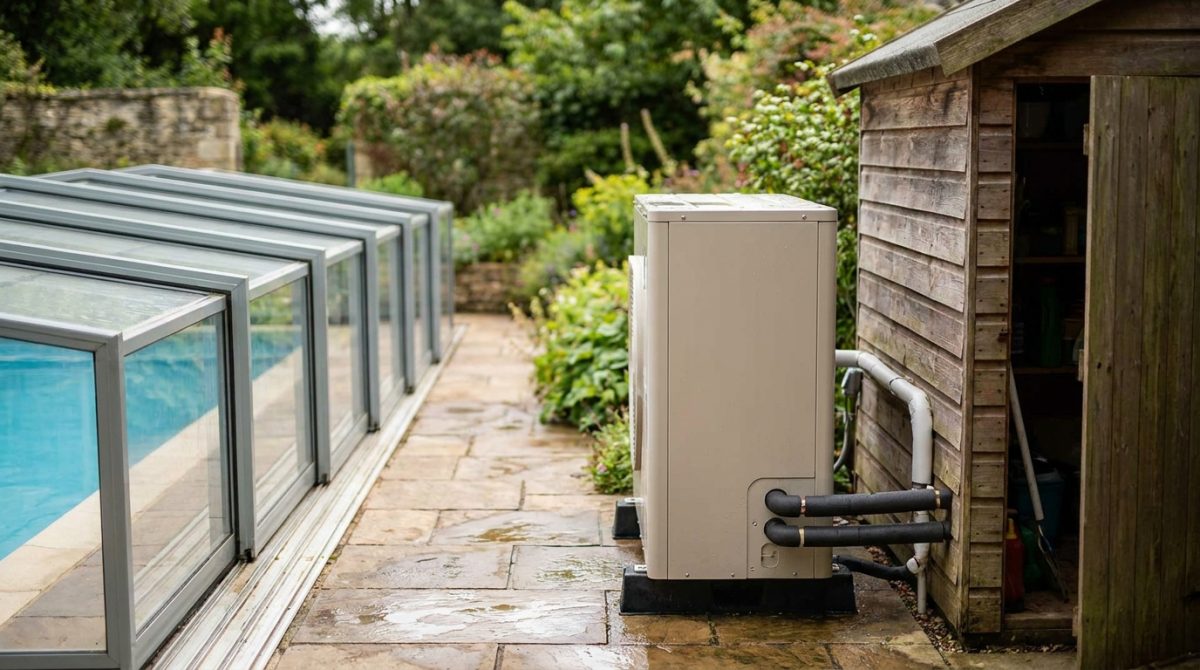
The way the compressor operates makes a significant difference to both efficiency and water temperature stability. Fixed-speed models run at full power until the set temperature is reached and then cut out entirely, cycling on and off repeatedly. Inverter-driven models modulate compressor speed continuously to match actual heat demand, consuming less electricity across a session and holding pool temperature far more steadily. Brands including Zodiac, Hayward and Fairland all offer inverter units rated for UK conditions, and the premium over fixed-speed models is typically recovered within two or three seasons of year-round use.
Installation costs in the UK range from £3,000 to £7,000 all-in, covering the unit itself, any electrical supply upgrade to support the additional load, and integration with the existing pipework and filtration circuit. The electrical side is worth examining carefully before quoting: older domestic supplies without adequate spare capacity will need an upgrade, adding cost and lead time.
The enclosure context is genuinely favourable here. Because an aluminium pool enclosure cuts peak heat loss substantially, a heat pump rated at 12 to 16 kW output can comfortably serve an enclosed pool that would require a 20 kW unit if exposed to the open air. Sizing down reduces purchase cost and means the unit runs closer to its optimal operating range more of the time, protecting efficiency figures in practice.
On grants: there is no pool-specific government incentive for heat pumps in the UK. However, homeowners integrating a pool heat pump as part of a wider domestic heat pump installation may be able to access the Boiler Upgrade Scheme, which currently offers £7,500 off the cost of a qualifying air-source heat pump. This requires careful design from the outset, so discuss it with an MCS-certified installer before committing to a configuration.
The best-fit profile for a heat pump is a homeowner committed to year-round use who wants the lowest sustainable running costs over a decade or more, can accommodate the higher upfront outlay, and is comfortable with a slower heat-up time than gas provides. If the pool sits unused for months at a time, the efficiency advantage narrows; if it runs 52 weeks a year, the heat pump case becomes very strong.
Solar Thermal Systems: Near-Zero Running Costs With Real Limitations
Solar pool heating is straightforward in principle. Pool water, or a separate heat-transfer fluid, is circulated through roof-mounted collectors where solar radiation raises its temperature. The warmed fluid returns to the pool, and the cycle repeats continuously during daylight hours when useful solar gain is available. The circulation pump is the only moving part with meaningful energy consumption, and in most systems it is a low-wattage unit that draws far less power than any active heater.
Choosing the Right Collector Type for the UK
Collectors divide into two broad categories. Unglazed mats, usually rubber or polymer, are low-cost and well-suited to topping up an outdoor pool during the summer months when ambient temperatures are already warm. They lose heat quickly in cooler or overcast conditions and are not appropriate for a UK enclosed pool used beyond high summer.
Glazed flat-plate collectors and evacuated-tube collectors are the correct choice for an enclosed pool in the UK. Both types trap heat more effectively under the glazing layer, reducing losses on cool or partly cloudy days. Evacuated-tube collectors in particular maintain collector fluid temperature well in low-light spring and autumn conditions, because the vacuum around each tube suppresses thermal losses almost entirely. The IEA Solar Heating programme notes that solar pool systems are among the most cost-effective solar thermal applications precisely because pools operate at relatively low target temperatures, which keeps collector efficiency high.
Running costs beyond the circulation pump are effectively zero. No fuel bill, no refrigerant charge, no compressor maintenance schedule. For a system sized correctly and backed by a suitable roof, solar thermal is the cheapest option to operate by a clear margin once the installation cost is recovered.
Sizing for a UK Enclosed Pool
A solar system capable of supporting a 50,000-litre enclosed pool through the UK swimming season typically requires 20 to 40 square metres of collector area. Optimal placement is a south-facing roof section pitched at 30 to 50 degrees. Deviation from this, either in orientation or pitch, reduces annual yield and pushes the required collector area upward. East or west-facing roofs are usable but require around 25 to 30 percent more area to compensate.
Installation costs for a glazed solar thermal pool system in the UK run from £4,000 to £10,000. The spread reflects collector type (evacuated tube is more expensive than flat-plate), roof access difficulty, the complexity of pipework runs from roof to plant room, and whether a buffer heat store is included to extend useful hours beyond peak sunshine.
Where Solar Falls Short
The fundamental constraint in the UK is solar availability between November and February. Even the best-specified evacuated-tube array delivers insufficient energy during those months to maintain comfortable swimming temperatures on its own. Average UK solar irradiance in December is roughly one-eighth of the June figure. A system sized for summer will be largely idle in midwinter, and a system sized for winter would cover most of a south-facing roof and still struggle. This is not a design flaw; it is physics.
The practical implication is that solar thermal works best as the primary system for a pool owner whose core season runs from March to October, with a backup heating source covering the coldest months. Anyone expecting to swim comfortably through January without a secondary heater will be disappointed.
The best-fit profile is a homeowner with suitable south-facing roof space, a primary swimming season from spring to autumn, a willingness to pair the solar array with a backup heat source for winter, and a strong motivation to keep long-term energy expenditure as low as possible. The solar integration approach becomes even more compelling when the enclosure itself is reducing the total heat demand the solar collectors need to meet.
Hybrid Strategies: When One System Is Never Enough
A single heating system is rarely the optimal answer for a year-round UK enclosed pool. The seasonal mismatch between solar availability and heating demand, combined with the efficiency limitations of heat pumps at low ambient temperatures, means most owners who take running costs seriously end up pairing two technologies rather than relying on one.
The most common and well-balanced pairing is solar thermal as the primary heat source from March to October, with a heat pump covering the deficit through the winter months. The solar array handles the bulk of the annual heating load during the period when it is most efficient and fuel savings are most significant. The heat pump steps in only when solar yield falls below what the pool needs, operating for fewer hours per year than it would running alone and therefore consuming considerably less electricity overall. A solar-plus-heat-pump hybrid can reduce annual electricity consumption by 40 to 60 percent compared to a standalone heat pump running year-round, a saving that compounds meaningfully over a decade.
The controls arrangement that makes this work without constant manual adjustment is a differential temperature controller. It monitors collector temperature and pool water temperature simultaneously, switching the active heat source automatically when the difference between them crosses a set threshold. When collectors are warmer than the pool by a meaningful margin, solar runs. When they are not, the heat pump takes over. No intervention required.
A solar-plus-gas pairing suits a different owner profile: someone who wants absolute speed of heat-up during winter months and is willing to pay higher fuel costs for the limited number of months when gas is doing the work, in exchange for near-zero costs across the summer. This combination sacrifices long-term running cost efficiency for on-demand responsiveness, which is a reasonable trade-off if the pool sees heavy use at irregular intervals through the colder months rather than daily maintained swimming.
Heat pump manufacturers including Zodiac publish pre-designed hybrid packages intended to integrate with solar collector arrays, with matched controls and pre-configured flow switching. Using a package designed to work together simplifies the installer’s job and reduces the risk of controls conflicts or incompatible flow rates between the two circuits.
It is worth recognising that the enclosure itself is the first stage of any hybrid strategy. A well-sealed low-profile aluminium enclosure with quality polycarbonate glazing can reduce total annual heating energy demand by 30 to 50 percent compared to the same pool running without any enclosure. Every unit of heat demand the enclosure eliminates is a unit no heating system has to generate, which means smaller collectors, a lower-rated heat pump, and a shorter gas boiler run time across the year. The structure is not just protecting the pool; it is actively reducing the job every downstream heating system has to do.
Installation Realities: What Your Garden and Home Infrastructure Actually Need
Choosing the right heating technology is only half the job. The other half is understanding what your property can actually support before any equipment arrives on site.
Gas boilers require a mains gas connection within a practical pipe run distance of the pool plant room. If your property does not already have gas, connecting to the network is possible in many areas but carries a significant upfront cost. A new gas supply to the property boundary can add between 1,500 and 3,000 pounds before any pool-specific pipework or installation begins. That alone can shift the economics decisively toward a heat pump for properties that are entirely electric.
Heat pumps draw considerably more current than standard domestic appliances. Expect to need a dedicated circuit rated at 32A to 63A, and for larger units serving pools above 50,000 litres, a three-phase supply may be required. If your consumer unit is more than fifteen years old, an upgrade is very likely needed. Budget 500 to 1,500 pounds for this electrical infrastructure work, separate from the heat pump itself.
Solar thermal collectors need clear, unobstructed roof space oriented broadly south, ideally within a manageable pipe run of the plant room. The pipework between roof and plant room must be fully insulated to prevent heat bleeding away before it reaches the pool. Labour costs for this insulated run rise sharply once the distance exceeds 15 metres, so the physical layout of your property matters as much as the roof’s orientation.

All three systems benefit enormously from a well-positioned, insulated plant room. Arch Enclosures aluminium framing can be specified with integrated plant room space within the enclosure footprint, which shortens pipe runs, reduces heat loss in transit, and keeps the installation tidy. This is a practical advantage that is easy to overlook when comparing headline equipment costs.
One question that comes up regularly is planning permission. In England, pool heating equipment generally falls within permitted development rights and does not require a formal application. However, if your property is listed or sits within a conservation area, check with your local authority before ordering any equipment, as permitted development rights can be restricted or removed entirely in those cases.
A final infrastructure detail that catches some homeowners out: the pool water chemistry system and the heater must be compatible. Gas boilers in particular must never have chlorinated pool water passing directly through their heat exchanger. An indirect circuit through a stainless steel or titanium plate heat exchanger is essential to prevent accelerated corrosion of the boiler internals. Specifying this correctly at the design stage avoids a costly failure within a few seasons.
Running Cost Comparison Over a Decade: Putting Real Figures on the Decision
Comparing heating systems on installation cost alone is one of the most common mistakes pool owners make. The figure that actually matters is total cost of ownership over a realistic ownership period. A decade is a useful horizon because it captures maintenance cycles, energy price volatility, and the point at which most systems approach their first major service requirement.
The figures below are indicative, based on a typical UK domestic pool of around 50,000 litres heated to 28 degrees Celsius, used across a nine-month season from March to November.
Gas Boiler Over Ten Years
Installation for a gas condensing boiler sized for pool use typically runs to around 4,000 pounds, including the plate heat exchanger and plant room pipework. Running costs for gas heating at current UK rates and typical usage patterns fall in the range of 150 to 300 pounds per month during the heated season. Using a central estimate of roughly 2,000 pounds per year, the cumulative running cost over ten years reaches 20,000 pounds. Add the installation cost and annual servicing at 100 to 200 pounds per year, and a reasonable ten-year total sits at approximately 24,000 pounds.
Air-Source Heat Pump Over Ten Years
A quality inverter-driven heat pump for a pool of this size costs around 5,500 pounds installed. Monthly running costs are substantially lower, typically 50 to 150 pounds per month across the season, owing to the coefficient of performance advantage. At an average of around 900 pounds per year, the decade’s running cost totals roughly 9,000 pounds. Add installation, the occasional refrigerant check (every two years or so), and you arrive at a ten-year total of approximately 14,500 pounds. That is nearly 10,000 pounds less than the gas boiler scenario under comparable energy price assumptions.
Solar Thermal With Gas Backup Over Ten Years
Solar thermal alone cannot reliably heat a UK pool through autumn and winter, so the honest comparison is a hybrid system: solar collectors handling the bulk of the load from April to September, with a gas backup for the colder months. Solar collector installation runs to approximately 7,000 pounds. The backup gas system adds around 2,000 pounds. Running costs for the gas element during limited winter use come to roughly 300 pounds per year, with near-zero cost for the solar-dominated months. Over ten years, and accounting for minimal solar maintenance, the total lands at around 12,000 pounds, making it the lowest total cost option of the three if the upfront capital is available.
These scenarios are sensitive to energy prices. A sustained rise in gas prices, which the UK has experienced twice in the past fifteen years, widens the gap further in favour of heat pumps and solar. Conversely, if wholesale electricity prices fall as renewable generation increases, the heat pump case gets even stronger. Anyone modelling their own decision should run the numbers at gas prices 30 percent higher than current rates to stress-test the comparison.
Maintenance is a hidden variable that the headline numbers can obscure. Gas boilers require an annual service costing 100 to 200 pounds; skipping it risks voiding warranties and accelerating wear. Heat pumps are lower maintenance but should have the refrigerant circuit inspected biennially. Solar collectors are the lowest maintenance of all, but the collectors and their mounting should be inspected for fouling, seal degradation, and debris build-up every three to five years.
There is one credit that belongs in every homeowner’s calculation: the passive energy saving that a quality enclosure provides. A well-specified Arch Enclosures aluminium structure with multiwall polycarbonate glazing can reduce the pool’s heat loss so substantially that the heating system is working against a much smaller demand. For anyone installing an enclosure and a new heating system at the same time, this compression of the underlying heat load effectively shortens the payback period of whichever technology they choose. The true cost of pool ownership calculation always looks more favourable when the enclosure is part of the picture from the start.
Environmental Impact: Carbon, Refrigerants and the Grid
For a growing number of homeowners, the carbon question is as important as the cost question. The three systems differ substantially in their emissions profiles, and the picture is shifting year by year as the UK grid decarbonises.
Gas boilers produce direct CO2 emissions every time they fire. Natural gas combustion releases approximately 0.2 kg of CO2 per kWh of gas burned. A pool that consumes 10,000 kWh of gas across a heated season generates around 2 tonnes of CO2 from heating alone. That is roughly equivalent to the annual tailpipe emissions of a small petrol car, and it is a fixed figure that does not improve as the energy system changes.
Heat pumps have no direct combustion emissions, but they do consume electricity, and the UK grid still carries a carbon intensity that varies by time of day and season. In 2024, the average UK grid intensity sits at around 150 to 200 grams of CO2 per kWh, and it continues to fall as offshore wind capacity grows. A heat pump drawing 3,000 kWh of electricity per year to deliver 15,000 kWh of useful heat to the pool produces roughly 0.5 tonnes of CO2 at current grid intensity. That is a four-to-one improvement over gas, and the figure will continue to improve passively as the grid cleans up.
Solar thermal produces no operational carbon emissions at all. There is an embodied carbon cost in manufacturing and transporting the collectors, but independent assessments consistently show this is recovered within one to three years of operation, after which the system is genuinely zero-carbon for heating purposes. The IEA Solar Heating and Cooling Programme confirms this makes solar pool heating one of the most cost-effective applications of solar thermal technology available.
Heat pump refrigerants deserve specific attention. Many older units and some current budget models still use R410A, an HFC refrigerant with a global warming potential almost 2,100 times that of CO2. UK F-Gas regulations are tightening the allowable use of high-GWP refrigerants, and R410A is being phased down. When specifying a heat pump, ask explicitly for a unit using R32 (GWP of around 675) or, better, R290 propane (GWP of 3). The technology is mature and widely available at the quality end of the market.
Homeowners who already have solar PV panels have a compelling additional option: routing daytime generation directly to the pool heating circuit. This cuts both the electricity cost and the carbon footprint of a heat pump in one step, and smart diverter controllers make the integration straightforward.
Matching the Heating System to Your Enclosure Specification
The enclosure you choose and the heating system you install are not independent decisions. The design of the structure directly affects how hard the heating system has to work and which technology delivers the best real-world performance.
A low-profile fixed aluminium enclosure fitted with high-clarity polycarbonate glazing captures substantial passive solar gain through the structure itself. Water temperatures inside these enclosures can run 5 to 8 degrees Celsius above an equivalent unenclosed pool on a clear spring day. This makes fixed enclosures the most natural pairing with a solar thermal or solar-primary hybrid system, since both the structure and the heating technology are working in the same direction.
Telescopic and retractable enclosures are popular because they allow open-air swimming in good weather, but they introduce a trade-off for heating. Each time the enclosure is opened, the trapped heat dissipates. The heating system must then recover the water temperature from a lower starting point when the enclosure is closed again. For owners who open their enclosure frequently during spring and summer, a gas boiler or a large inverter heat pump with a fast recovery time becomes more valuable than it would be for a fixed enclosure where conditions remain stable.
Ventilation design within the enclosure also affects heat pump performance in a specific way. Air-source heat pumps work by extracting heat from the surrounding air. If the heat pump’s intake is drawing from inside a well-sealed enclosure, it will cool the enclosure air, which is counterproductive. A properly ventilated enclosure that allows the heat pump to pull fresh ambient air from outside, while the warm enclosure air is retained around the pool surface, gives the best outcome for both pool temperature and heat pump efficiency.
The panel specification matters too. Multiwall polycarbonate panels with four or more internal chambers significantly reduce overnight conductive heat loss through the enclosure skin compared with twin-wall or single-layer alternatives. Reducing that overnight loss lowers the base load the heating system must overcome each morning, which in practice raises the real-world coefficient of performance for a heat pump and reduces gas consumption for a boiler. It is a specification choice that pays back repeatedly across the life of the installation.
Arch Enclosures patented aluminium profiles allow plant room space to be integrated within the enclosure footprint rather than housed in a separate outbuilding. This shortens the pipe run between the heater and the pool to the minimum practical distance, cutting the heat lost in transit and simplifying installation. It is a structural advantage that applies equally to gas boilers, heat pumps, and solar thermal buffer tanks, and it is worth factoring into any like-for-like comparison between enclosure suppliers.
Making the Final Call: A Decision Framework for Homeowners
Every heating decision covered in this article reduces to a sequence of practical steps. Work through them in order and the right system will become clear without needing to compare every option on every dimension at once.
Step one: define exactly how you intend to use the pool
Occasional use from June to August is a fundamentally different brief to extended April-to-October swimming, and both differ sharply from daily year-round use. Occasional seasonal use can be served comfortably by solar thermal alone or a modest heat pump running part-time. Extended spring-to-autumn use shifts the balance toward a heat pump as the primary system. Genuine year-round daily swimming in a UK climate demands either a high-output gas boiler or a capable inverter-driven heat pump, with solar as a cost-reducing supplement rather than the primary source. Getting this wrong at the outset is how homeowners end up with undersized equipment that runs flat out every day and wears out in half its rated lifespan.
Step two: audit what your site can actually support
Before any cost comparison is worth running, three infrastructure questions need honest answers. First, is mains gas connected and is the supply pressure adequate for a pool-rated condensing boiler? Second, what is your roof orientation, pitch and available unshaded area? South-facing roofs between 30 and 45 degrees of pitch are workable for glazed solar thermal collectors; east-west orientations are marginal and need larger collector arrays to compensate. Third, what is your electrical supply capacity? An inverter-driven air-source heat pump in the 12 to 16 kW output range will draw 3 to 5 kW of electrical input continuously and will need a dedicated supply circuit. These three constraints can eliminate options entirely before a single quote is requested, which saves time and prevents the disappointment of falling in love with a system your site cannot support.
Step three: calculate passive savings before sizing active heating
An aluminium pool enclosure is not a neutral shell. It reduces wind-driven evaporative loss, retains solar gain during daylight hours, and maintains the air temperature around the water surface. The combined effect can cut the active heating load by 40 to 60 percent compared with an equivalent unenclosed pool. That reduction needs to be quantified for your specific enclosure configuration and pool volume before any installer sizes a boiler or heat pump. Sizing active heating equipment against the gross demand of an open-air pool will give you a system that is substantially oversized, costs more to buy, and in some cases cycles inefficiently because it heats the pool faster than the controls can respond.
Matching the framework to the most common scenarios
For year-round daily swimming where mains gas is already connected and there is no suitable roof space for solar collectors, a high-efficiency condensing gas boiler paired with a plate heat exchanger remains the most practical choice. Running costs are higher than alternatives, but installation is straightforward, heat delivery is rapid, and the technology is well understood by UK engineers and service contractors.
For year-round use without mains gas and with a modern single-phase or three-phase electrical supply, an inverter-driven air-source heat pump rated at 12 to 16 kW output is the strongest all-round performer when measured against lifetime cost for an enclosed pool holding 40,000 to 60,000 litres. The efficiency advantage over gas compounds year after year, and the enclosure’s thermal retention means the heat pump spends less time at peak load.
For a household where environmental impact carries real weight and where the site can support a more complex installation, glazed solar thermal collectors sized at 25 to 35 square metres paired with a small backup heat pump represent the lowest-carbon and lowest long-term-cost configuration available. The solar array handles the bulk of the demand from April through September. The heat pump covers the deficit in winter and on overcast stretches. The combination is more involved to commission and control correctly, but the running cost over a decade is consistently the lowest of any active heating strategy.
How to instruct your installer
Request quotes that include a formal heat load calculation specific to your pool volume, your enclosure specification and your target water temperature range. Any installer sizing equipment from a rule of thumb based on pool dimensions alone is skipping a step that matters. The calculation should account for the enclosure’s thermal envelope, local degree-day data for your region, and the number of months per year the pool will be in active use.
Where budget allows, commission a system that is slightly oversized for the enclosure rather than one sized to the minimum. An inverter controller on a heat pump or a modulating gas boiler can turn that additional capacity down during mild conditions. An undersized system running continuously at maximum output shortens equipment life, increases energy consumption, and fails to maintain temperature on the coldest days of the year when you want to swim most.
The timing of this decision matters as much as the decision itself
The right moment to choose a heating system is during the enclosure design phase, not after the structure is built and the plant room is already positioned. Enclosure orientation can be adjusted to maximise passive solar gain. Glazing specification can be changed to balance heat retention against ventilation. The plant room can be located to minimise pipe runs between the heater and the pool vessel, which reduces standing losses. Each of those optimisations is straightforward during design and expensive or impossible to retrofit.
Arch Enclosures design consultants can model the passive heat gain for a proposed enclosure configuration and produce the thermal envelope data that heating system specifiers need to right-size equipment from the outset. Bringing those two conversations together at the planning stage, rather than treating the enclosure and the heating system as separate purchases, is what separates a pool that performs well in January from one that struggles to hold temperature and costs more to run than it should every year for the next twenty.
