
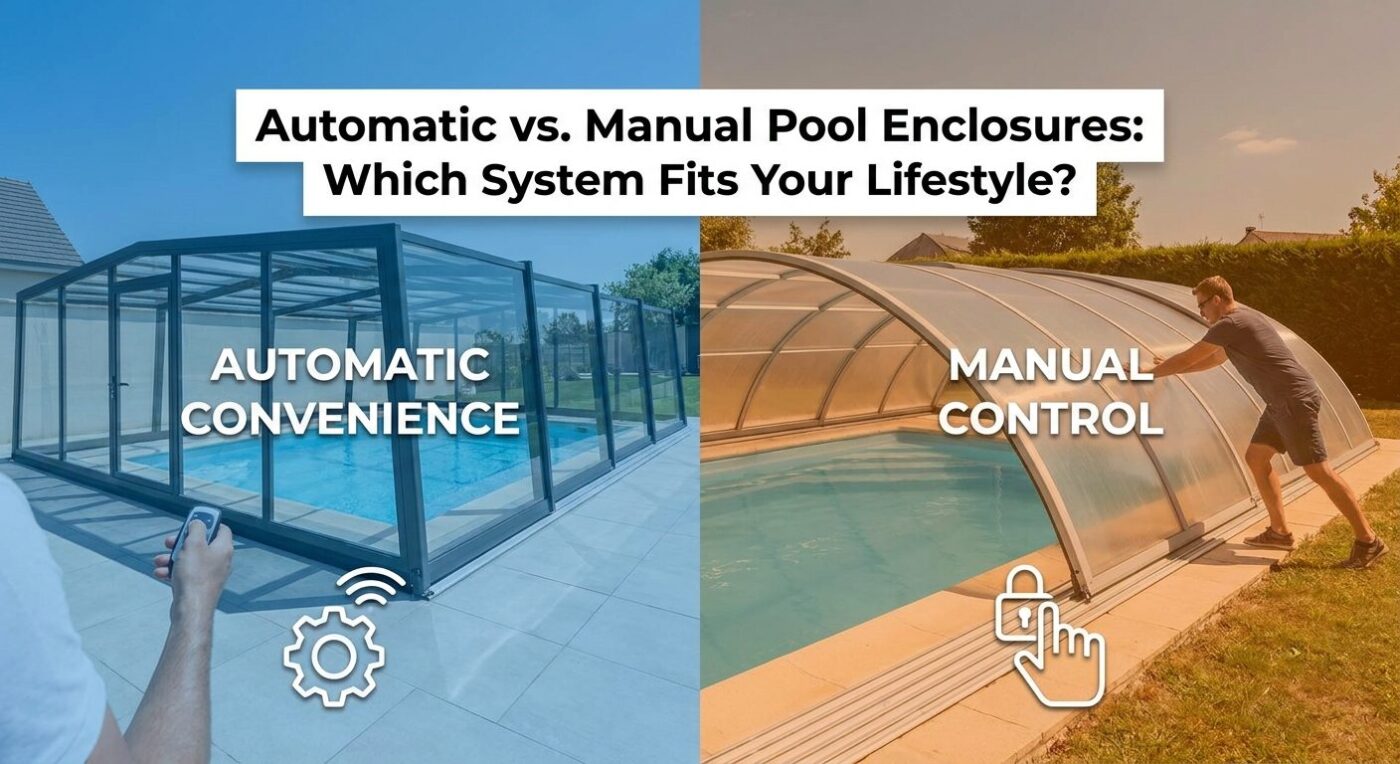
Most people spend a long time deciding on the shape, glazing, and frame colour of a pool enclosure. Very few spend the same time deciding how it actually opens. That oversight matters more than almost anything else on the spec sheet.
The operational mechanism is what you interact with every single day. Get it wrong and a beautifully engineered structure becomes something you leave closed rather than bother with on a Tuesday evening after work.
Why the Opening Mechanism Matters More Than You Think
The choice between manual and automatic operation shapes how often you actually use your enclosure, not just how it looks sitting at the end of the garden. An enclosure you open enthusiastically in July but rarely touch in October is failing at its core job, which is to extend your swimming season across every month of the year.
Research into habitual behaviour around home amenities consistently shows that friction kills frequency. A system that requires physical effort to open or close is statistically less likely to be used every session. That matters because the entire investment rationale for a pool enclosure rests on year-round swimming. If the mechanism discourages daily or near-daily use, the heat retention benefit, the water chemistry consistency, and the extended season you paid for all begin to erode.

Manual systems use a sliding or folding track mechanism operated by hand. On a well-designed low-profile or telescopic enclosure, one or two people can move panels in around three to five minutes, which sounds manageable until it is raining, you have wet hands, or you are trying to close up at ten o’clock at night. Fully telescopic designs make this somewhat easier by stacking sections cleanly, but the physical effort remains.
Automatic systems use an electric motor, a hydraulic actuator, or smart-home integration to move the same panels at the press of a button or on a programmed timer. The physical effort drops to near zero, which changes the psychological relationship with the enclosure entirely.
The operational gap between the two types directly affects heat retention, water chemistry maintenance intervals, and security outcomes. A manual enclosure left partly open overnight because closing it felt like a chore loses heat, allows evaporation that disrupts chemical balance, and provides less of a security barrier than a fully closed system. This is a functional decision, not just a convenience preference, and it deserves the same analysis you would apply to choosing between a heat pump and a gas boiler.
The Real Costs: Purchase Price, Installation, and the Long Game
The headline price difference between manual and automatic enclosures is real, but it is only part of the financial picture. Running costs, servicing, and energy savings all feed into the total, and the calculation looks quite different over a ten-year horizon than it does at the point of purchase.
Upfront costs and what drives them
Manual enclosures carry a lower upfront cost and simpler installation, making them accessible for homeowners who want weather protection without a premium outlay. There are no motors to wire, no control boards to configure, and no hydraulic systems to pressurise. The structure goes up, the panels slide, and the job is done.
Once you move into motorised territory, costs rise in distinct steps. Market analysis for automatic pool cover systems puts entry-level semi-automatic and snap-on systems at roughly $3,500 to $8,000 installed, standard electric track systems for a typical residential pool at $8,000 to $18,000, and premium hydraulic or retractable slat systems for large residential or commercial pools at $20,000 and above. Converting those figures to sterling at approximate current rates, you are looking at roughly £2,800 to £6,500 for entry-level, £6,500 to £14,500 for mid-range electric track, and £16,000 upwards for hydraulic premium systems.
In UK aluminium enclosure terms, the motorisation component adds cost at the specification stage, but it also delivers a measurable return through reduced heat pump running hours. A properly sealed enclosure used consistently can cut pool heating costs by up to 50 percent compared to an uncovered pool. The key word there is consistently. That saving depends on the enclosure actually being closed when the pool is not in use, which brings the behavioural argument back into the cost calculation.
Ongoing servicing and failure points
Automatic systems have more components that can require servicing over their lifetime. Motors, control boards, track sensors, and hydraulic seals all have finite service lives. A motor failure on the morning you want to open for a swim is a genuine inconvenience, and an out-of-warranty control board replacement can run into several hundred pounds. A well-maintained manual track, by contrast, has very few failure points. The wheels, bearings, and seals on a quality aluminium track are the primary wear items, and they are inexpensive to replace.
That said, the servicing picture is not uniformly negative for automatic systems. Quality matters enormously here. Premium automatic enclosures carry CE marking and TUV certification, and warranty periods of five to ten years are standard for high-quality covers of this type, covering both the structural elements and the motorised components. Simpler manual systems often carry shorter warranties, though their replacement part costs are also lower when something does eventually wear out.
The retrofit trap
One cost factor that homeowners frequently underestimate is the expense of adding motorisation after the fact. Retrofit complexity is a genuine financial risk. Adding electric motor systems to an existing freeform or bespoke pool enclosure requires track modifications, cable routing, control panel installation, and in some cases structural adjustment to accommodate the additional load and movement path of the drive system. The enclosure technology involved in a purpose-built automatic system is designed from the ground up to accommodate these elements cleanly. Bolting them onto a structure that was not designed for them costs significantly more and rarely achieves the same result.
The practical implication is straightforward. If there is any reasonable chance you will want automation in the future, specify it at design stage. The cost difference between including motorisation in the original build and retrofitting it three years later is substantial enough that many owners who chose manual at the outset regret not stretching the budget initially.
For homeowners weighing the overall heating and efficiency picture alongside their enclosure choice, it is worth reading about heating your enclosed pool in parallel with this decision, since the enclosure mechanism directly influences which heating system delivers the best return.
Daily Life With Each System: Convenience, Safety, and Who Is Actually Using the Pool
Abstract convenience arguments only go so far. What actually matters is how the two systems behave across a typical week in a real household, with different people using the pool at different times for different reasons.
The daily friction question
Fully automatic enclosures operate at the touch of a button or via smart controls, removing the friction that causes manual systems to be left open or partly closed. For a household where the pool is used most days, that frictionless operation changes everything. The enclosure gets opened properly before a swim and closed properly afterwards, every time, without negotiation or effort.
Manual systems impose a small but recurring time cost and physical demand. Three to five minutes to open, three to five minutes to close. Over a week of daily swimming that is close to an hour of panel-sliding, which feels very different in December than it does in June. For users who swim infrequently or seasonally, this is genuinely not a significant burden, and the simplicity of a manual system with no electronic dependencies has real appeal. There is no motor to fail, no control board to update, and no smart-home integration to troubleshoot.
Safety implications for families
For households with children or pets, the safety case for automation is strong and worth taking seriously as a primary decision factor rather than a secondary one. An automatic system can be locked closed remotely or put on a schedule, preventing unauthorised access to the pool without requiring anyone to physically check that the enclosure is secured. A manual enclosure depends on a person completing the closure every single time, which in practice means it occasionally does not happen, particularly when children are involved in the opening and closing routine.
The ability to lock an automatic system from inside the house via a smart-home app, or to set it to close automatically at a fixed evening time, provides a layer of passive safety that manual operation simply cannot replicate.
Who struggles with manual systems
Older swimmers, those with limited mobility, or homeowners who entertain frequently will find manual systems a recurring inconvenience that gradually erodes the pleasure of pool ownership. The accessible-luxury positioning that a pool enclosure is designed to deliver starts to feel hollow if opening the thing requires strength, coordination, or a second person every time.
Automatic systems can integrate with wider smart home platforms. The enclosure can be set to open at a programmed time before a regular morning swim and close automatically at dusk, without any human input beyond the initial configuration. For someone who swims at six-thirty every weekday morning, that kind of automation means the pool is ready and waiting rather than requiring a cold, slightly effortful setup ritual before you have even had coffee.
Ventilation and interior comfort
Ventilation is a relevant daily-use factor that does not always feature prominently in the manual versus automatic discussion. Both system types can include integrated ventilation panels that allow air circulation when the enclosure is closed, preventing the condensation and stuffiness that would otherwise make the interior uncomfortable on warm days. Automatic systems go further by allowing ventilation adjustments to be automated in response to temperature or humidity conditions inside the enclosure, maintaining comfortable conditions without manual intervention. On a hot August afternoon, an automatically ventilated enclosure stays pleasant to swim in. A manual system in the same conditions requires someone to notice the problem and physically adjust the panels.
Reliability, Maintenance, and What Happens When Things Go Wrong
The reliability question is where the two systems diverge most clearly in practice. A manual enclosure is, structurally, a series of aluminium sections running on tracks. The maintenance list is short: clean the tracks periodically to prevent grit build-up, lubricate the rollers with a silicone-based product two or three times a year, and inspect the seals after winter. All of this an owner can do in under an hour with no specialist knowledge. There is very little that can fail in a way that requires a callout.
Automatic systems introduce motors, control electronics, and in some cases hydraulic components. Each adds a failure point that a homeowner cannot diagnose or fix without professional help. A motor fault in January does not just mean inconvenience; it can mean the enclosure is stuck closed and inaccessible, or worse, stuck partially open during a cold snap, leaving the pool exposed and heating costs spiking. Before signing any contract, ask the supplier what their average callout response time is and whether replacement motors and control boards are held in UK stock. A six-week wait for a part shipped from Europe is not acceptable when your pool heating is running continuously through February.

The pool environment itself is the silent aggressor here. Chlorine vapour, persistent high humidity, and the repeated thermal cycling between a heated enclosure interior and a cold UK exterior accelerate corrosion on any electrical component that is not specified correctly. This is not a theoretical concern. Contacts corrode, motor brushes degrade faster, and control boards fail prematurely when components are rated for domestic interiors rather than pool-side conditions. Any automatic system you consider must use IP-rated, marine-grade components throughout. If a supplier cannot confirm the IP rating of their motor housings and control electronics, treat that as a red flag.
For the structural framing itself, aluminium is the correct answer for both manual and automatic enclosures, and it is worth understanding why. Aluminium does not rust, does not require repainting, and holds its structural integrity under the snow and wind loads that a UK installation will see across a 10 to 20 year lifespan. Timber alternatives look attractive in a brochure but absorb moisture, swell, and eventually rot in a poolside environment. Steel is stronger but corrodes without consistent protective treatment. Aluminium removes both problems, which is why it is the material of choice across the industry for frames that need to last. You can read more about the specific engineering choices behind quality enclosure construction on the enclosure technology page.
The after-sales relationship matters far more with an automatic system than a manual one. A manual enclosure owner interacts with their supplier mainly at installation and perhaps at a five-year service check. An automatic system owner may need that relationship three or four times across the product’s life. Before committing, ask specifically about motor service intervals (typically every three to five years for a quality system), parts availability in the UK, and whether the company offers a service contract. Warranties of five to ten years are common on premium systems, but a warranty is only as good as the company’s ability to honour it quickly.
Matching the System to Your Situation: A Practical Decision Framework
The honest answer to which system suits you is not about which one is better in the abstract. It is about how often your pool gets used, who uses it, and what friction you are willing to tolerate in the daily routine.
If you swim three or more times per week, have children who use the pool independently, or have a household member with mobility considerations that make a push-and-slide mechanism physically demanding, the premium for automation is likely to pay for itself. Higher frequency of use means more occasions where the one-touch convenience of a motorised system removes a small but real barrier. It also means the pool is open more often, which compounds the heat-retention benefit and reduces your overall running costs. Market analysis of pool cover systems consistently shows that automated systems drive higher actual pool usage, which is the clearest indicator of return on investment for a leisure asset.
If you use the pool seasonally, are comfortable with a brief manual setup routine, or are working within a budget where the cost difference between manual and automatic represents a meaningful constraint, a well-engineered manual enclosure is not a compromise. It delivers the same weather protection, the same thermal retention, and the same extension of your swimming season. The operational experience is simply different, not inferior. Many owners who swim on weekends and through summer find the manual routine unremarkable after the first few weeks.
New-build pool projects have one clear piece of advice: specify the automation level at design stage. Retrofitting a motorised system to a finished enclosure is rarely straightforward. The track geometry, counterbalancing, and cable routing for a motorised system differ from a manual installation, and the cost of reworking a completed structure can approach the original system price. If there is any chance you will want automation in the future, build that possibility in from the start, even if you commission the manual version initially and upgrade later.
For commercial operators, hotels, and hospitality venues, the calculation is more straightforward. The frequency of use by multiple guests across a single day means a manual system creates operational bottlenecks. Staff time spent opening and closing the enclosure is a real cost. More importantly, the expectation of a seamless, premium experience that guests at a hotel pool or spa have is simply not compatible with asking them to manually slide heavy sections. Automatic operation is the baseline specification for any commercial installation, and the duty-of-care obligations around pool access make reliable, controllable enclosure operation a practical necessity rather than a luxury.
The single most useful step you can take before making a final decision is to experience both system types in person. Specification sheets list motor torque ratings and IP classifications, but they do not tell you how a section feels as it moves, how the locking mechanism engages, or whether the operational sequence fits naturally into the rhythm of your household. Visit a showroom or, better still, ask your supplier for a reference installation you can see working in a real domestic or commercial setting. The physical experience of opening and closing each type of enclosure will clarify the lifestyle fit in five minutes more effectively than any amount of reading. That clarity is worth the trip.
