
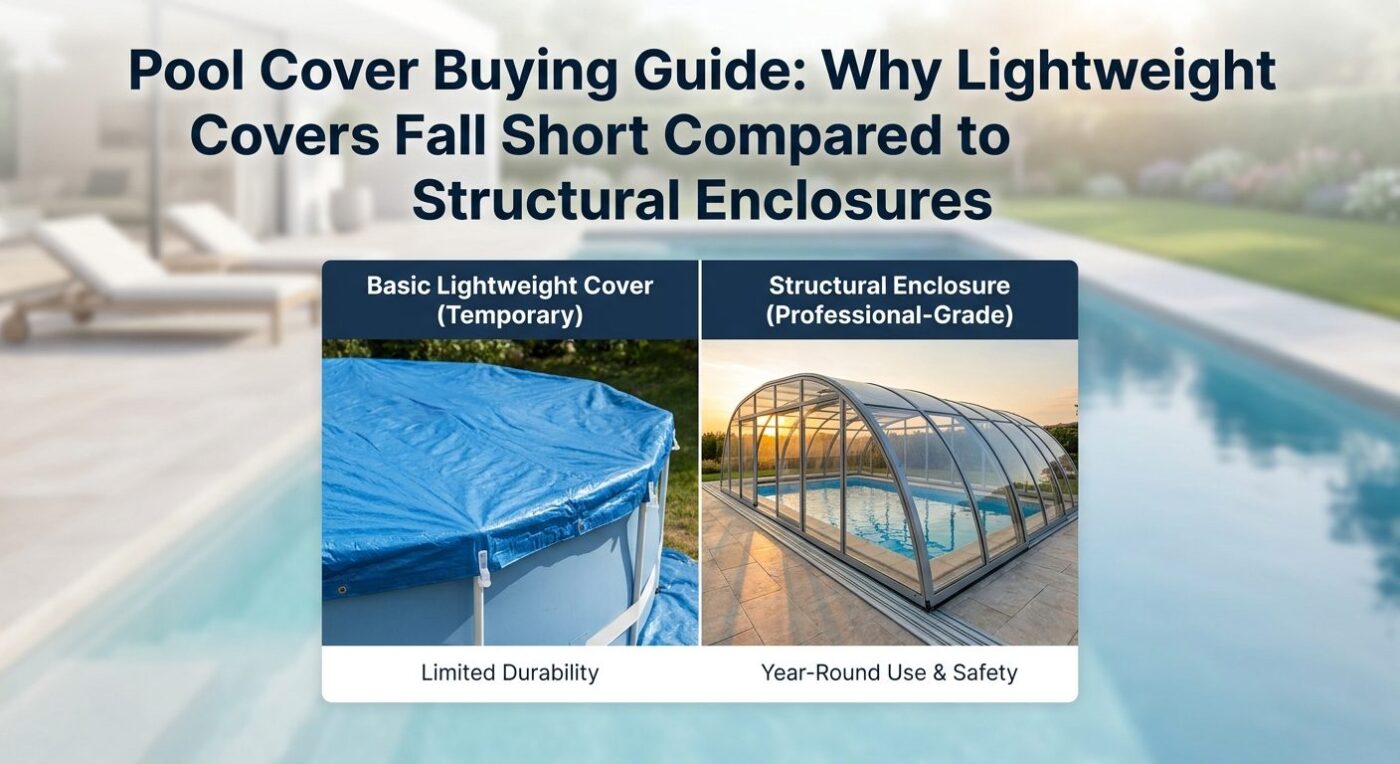
A basic pool cover is cheap, easy to find, and feels like a sensible first step. The problem is that most lightweight options last between one and three seasons before the material degrades, and they do very little to extend your swimming season or reduce heating costs in a meaningful way. If you have invested in a pool, the cover protecting it deserves the same level of scrutiny as every other decision you made.
This guide cuts through the marketing around standard pool covers and explains, practically, where they fall down and what a structural enclosure does differently.
What Lightweight Pool Covers Actually Do
Standard tarpaulin-style covers serve a narrow purpose: keeping large debris out of the water when the pool is not in use. They are held down with water bags or weights around the perimeter, and they do reduce evaporation to some degree. That is roughly where their usefulness ends.
The material used in most budget covers is a woven polyethylene mesh or a tarp-like fabric. Neither provides meaningful thermal insulation. On a cold October night, your pool is still losing heat through the cover, and your heating system is still working to compensate. The cost saving on energy bills turns out to be far smaller than the packaging suggests.
There is also a safety issue that rarely gets addressed honestly. Standard covers hold very little weight. An animal or a child stepping onto one will go straight through into the water. This is not a minor caveat; it is a serious hazard in any household with children or pets nearby.

The Durability Problem
Most pool cover manufacturers are quiet about lifespan. Independent assessments consistently put standard covers at one to three seasons before the material becomes brittle, tears at the anchor points, or starts to let water and debris through. UV exposure accelerates degradation significantly, and the UK’s mix of intense summer sun and heavy winter frost is particularly unforgiving.
When you factor in replacement costs every two or three years, a budget cover is not as economical as it first appears. Two or three replacement covers over a decade, plus the labour and time involved each time, starts to add up considerably. The true cost of pool ownership rarely accounts for this recurring spend at the point of purchase.
Even higher-specification solid covers with mesh panels or solar bubble designs face the same fundamental constraint: they are flat, unstructured, and exposed to the full force of whatever the weather delivers. A particularly heavy snowfall or a sustained storm can buckle, stretch, or displace them entirely.
The Season Extension Myth
Marketing for pool covers frequently claims they will extend your swimming season. What that usually means in practice is that your water cools down slightly more slowly at the end of August. It does not mean you will be swimming comfortably in November or March.
A cover sitting on the water surface cannot create a warmer ambient environment around the pool. You are still stepping out onto cold poolside tiles in cold air, and the moment you lift the cover, the heat that was retained dissipates rapidly. This is not a technicality; it is the core limitation of any flat, unstructured product.
True season extension requires enclosing the air around the pool, not just placing a layer over the water. That is a fundamentally different engineering challenge, and it is one that flat covers simply cannot address regardless of their quality or price point.
What a Structural Enclosure Changes
An aluminium-framed pool enclosure surrounds the entire pool area, sides and roof, creating an enclosed microclimate that retains heat, blocks wind, and keeps the space usable through months that would otherwise be written off. The difference is not incremental; it is a completely different category of solution.
Polycarbonate glazing, which is standard in quality enclosures, provides strong thermal performance without the weight penalty of glass. It allows solar gain during daylight hours, which contributes meaningfully to water and air temperature, while the enclosed structure holds that warmth in after dark. Many pool owners in the UK find they can swim comfortably from March through to November, and some use their enclosed pools year-round.
The structural integrity is another dimension entirely. A properly engineered aluminium enclosure is designed to handle UK wind loads and snow loadings without deformation or displacement. There is no equivalent concern to the water-bag situation; the structure is fixed, anchored, and rated for real weather conditions. For a deeper look at how framing and glazing choices affect long-term performance, the guide to pool enclosure glazing materials covers the specifics in detail.
Maintenance: Where the Comparison Gets Stark
A standard pool cover reduces debris ingress but does not eliminate it. Dust, pollen, and fine particles still enter the water. The cover itself accumulates algae and dirt on its upper surface, which then transfers to the pool edges or into the water when you handle it. Removing and replacing it every time you want to swim is also a genuine physical task, particularly with larger pools.
An enclosure substantially reduces all of these maintenance demands. Wind-blown debris does not reach the water. UV exposure to the pool surface is filtered rather than direct, which slows algae growth and extends the life of the pool shell and interior finishes. Chemical usage typically drops because the water is not subject to the same environmental stresses as a fully exposed outdoor pool.
Retractable and telescopic enclosure designs give you the flexibility to open the structure fully on warm days, so you are not choosing between protection and the open-air experience. Models like the fully telescopic range allow sections to slide back completely, combining the benefits of an enclosed pool with the feel of an outdoor one when conditions allow.
The Aesthetics Argument
One reason buyers default to covers is appearance: a pool cover is invisible when the pool is in use, and the pool garden looks unchanged. An enclosure, by contrast, is a permanent architectural presence. This is a legitimate consideration, and it deserves a direct response.
Modern low-profile enclosures are designed precisely with this concern in mind. A well-specified aluminium enclosure sits close to the water line, does not dominate the garden, and can be finished in powder-coated colours that complement the surrounding architecture. The structure also adds to the visual interest of a garden rather than simply occupying it; a well-lit enclosure in the evening creates an attractive focal point rather than an industrial intrusion.
The comparison point should not be between a cover (invisible) and an enclosure (present). It should be between a cover (functional compromise) and an enclosure (functional upgrade with considered design). When framed that way, the visual trade-off looks quite different.
Who Should Consider Making the Switch
A lightweight cover is adequate if your pool is genuinely seasonal, you live in a warm climate, and keeping the water clean during winter closure is the only goal. For UK pool owners, that scenario is rare.
An aluminium enclosure makes practical sense for anyone who:
- Wants to swim for more than four or five months of the year
- Has children or pets using the pool area
- Is spending significantly on pool heating and wants to reduce those costs
- Is tired of the physical effort and mess involved with seasonal covers
- Has invested in a high-quality pool and wants the protection to match
The upfront cost of an enclosure is higher than a cover. That comparison is only meaningful if you ignore everything that happens after the first season: the replaced covers, the heating bills, the shortened swimming season, and the continued exposure of the pool to UK weather. Over a five to ten year horizon, the economics shift considerably in favour of the structural solution.
The Bottom Line on Pool Covers
A pool cover does one thing reasonably well: it keeps large debris out of a closed pool. Beyond that, the promises around insulation, season extension, and protection are routinely overstated. The materials degrade, the designs are inherently limited by being flat and unstructured, and the safety risks are serious enough that they should feature far more prominently in any honest buying guide.
A structural aluminium enclosure is not just a better cover. It is a different product solving a different and more complete set of problems. If your pool exists to be used and enjoyed rather than merely maintained, that distinction is worth taking seriously.
