
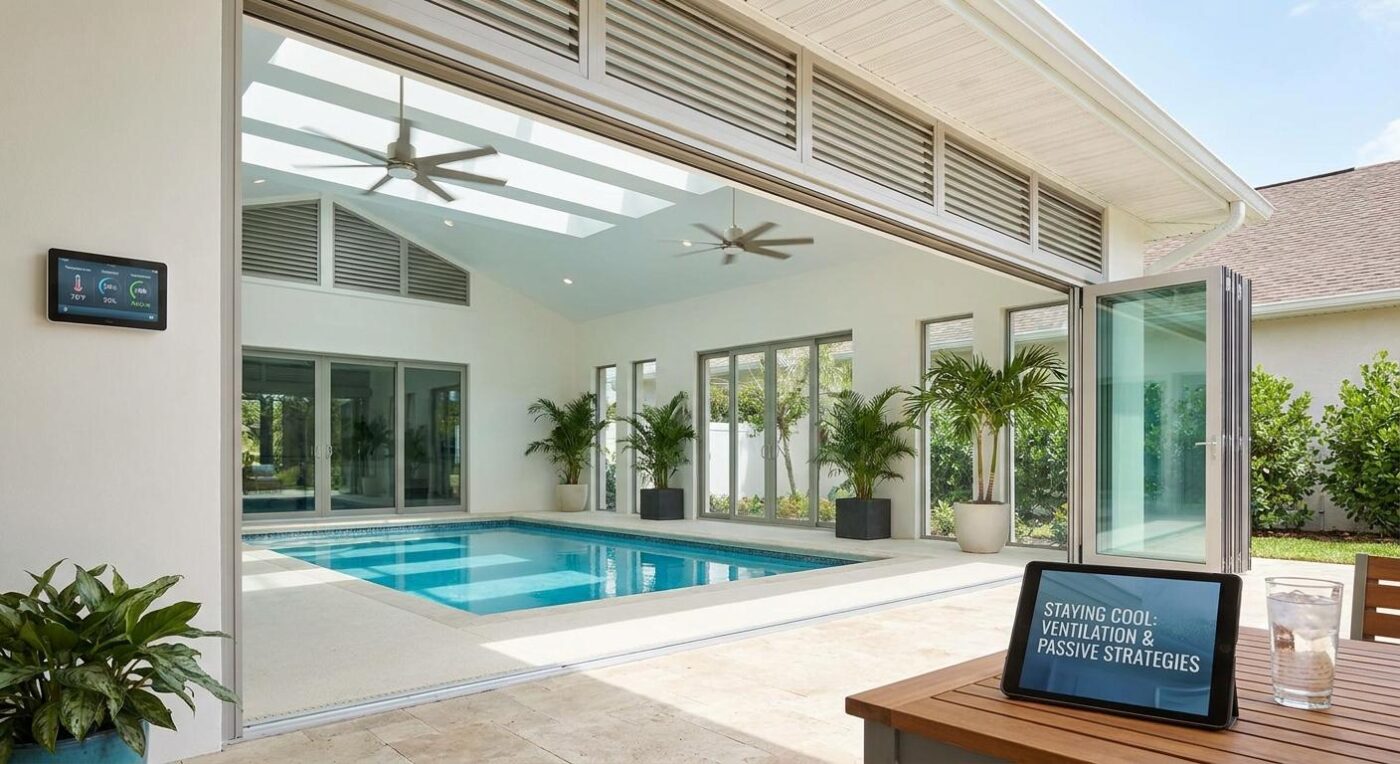
A pool enclosure that feels like a warm, sheltered retreat in March can turn into something closer to a steam room by mid-July. Most owners experience this shift the first summer after installation and assume something has gone wrong. Nothing has. The physics are working exactly as designed, just in the wrong direction for the season.
Understanding why it happens, and what specifically to do about it, starts with separating two problems that often get lumped together: heat and humidity. They share a space but they have different causes, different consequences, and different solutions. Treating them as one thing is where most owners waste money.
Why Pool Enclosures Get Hot and Why That Surprises Most Owners
A glazed aluminium enclosure behaves like a greenhouse. Short-wave solar radiation passes through the glazing relatively easily, is absorbed by the pool water, the surrounding paving, and the structure itself, and then re-radiates as long-wave infrared heat. That longer wavelength cannot escape back through the glass as easily as it came in. The result is a steady accumulation of heat inside the structure even when the outdoor temperature feels perfectly comfortable.
On a typical UK summer day where the outdoor air temperature sits between 22 and 25 degrees Celsius, an unventilated enclosure can reach internal temperatures of 35 to 40 degrees Celsius. That gap of 12 to 15 degrees above ambient is not a fault or a design flaw. It is the direct result of the same insulating properties that make the enclosure so effective at keeping you warm in February. Research into glazed pool enclosures confirms that heat accumulation inside these structures consistently exceeds comfortable environmental quality standards when no ventilation or shading strategy is in place.

Water evaporation from the pool surface adds another layer to the problem. The pool is constantly releasing water vapour into the enclosed air, and that evaporation process carries latent heat with it. This means the thermal load inside an enclosed pool space is not just solar gain from the glazing. It is a combination of solar heat and moisture-driven heat that makes the environment feel considerably heavier and more oppressive than a dry conservatory of the same size would at the same temperature.
Most owners install an enclosure thinking primarily about winter: protection from rain and wind, an extended swimming season, and a comfortable temperature when the outdoor air would otherwise make the pool unusable. Those expectations are entirely correct. What catches people off guard is that the same insulating properties which trap warmth in October also trap heat in July and August, when the sun angle is high, daylight hours are long, and solar intensity is at its peak.
The reassuring part is that the physics working against you in summer are forces you can redirect rather than overcome. Expensive full air conditioning is rarely the first answer, and often not necessary at all. Passive and low-energy strategies, applied correctly and consistently, can make a pool enclosure genuinely comfortable throughout the hottest weeks of the UK summer. The starting point is understanding the two problems properly rather than reaching for a single expensive fix that addresses only one of them.
The Humidity Problem Is Separate from the Heat Problem
Step inside an enclosed pool space on a warm day and you will notice that the discomfort does not feel exactly like being in a hot room. There is a weight to it, a closeness. That sensation is moisture. The enclosed air sits directly above a large body of water, and following basic physical laws around evaporation, the relative humidity inside that space can comfortably exceed 80 percent. At elevated temperatures, that figure can push higher still.
The reason high humidity feels so much worse than dry heat at the same temperature comes down to how the body cools itself. Sweat evaporates from the skin, and that evaporation removes heat. When the surrounding air is already saturated with moisture, sweat cannot evaporate efficiently. The body’s primary cooling mechanism stops working properly, and the perceived temperature rises well above what a thermometer would show. A reading of 30 degrees Celsius in dry air is uncomfortable but manageable. The same temperature at 85 percent relative humidity feels physically oppressive to most people and carries genuine health implications for sustained activity like swimming. The hydration demands of swimming in a humid enclosed pool space are worth taking seriously, as explored in this guide to year-round pool hydration.
Humidity also damages the structure and its surroundings in ways that heat alone does not. When warm, moisture-laden air contacts a cooler surface such as the glazing panels, aluminium frames, or any timber furniture near the pool, it deposits that moisture as condensation. Left unmanaged, that persistent dampness accelerates mould growth on soft furnishings and seals, causes corrosion on metal components, and degrades the appearance of the enclosure over time. This is not a cosmetic issue. It is a structural and maintenance issue with real long-term cost implications.
As Compass Pools notes, all indoor pools require some form of environmental control, whether described as dehumidification, air handling, or ventilation management, specifically to prevent condensation and mould forming. The laws of physics make this non-negotiable. Enclosed air with a large water source nearby will always have a high relative humidity unless something is actively moving that moisture out of the space.
The conceptual mistake most pool owners make is treating heat and humidity as a single problem. Air conditioning systems, for example, do reduce temperature. They can also provide some dehumidification as a side effect. But running an air conditioning system primarily to manage moisture load is expensive, energy-intensive, and often insufficient on its own. Conversely, opening the enclosure purely to cool the air may help with temperature but can actually introduce more humid outdoor air on certain days, depending on conditions.
Treating them as separate problems that each require their own strategy is the key shift. Heat gain is primarily a solar control and ventilation challenge. Humidity is primarily a moisture extraction and air exchange challenge. The tools that address each overlap somewhat, but they are not the same tools, and applying the wrong one to the wrong problem wastes money and leaves you uncomfortable.
A practical rule of thumb helps here. If the glass panels are fogging up on the inside, particularly on the cooler outer panes, humidity is the dominant problem and the priority should be improving air exchange and moisture extraction. If the space feels intensely hot but the glass is clear, solar heat gain is the main driver and the focus should shift to shading, reflective glazing, or ventilation to flush warm air out before it accumulates.
Retractable and Sliding Panels: Your First and Most Powerful Tool
All the passive cooling strategies available to a pool enclosure owner, retractable or sliding panels are the single most effective intervention. They are also the most immediate. Nothing else you can do to the space will shift heat and humidity as quickly or as completely as physically opening a large section of the enclosure to the outside air.
Telescopic or sliding panel systems allow individual sections of the enclosure to stack neatly at one end of the structure, opening up substantial portions of the enclosure roof or walls to natural airflow. When you do this, you are not just providing a gap for air to enter. You are eliminating the greenhouse effect entirely in that section of the structure. Solar radiation passes through without being trapped, humidity escapes freely, and the air inside is no longer a closed, accumulating system.
The design detail that separates a well-engineered sliding system from a basic retractable cover matters here. Arch Enclosures’ sliding systems are designed so that segments can move in both directions along the track, not simply stack at one fixed end. This means an owner can open sections on the windward side of the enclosure to allow cool incoming air, while simultaneously opening sections on the leeward side to create an exhaust path for the warm, humid air already inside. The result is a deliberate cross-flow of air through the structure rather than a single opening that leaves pockets of still, hot air on the far side of the pool.
On a typical UK summer day with a light breeze, fully opening two or more panels in this cross-flow configuration can drop internal temperatures by 8 to 12 degrees Celsius within 20 to 30 minutes. That range depends on the outdoor wind speed and the size of the openings, but the principle is consistent. Moving air has a cooling effect that still air at any temperature cannot replicate, and cross-flow ventilation moves far more air volume than a single opening of the same total area.
Timing Makes the Difference
The practical morning routine matters as much as the mechanics. On a clear summer day, solar intensity builds steadily from mid-morning through to around 2 or 3 in the afternoon. Opening the enclosure panels on the shaded side of the structure before solar noon allows cool incoming air to circulate through the space without introducing direct solar radiation from the wrong angle. Closing the panels again in the mid-to-late afternoon traps the cooler air that has built up during the ventilation window, keeping the space more comfortable for evening swimming than it would otherwise be.
This morning-open, afternoon-close routine takes around five minutes to execute and costs nothing to run. It is the simplest and most cost-effective cooling strategy available to any pool enclosure owner, and it is only possible because the panels are designed to move quickly and lock securely in position.
Partial Opening Is Often More Effective Than Full Opening
On very hot, still days, fully opening the enclosure can actually introduce more problems than it solves if there is no meaningful breeze to drive airflow. With panels fully retracted and no wind, the pool sits exposed to direct high-intensity sun, water evaporation increases sharply, and the temperature around the pool deck can rise faster than a ventilated closed enclosure would allow.
Partial opening on days like this creates a directed channel of air movement through the structure. Think of it as a nozzle effect. Air moving through a constrained gap travels faster and with more directional force than the same volume of air in open space. Opening two panels on opposite sides while leaving the rest of the structure closed channels ambient air across the pool surface and out the other side, cooling both the air and the water more effectively than full exposure to still hot air would achieve.
Locking mechanisms on retractable enclosures are what make partial opening practical rather than risky. Panels secured at a specific position do not rattle, shift, or drift in variable wind. Owners do not need to be present to manage the enclosure if a breeze picks up. The structure stays in exactly the configuration that was set, providing safe, stable ventilation without requiring constant adjustment or supervision.
Strategic Vent Placement and Door Positioning for Cross Ventilation
Cross ventilation is not complicated, but it does require getting two things right at once: where air comes in and where it goes out. The underlying principle is borrowed directly from passive house architecture. You need an intake opening on the side of the enclosure that faces the prevailing wind, and an exhaust opening on the opposite or perpendicular side. Without both, you get turbulence and stagnation rather than a clean, steady airflow through the space.
In the UK, the prevailing wind direction is south-westerly across most of the country. For a typical east-west oriented pool enclosure, that translates to a specific design decision: position the intake vent or door on the south-west gable end, and the exhaust opening on the north-east gable. This alignment allows the natural wind to do most of the work on breezy summer days, pulling air through the full length of the enclosure without any mechanical assistance.
The height of those openings matters as much as their position. Integrated single or double doors built into the side of the enclosure are the most practical primary ventilation openings, but they should be positioned at mid to high height rather than at ground level. Hot air accumulates at the top of the space and that is where you want to displace it first. A door that only opens at floor level lets cool air pool on the decking while the really uncomfortable heat sits just above head height, which is exactly where you and your family are spending time.

Ridge vents or high-level louvres fitted at the apex of an arched enclosure give you an additional passive tool that works independently of wind: the stack effect. Hot air rises naturally, accumulates at the ridge, and exits through the high-level openings. As it does, it draws cooler air in through the lower side openings. No fan required. On a still, sunny afternoon when there is no breeze to drive cross ventilation, the stack effect can still generate a meaningful air change rate if the high-level vents are adequately sized.
Research on glazed heated swimming pools published in the MDPI Sustainability journal found that targeted natural ventilation strategies measurably reduced internal temperatures and improved environmental quality without adding any cooling energy demand. That is the ideal outcome: better comfort at zero additional running cost.
The specific sizing question is one to raise with your installer at the design stage. A vent area equal to roughly 5 percent of the floor area is a commonly cited minimum for adequate passive air change in glazed pool spaces. For a modest 6 by 4 metre enclosure with a 24 square metre footprint, that means at least 1.2 square metres of combined vent opening. Getting this right early is far simpler than retrofitting larger openings into a finished structure later.
Solar Control Glazing and Shading: Stopping Heat Before It Enters
The most efficient cooling strategy in any glazed structure is prevention rather than cure. Once shortwave solar radiation passes through the panels and is absorbed by the pool water, the decking, and the aluminium frame, it converts to longwave heat. Longwave heat cannot escape back through glass the same way it entered. The result is the greenhouse effect in its literal form, and no amount of ventilation will fully undo what could have been blocked at the boundary.
Solar control coatings on polycarbonate and toughened glass panels address this at source. Good quality solar control glazing can reject 40 to 60 percent of incoming solar energy while still transmitting the majority of visible light. The practical effect is a space that stays bright and open-feeling but does not accumulate the fierce radiant heat that untreated clear glazing allows through on a July afternoon. This is worth specifying at the build stage because retrofitting solar control film to existing panels, while possible, rarely achieves the same performance.
For shading, the key principle is that external shading outperforms internal blinds by a significant margin. An internal blind absorbs or reflects solar radiation after it has already passed through the glazing and entered the thermal envelope. An external canopy, retractable awning, or pergola-style side screen stops the radiation before it makes contact with the panels at all. Even a relatively modest external shade structure on the south and west faces of an enclosure, where the most intense afternoon sun strikes, reduces the peak heat load considerably.
The Climate Change Committee identifies permanent shading structures including canopies as a well-evidenced passive cooling measure. Shade sails and pergola structures carry a cost in the range of £1,900 to £5,500 in 2025 prices, depending on size and specification. That is a modest investment against the alternative of retrofitting a mechanical cooling system, which carries both higher capital costs and ongoing energy bills.
For enclosures with polycarbonate roofing panels, there is a useful low-cost retrofit available during peak summer weeks. A reflective foil membrane applied to the exterior surface of the roof panels reduces solar transmission meaningfully without any structural alteration. It is not a permanent solution and does reduce light transmission, so most owners use it selectively during the hottest weeks rather than year-round. But as a way to test the impact of solar control before committing to upgraded panels, it is a practical starting point.
Orientation is the factor that is easiest to influence at the design stage and hardest to change afterwards. An enclosure aligned so its longest axis runs east to west minimises the surface area of the end gables that faces south-west. The south-west elevation catches the low but intense afternoon sun, which is the single biggest driver of peak heat build-up in a UK pool enclosure during summer. A north-south orientation exposes the full length of the enclosure’s broadest face to that afternoon sun, effectively maximising the problem. If you are still at the planning stage, glazing and orientation decisions are worth discussing in detail with your designer before anything is fixed on site.
Low-Energy Mechanical Assists: Fans, Destratification, and Heat Recovery Ventilation
Passive strategies cover most situations in the UK climate, but they have a specific failure condition: a still, overcast, humid day in late summer. No breeze means no cross ventilation. Overcast conditions mean the stack effect is weaker. The enclosure is warm from days of accumulated heat and the humidity is building. This is when targeted mechanical assists earn their place, not as a replacement for the passive approaches but as a low-energy backup that handles the edge cases.
Ceiling-mounted destratification fans are the first mechanical tool worth understanding. In a typical arched enclosure, there can be a temperature difference of 6 to 10 degrees between the hot air layer trapped at roof level and the air at water surface height. Destratification fans running at low speed push that hot upper layer back down and mix it with cooler mid-level air. In practice, this reduces peak temperature at head height by 3 to 5 degrees in most enclosure geometries, without adding any cooling energy. The fans use very little electricity at low speed, often under 50 watts, and are virtually silent in operation.
One common and costly mistake is reaching for a portable evaporative cooler when the heat becomes uncomfortable. Evaporative coolers work by passing air over a wet medium, which lowers air temperature through evaporation. In a dry living room that is a reasonable approach. In a pool enclosure, where the air is already carrying a significant moisture load from the pool surface, adding more evaporated water pushes the relative humidity higher still. You might feel marginally cooler for ten minutes and then find yourself in a warm, clammy fog. The humidity problem, which runs parallel to but independent of the heat problem, gets dramatically worse. Evaporative coolers have no place in an enclosed pool environment.
Heat Recovery Ventilation units, usually referred to as HRV systems, are a more considered mechanical option for enclosures used heavily year-round. An HRV extracts humid stale air mechanically and passes it through a heat exchanger. In winter, that process recovers warmth from the outgoing air and uses it to pre-heat the incoming fresh air, which is highly efficient. In summer, most systems can be switched to a bypass or reversal mode that simply flushes hot humid air out and draws in cooler outdoor air without the heat exchange step. The result is effective ventilation at relatively low energy cost across both seasons.

Recotherm, a specialist pool ventilation supplier with over 40 years of experience in the field, uses fully variable fan systems that adjust dynamically based on actual pool hall conditions at any given moment. Rather than running at a fixed output regardless of whether conditions require it, the system modulates its output continuously, using only the energy needed for the current state of the space. That principle demonstrates clearly that mechanical ventilation does not have to mean high running costs. The energy cost tracks the actual ventilation demand, which in a well-designed enclosure with good passive measures in place is relatively modest for most of the year.
For smaller residential enclosures where a full HRV installation is not warranted, there is a practical low-budget mechanical option that is often underestimated. Two box fans, one positioned in the intake opening and one in the exhaust opening on the opposite side of the enclosure, can generate sufficient air change rates in small to medium spaces at a running cost of a few pence per hour. The key is treating them as a proper system rather than just placing one fan pointing inward. Intake fan on the south-west side, exhaust fan on the north-east side, both running simultaneously. That mimics the cross ventilation principle with mechanical force on days when natural wind cannot do the job. A pair of quality 50-watt box fans running together costs roughly 1 to 2 pence per hour at typical UK electricity rates, making them one of the most cost-effective ventilation tools available at any level of investment.
The mistake to avoid with any mechanical ventilation is running it intermittently rather than continuously during warm humid periods. A fan that runs for 20 minutes and then stops allows humidity to rebuild to its previous level. Consistent low-level airflow is more effective than bursts of high airflow followed by long periods of stagnation. If the goal is to prevent condensation on frames and to keep the air genuinely comfortable, steady and gentle beats occasional and forceful every time.
