
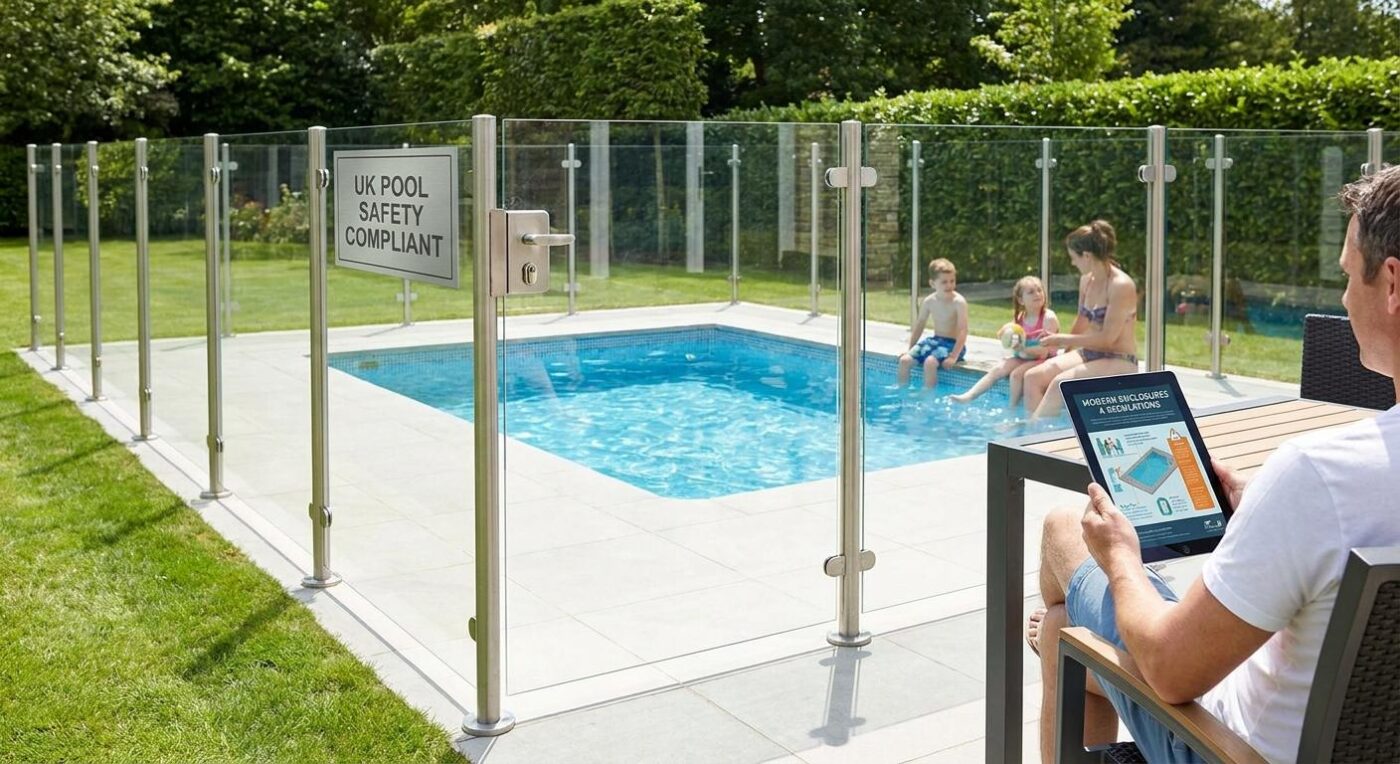
Many UK homeowners install a fence around their pool and consider the safety question closed. The reality is more nuanced, and the good news is that it works in favour of enclosures. Understanding what the rules actually require, rather than what people assume they require, often reveals that a quality pool enclosure does far more for compliance than a simple boundary fence ever could.
The State of UK Pool Safety Law
Unlike France or Australia, the UK does not currently have statutory obligations specifically governing domestic pool safety. There is no single piece of legislation that mandates fencing heights or cover specifications for residential pools in England, Scotland, Wales, or Northern Ireland. What exists instead is a framework of guidance, best practice, and Building Regulations that apply to specific elements of any pool installation.
Building Regulations approval is required for structural work, drainage systems, electrical installations, and indoor ventilation. Those rules apply regardless of whether your pool is inside or outside. Beyond that, the responsibility for preventing unauthorised access, particularly by young children, falls on the pool owner, guided by industry standards and common law duty of care.
This is where the misconceptions start. Some owners assume that because there is no rigid national pool fencing law, they can skip protective measures entirely. Others believe a fence alone satisfies every possible obligation. Neither position is correct, and both can have serious consequences.
What Good Safety Practice Actually Looks Like
Even without a statutory mandate, the guidance that pool professionals follow is consistent. Any fence around a pool should be at least 1.2 metres (roughly 4 feet) high, with no gaps wide enough for a child to squeeze through. Gates should be self-closing and self-latching, opening away from the pool rather than towards it. Safety signage should be visible in the pool area at all times.

For pool covers, the French standard NF P90-308 is widely referenced in the UK industry. Under that standard, a cover classified as a safety cover must support a load of 100kg, preventing a child from falling through the surface. A basic bubble or solar cover does not meet this threshold. The cover or shelter must also be capable of being locked when adults are not present.
These are not obscure technical requirements. They represent practical minimum expectations that any responsible pool owner should meet, regardless of what the law formally demands today.
How Enclosures Address These Requirements
A well-designed pool enclosure satisfies several of these safety concerns at once, often more effectively than standalone fencing. The structure physically prevents children and animals from accessing the pool without adult supervision. When locked, it functions as both a barrier and a cover, combining two separate safety measures into a single system.
For commercial operators, including hotel pools, leisure centres, and holiday parks, the stakes are higher still. Health and safety legislation, employer liability, and duty of care to guests create a more formal compliance environment. A robust enclosure with lockable access points gives operators a documented, auditable safety measure that a basic fence simply cannot match.
Enclosures also address the practical gap in standard fencing: seasonal use. A fence protects the pool but does nothing to prevent water contamination, debris accumulation, or the general deterioration that comes from leaving a pool exposed through a UK winter. An enclosure protects the water quality as well as restricting access, reducing chemical costs and maintenance time across the year.
Planning Permission: The Detail That Catches People Out
The planning question is one of the most frequently misunderstood aspects of pool enclosure ownership. The answer depends heavily on the specific design, size, and location of the structure. A low-profile retractable enclosure that sits close to the ground will typically fall within Permitted Development rights in England, meaning no formal planning application is needed. A tall, permanent structure with a substantial footprint is far more likely to require permission.
It is also worth knowing that Building Regulations do not generally apply to pool enclosures classified as temporary structures. However, this classification is not automatic. Local authorities interpret these rules differently, and what one council permits without question, another may scrutinise closely. Installing a structure that costs upwards of £30,000 without verifying the local position first is a risk no one should take.
The safest approach is to confirm the planning status of your intended enclosure with your local planning authority before committing to a design. A reputable enclosure manufacturer will have navigated these questions many times and can advise on which configurations are most likely to benefit from Permitted Development rights in your area.
Choosing a Design That Does Both Jobs
The most useful shift in thinking is to stop treating safety compliance and pool usability as separate problems. An enclosure solves both simultaneously. It extends your swimming season into autumn and early spring, shields the water from wind and rain, maintains water temperature, and restricts unauthorised access. These are not competing priorities.
When evaluating enclosure options, the features that matter most for compliance are straightforward:
- Lockable entry points that cannot be bypassed by children
- Structural integrity sufficient to prevent collapse or forced entry
- A design that prevents falls into the water when the pool is unattended
- Materials that meet the durability demands of a UK outdoor environment
High-quality aluminium framing satisfies the structural requirements while remaining light enough for retractable systems. The corrosion resistance of marine-grade aluminium means the structure maintains its integrity through years of exposure to rain, humidity, and pool chemicals without degrading in ways that could compromise safety.
The Practical Takeaway
UK pool safety regulation is less prescriptive than in some countries, but that does not mean the obligations are vague. Duty of care, Building Regulations, and widely accepted industry standards create a clear expectation: pool access must be controlled, especially when children are nearby. Meeting that expectation with a quality enclosure is not a compromise or an expensive extra. It is simply the most complete answer to the safety question that domestic and commercial pool owners face.
The owners who run into trouble are rarely those who chose enclosures. They are the ones who assumed a token fence or an unrated cover would be enough, and discovered later that it was not.
