

An unenclosed outdoor pool in the UK is essentially a heat sink. Studies consistently show that evaporation from the water surface accounts for roughly 70% of total heat loss, meaning a gas boiler or heat pump is spending most of its energy replacing water that simply dries into the air. On a breezy October evening, that loss accelerates further, and even a well-specified heating system struggles to keep pace.
That is the problem a pool enclosure solves before any heating equipment is even specified. Understanding precisely how it solves it is what determines whether you end up with a comfortable year-round pool or an expensive one that is still cold in March.
Why an Enclosure Changes Everything About Pool Heating
The moment you place an aluminium and polycarbonate or glass enclosure over a pool, you create a secondary thermal envelope around the water. Wind-driven evaporation, which is the dominant heat-loss mechanism for any open body of water, drops to near zero. The air layer immediately above the pool surface becomes warm and humid rather than constantly stripped away and replaced with cold, dry outdoor air.
This has an immediate and measurable consequence. The ambient air temperature inside a well-sealed enclosure on a mild spring day will typically run 6 to 10 degrees Celsius warmer than outside, simply from passive solar gain through the glazing and from the pool water radiating heat into a contained space. That buffering effect is what allows UK pool owners with enclosures to report comfortable swimming from April through to October without any supplementary heating running at all.

Add a heat pump to that enclosed environment and the picture changes again. The enclosure is no longer just extending a season, it is enabling genuine year-round use. Because the air inside is already warmer than outside, an air-source heat pump operating within or adjacent to the enclosure draws on a higher starting temperature, which directly improves its efficiency across the colder months when it would otherwise be working hardest.
What the enclosure fundamentally does is redefine the heating problem itself. Without one, you are conditioning water exposed to open sky, wind, and rainfall, a losing battle in any UK winter. With one, you are heating a semi-controlled internal environment where your heating equipment only needs to top up what solar gain, retained humidity, and thermal mass have already contributed. That distinction is not just philosophical: it directly determines what size of heat pump you need and which configuration of equipment makes sense for your installation.
Specifically, it changes the calculation on whether an air-to-water unit alone will suffice or whether managing the air temperature and humidity inside the enclosure requires a second system working alongside it. Getting that choice right is where the real efficiency gains are made, and where the most common specification mistakes happen.
Air-to-Water vs Air-to-Air: Two Very Different Jobs Inside an Enclosure
These two technologies are often discussed as though they are competing options for the same problem. Inside an enclosed pool, they are not. They serve distinct functions, and conflating them when specifying equipment is one of the most common and costly mistakes installers make on domestic pool projects.
Air-to-Water: Heating the Pool Itself
An air-to-water heat pump extracts thermal energy from outdoor air and transfers it directly into the pool water through a refrigerant circuit and heat exchanger. This is the dominant technology for controlling water temperature in UK pool installations, and it is extremely well suited to the job. Pool heat pumps typically achieve a Coefficient of Performance (COP) of between 4 and 6, meaning every 1 kWh of electricity input delivers 4 to 6 kWh of useful heat into the water.
That COP figure is not fixed. It improves as outdoor air temperature rises, which is why the enclosure itself becomes an asset. If the air intake for an air-to-water unit draws from inside the enclosure rather than from outside, it is operating on air that may already be 15 or 18 degrees Celsius on a spring day, rather than the 8 or 9 degrees typical outdoors. The COP climbs accordingly, and your electricity bill falls.
The practical ceiling for an air-to-water unit, though, is the water temperature. Once the pool is at its target temperature, say 28 to 30 degrees Celsius for comfortable leisure swimming, the unit’s job is done. It has no role in managing the air above the water, the humidity levels inside the enclosure, or the comfort of the space for people standing or sitting poolside.
Air-to-Air: Conditioning the Space
An air-to-air heat pump extracts heat from outdoor or recirculated indoor air and delivers warm air into the enclosed space rather than into the water. Inside a pool enclosure, its primary function is conditioning the air volume above the pool: keeping it warm enough for comfortable poolside use, and managing the temperature differential between the water surface and the surrounding air that drives evaporation and condensation.
When an air-to-air unit draws from the warm, humid air already present inside the enclosure rather than pulling cold air in from outside, it can achieve COPs comparable to or exceeding those of outdoor-draw units. It is, in effect, recycling heat that the water heating system has already paid for, redirecting it back into the air space rather than allowing it to dissipate through the structure.
This is where enclosed pool design becomes genuinely interesting from an engineering perspective. The warm, saturated air inside the structure is a heat resource. A well-specified air-to-air system treats it as one.
The Practical Answer: Use Both
For any enclosed domestic pool in the UK, the practical recommendation is a hybrid approach. An air-to-water unit handles water temperature control, sized to the pool volume, target temperature, and worst-case ambient conditions. An air-to-air unit or a heat recovery ventilation system manages the air environment, controlling both temperature and humidity simultaneously.
Each unit must be sized for its specific load, not for the pool as a whole. This is the specification detail that gets skipped most often. An oversized air-to-water unit running at partial load and a ventilation system that is too small to handle peak evaporation on a busy summer day are both common results of treating this as a single-system problem. The enclosed pool is two thermal problems sharing one structure, and the equipment list needs to reflect that. For a broader look at how these systems compare against other heating options, the guide on heating enclosed pools covers the full range of choices in more detail.
Heat Recovery Ventilation: The Hidden Efficiency Multiplier
There is a thermal process happening inside every enclosed pool that most owners never think about, and it costs them money every hour the pool is running. The water evaporates. The air above it becomes warm and laden with moisture. That air has to go somewhere, because if it is not removed, it condenses on every cold surface it can find: the glazing, the aluminium frames, the seals, the mechanical equipment.
Standard practice is to exhaust it. An extract fan pulls the warm, humid air out of the enclosure and discharges it to atmosphere. The problem is that this air might be 28 or 30 degrees Celsius. Ejecting it and replacing it with 5-degree winter air means the heating system immediately has to work harder to restore the temperature inside the enclosure. You paid to heat that air. You just threw it away.
What HRV Actually Does
A heat recovery ventilation unit intercepts that outgoing warm air before it leaves the building. Inside the unit, a plate heat exchanger brings the outgoing air stream into close thermal contact with the incoming fresh air stream without mixing the two. Heat transfers from the warm exhaust air to the cold incoming air. The exhaust air leaves cooler than it arrived. The incoming air enters warmer than it started. No electricity is used in the transfer itself, only in the fans that move the air.
The efficiency of this process, measured as the proportion of thermal energy recovered, typically runs between 70 and 90% in well-specified natatorium-grade units. For a domestic enclosed pool running at 30 degrees Celsius water temperature with moderate year-round usage, that recovery rate translates to a reduction in ventilation-related heat loss of 2,000 to 4,000 kWh per year depending on pool size and how often the pool is in use. At typical UK electricity tariffs, that represents a meaningful annual saving before any other efficiency measure is considered.
The Corrosion Problem Standard HRV Units Cannot Handle
A critical specification detail: the HRV units used in pool enclosure installations must be designed specifically for natatorium environments. The air inside an enclosed pool is warm, highly humid, and contains chlorine compounds from the water treatment chemistry. Standard residential HRV units use aluminium heat exchanger cores, galvanised steel casings, and standard plastic components that are not built for this environment. In a pool hall application, they degrade within months. Seals fail, the heat exchanger core corrodes, and airflow drops, reducing recovery efficiency precisely when the pool season is most demanding.
Pool-specific HRV units use epoxy-coated or polypropylene heat exchanger plates, stainless steel or heavily coated casings, and corrosion-resistant fan assemblies. They cost more than residential equivalents, but the alternative is replacing a standard unit every two or three years while also managing the structural damage that inadequate ventilation causes to the enclosure itself.
Closing the Thermal Loop
The most sophisticated enclosed pool installations integrate the HRV unit with the air-to-air heat pump loop to create what amounts to a closed thermal circuit. The HRV recovers heat from ventilation exhaust. That recovered heat pre-warms incoming air. The air-to-air heat pump then tops the incoming air up to the target enclosure temperature using far less energy than it would if starting from cold outdoor air. The load on the primary air-to-water water-heating heat pump falls in turn, because the air temperature inside the enclosure is being maintained efficiently, reducing the temperature differential between the water surface and the surrounding air that drives evaporative heat loss in the first place.
Each system feeds the next. The enclosure structure contains the heat. The HRV recovers what ventilation would otherwise waste. The air-to-air unit maintains comfortable air conditions with minimal input. The air-to-water unit keeps the water at swimming temperature, operating at a higher COP because its operating environment is already warm. Done correctly, this is not a collection of independent components: it is an integrated thermal system where the enclosure itself is as much a part of the design as the mechanical equipment inside it.
Sizing Your System: The Numbers That Actually Matter
Getting the sizing right is the single decision that determines whether your system performs brilliantly or disappoints for the next decade. Start with pool water volume, because everything else follows from it. A standard domestic pool measuring 8m x 4m x 1.5m holds approximately 48,000 litres of water. That figure is your anchor point for every calculation that follows.
The working rule of thumb for UK conditions is to allow 1 kW of heat pump output per 10,000 litres for temperature maintenance. On that basis, the 48,000 litre example above needs around 5 kW of continuous output to hold a stable temperature. That sounds modest, but it applies only once the pool has reached target temperature. For initial heat-up from cold, you need to add 30 to 50% headroom on top of that maintenance figure. In practice, that means specifying a unit in the 7 to 8 kW range for that pool, not 5 kW, so that the first heat-up after a cold spell does not take three or four days.
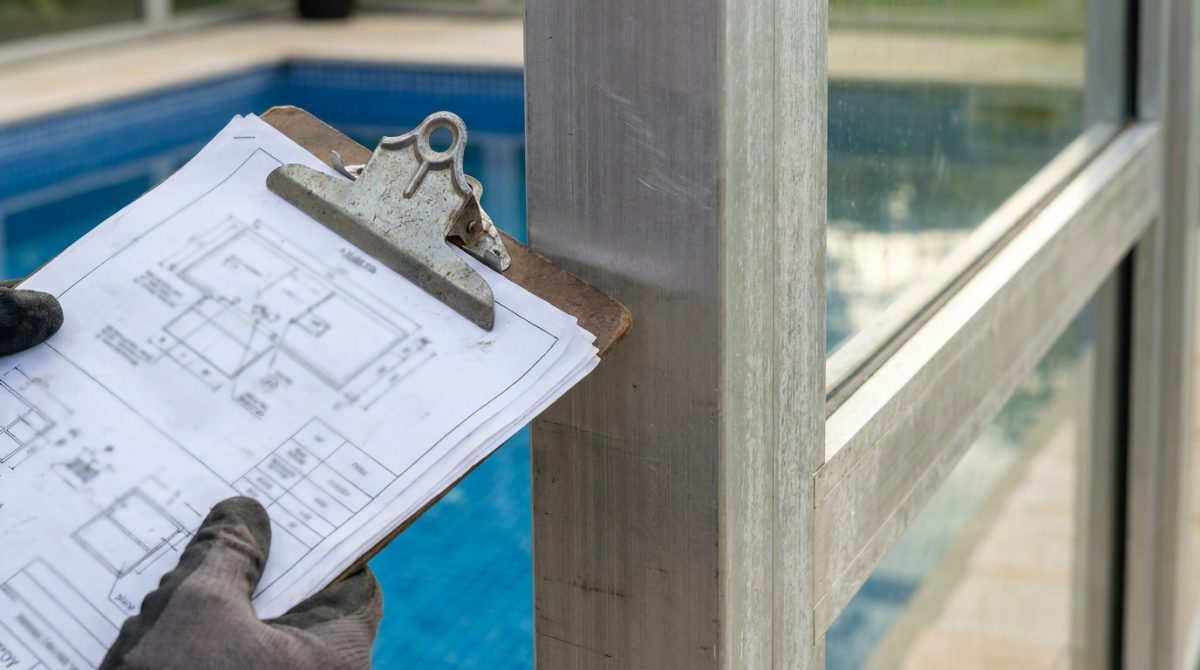
The enclosure itself tilts the performance equation in your favour in a concrete way. On a cold UK day when outdoor air sits at 5 degrees Celsius, the air inside a well-glazed enclosure will typically be 5 to 10 degrees warmer, often sitting between 10 and 15 degrees. Heat pump COP rises with source air temperature, so an enclosed installation will routinely deliver better efficiency than an identical outdoor unit working against raw winter air. You are not just protecting the pool from wind chill; you are providing your heat pump with a warmer working environment throughout the year.
The ventilation and air-handling component requires separate sizing logic. Building regulations for pool spaces typically require between 4 and 10 air changes per hour depending on bather load and pool surface area. To size the heat recovery ventilation unit correctly, you need to know the enclosure’s total air volume, which is the footprint multiplied by the internal height. A 10m x 6m enclosure with a 3m ridge height contains roughly 180 cubic metres of air. At 6 air changes per hour, that demands a unit capable of processing 1,080 cubic metres per hour. Many off-the-shelf domestic HRV units are rated at 200 to 400 cubic metres per hour, which falls well short.
Undersizing the ventilation heat recovery unit is the most common fault found on enclosed pool installations. A system that cannot handle peak humidity allows condensation to form on the aluminium glazing bars. That condensation accelerates corrosion, degrades sealants, and in persistent cases voids structural warranties. It is a failure mode that is entirely avoidable but regularly seen when pool engineers and enclosure manufacturers are not working from the same specification document.
The correct approach is to commission a full heat-loss calculation before any equipment is ordered. That calculation should account for glazing U-values, ground losses through the pool shell and surrounds, the compass orientation of the enclosure, and the local climate data for your site. A pool in Cornwall and a pool in Yorkshire will have meaningfully different heat loss profiles even if the structures are identical.
Arch Enclosures’ aluminium framing systems use thermally broken profiles, which reduce conductive heat loss through the structure compared to non-broken alternatives. In a standard aluminium section without a thermal break, the metal conducts cold from outside directly to the inner face of the frame. A broken profile interposes a low-conductivity material, cutting that conductive pathway significantly. Over a full winter season, that difference shows up in the heat-loss calculation and ultimately in the size of heat pump you need to specify. Smaller heat pump, lower capital cost, lower running costs. The structural choice and the mechanical choice are not independent decisions.
Running Costs and Seasonal Savings: Putting Real Figures on It
Numbers matter here. Abstract claims about efficiency are easy to make and hard to evaluate. What pool owners actually need is a comparison they can test against their own situation.
Heating an unenclosed outdoor pool in the UK with a gas heater to a comfortable 28 degrees Celsius costs between 3,000 and 6,000 pounds per year, depending on pool size, geographic location, and how long you want to swim. The wide range reflects real variation: a large pool in Scotland used from April to October sits at the upper end; a smaller pool in the south of England used mainly in summer sits toward the lower end. That figure assumes natural gas at current tariffs and a modern condensing boiler running at around 90% efficiency.
Switching to an air-to-water heat pump with a seasonal COP of 4, running on a standard electricity tariff of roughly 24 pence per kWh, changes the unit economics dramatically. At COP 4, you are delivering 4 kWh of heat for every 1 kWh of electricity consumed. With electricity at 24p per kWh, that works out to approximately 6 pence per kWh of heat delivered. Natural gas at around 6 to 7 pence per kWh has a similar headline fuel cost, but the boiler’s efficiency loss means the actual delivered heat cost is higher, and gas prices remain volatile in a way that grid electricity, increasingly backed by renewables, is not.
Adding an enclosure on top of the heat pump switch reduces total heating load by an estimated 30 to 50% compared to an open pool. The enclosure cuts evaporative losses (which account for the majority of pool heat loss), reduces wind exposure, and traps solar gain. Neither the enclosure alone nor the heat pump alone delivers the full saving. The combination is where the real financial case sits.
A domestic enclosed pool using a correctly sized air-to-water heat pump paired with HRV ventilation can realistically achieve annual heating bills in the range of 800 to 1,800 pounds. Set against the 3,000 to 6,000 pound benchmark for an open gas-heated pool, that is a saving of between 1,200 and 4,200 pounds every year. Over ten years, even at the conservative end of that range, the numbers are substantial.
The next step for pool owners who want to push running costs further down is pairing the heat pump with a solar PV array. Systems such as the Polysolar and Polytropic combination from Clear Pro Pools are designed specifically for this purpose, allowing the heat pump to run primarily on self-generated electricity during summer months. When solar generation matches or exceeds heat pump consumption, the marginal cost of heating drops toward zero. The pool, in effect, heats itself on sunshine during the months when you most want to use it.
Commercial operators stand to gain disproportionately from this combination. Leisure pool temperatures typically sit between 28 and 30 degrees Celsius, which is well within the sweet spot for air-source heat pump efficiency. COP does not degrade significantly at these moderate targets the way it would if you were trying to reach the temperatures needed for domestic hot water or radiator heating. That means commercial pools can rely on consistently high COP across their entire operating schedule, not just during mild weather.
For a realistic view of pool ownership costs, payback periods for heat pump installation in an enclosed pool context typically run from 3 to 7 years. The range depends on what heating system is being replaced, how intensively the pool is used, and whether solar PV is also installed. A pool replacing a gas boiler and adding an enclosure at the same time will sit toward the faster end of that range. A pool that already has an enclosure and is simply upgrading the heat source will take slightly longer, but the payback is still well within the expected lifespan of the equipment.
Eco Credentials: Carbon, Refrigerants, and the Net Zero Picture
The environmental case for heat pumps in enclosed pools is strong, and it gets stronger every year without any change to the equipment.
The UK electricity grid’s carbon intensity has fallen significantly over the past decade. In 2024, average grid intensity sits at approximately 170 grams of CO2 per kWh. A heat pump with a COP of 4 divides that figure by four, delivering heat at an effective carbon intensity of around 42 grams of CO2 per kWh of heat. That is the actual emissions footprint of heating your pool water.
Compare that with natural gas. A condensing boiler running at 90% efficiency delivers heat at roughly 200 grams of CO2 per kWh, accounting for the gas’s inherent carbon content and the boiler’s conversion losses. The arithmetic is clear: under current grid conditions, an air-source heat pump operates at nearly five times lower carbon intensity for pool heating than a gas boiler. That gap will widen further as renewable generation continues to grow.
The refrigerants used inside heat pumps matter too, and the industry has moved quickly here. Legacy systems used R410A, which carries a global warming potential (GWP) of 2,088. Modern pool heat pumps increasingly use R32 or R290 (propane). R290 has a GWP of just 3, making it essentially climate-neutral as a refrigerant. If the unit develops a leak, the environmental impact is negligible compared to an R410A failure. When specifying a new heat pump, confirming the refrigerant type is a straightforward question to ask the installer.
Air-to-air systems that recirculate internal enclosure air avoid another set of concerns entirely. They do not require ground works, do not disturb existing landscaping, and have no impact on the outdoor air mass in any meaningful sense. For sites where ground source heat pump installation is impractical because of soil conditions, plot size, or planning constraints, an enclosed air-to-air system offers a clean alternative with no site disruption.
On the financial side of the green transition, the Boiler Upgrade Scheme in England and Wales currently offers 7,500 pounds toward qualifying heat pump installations. Whether a pool-only installation qualifies depends on the specifics of the application, and professional advice from a registered MCS installer is essential before assuming eligibility. For installations that do qualify, that grant materially shortens the payback period described in the previous section.
Perhaps the most compelling long-term argument for installing a heat pump now is that the system’s carbon footprint will continue to fall without any further investment. As the grid takes on more wind, solar, and tidal generation, the 170 grams per kWh figure will drop. The same heat pump running on the same electricity tariff in 2030 will have a lower carbon footprint than it does today. Pool owners who choose gas lock themselves into a fixed carbon trajectory. Those who choose a heat pump are positioned to benefit from every future improvement in grid decarbonisation automatically.
Installation Considerations Specific to Aluminium Enclosure Structures
Getting the physical installation right is where theory meets the real world, and this is where most problems originate. A few specific rules apply when fitting a heat pump system to an aluminium enclosure that do not apply to a standalone domestic installation, and ignoring them creates costly problems later.
The outdoor heat pump unit must be positioned so that its exhaust air cannot recirculate back into the enclosure’s air intake. Once exhausted air re-enters the system, the unit is effectively working against itself, and efficiency drops sharply. A minimum separation of 2 metres between exhaust outlet and any enclosure opening or vent is standard practice, so this needs to be factored into the plant layout before groundworks are confirmed.
Refrigerant pipework that runs through or alongside the aluminium enclosure frame must be insulated and sleeved at every contact point. Aluminium and copper refrigerant pipe are dissimilar metals, and where they touch in the presence of moisture, galvanic corrosion will follow. It is a slow process, but it causes frame pitting and pipe degradation that is expensive to repair once it takes hold.
The enclosure’s sliding or retractable panels must remain fully operable after installation. Pipe and cable routes should be planned to run below or beside the travel path of any moving section, never across it. A heat pump that forces you to leave a panel locked open in winter has defeated its own purpose.
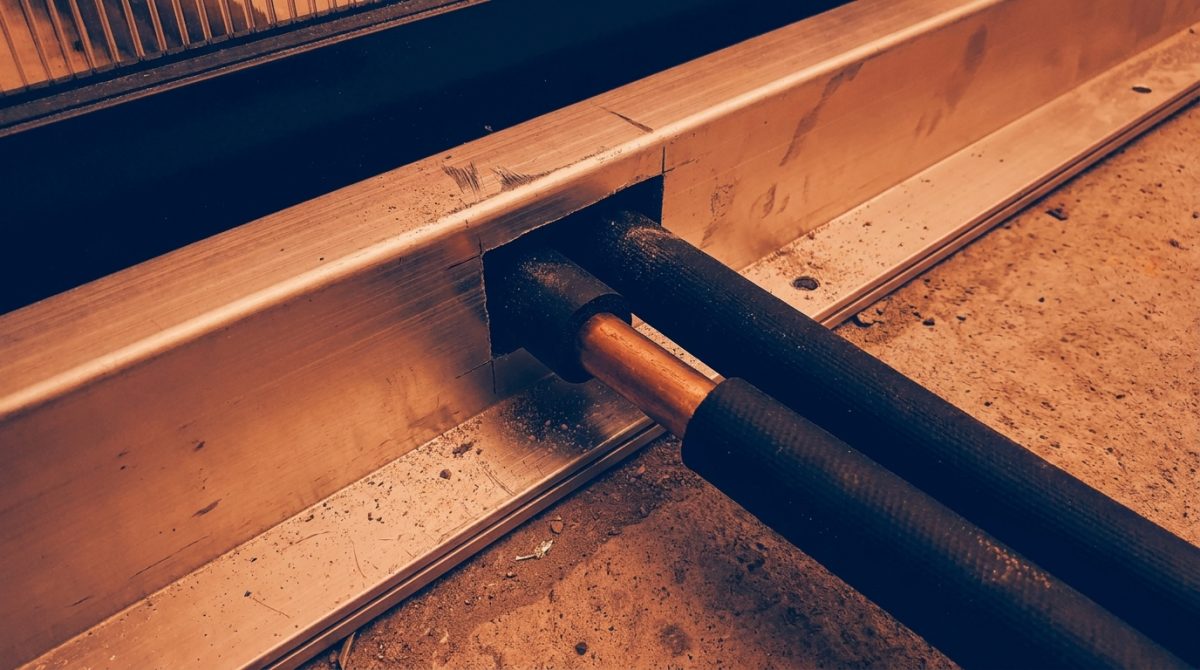
Electrical supply for a domestic pool heat pump typically requires a dedicated 32A or 40A circuit from the consumer unit. Planning this cable run before groundworks are finalised avoids the need to break up finished paving or decking later, which is both disruptive and expensive.
Condensate drainage deserves particular attention inside an enclosure. Both the outdoor heat pump unit and any internal HRV unit produce condensate during normal operation. If that water is allowed to pool near aluminium baseplate fixings, it will cause corrosion at the fixings over time. Route condensate to a proper drain from the outset, not to a gravel soak or a low point in the structure.
Finally, use an installer who has hands-on experience with both heat pump commissioning and pool enclosure structures. When something goes wrong, the heat pump manufacturer and the enclosure manufacturer will each point at the other if the installation does not meet both parties’ requirements. A single experienced contractor who understands both disciplines eliminates that dispute before it starts. For a full comparison of how different heating technologies interact with enclosed pool structures, the pool heating options guide covers the ground in detail.
Building a Year-Round Swimming System That Actually Delivers
There is a clear hierarchy of investment when you are building a genuinely usable year-round pool, and getting the order right is the difference between a system that compounds its own benefits and one that leaves money on the table. The enclosure comes first. It reduces heat loss, cuts chemical consumption, and creates the stable microclimate that makes everything else work more efficiently. The heat pump comes second, doing its job inside an environment that is already partially conditioned rather than fighting the open sky. Solar PV comes third, cutting the operating cost of the heat pump once the infrastructure is already in place. Each layer multiplies the return on the one before it.
A well-specified system combining an aluminium enclosure, an air-to-water heat pump, HRV ventilation, and a pool blanket used overnight can realistically hold 28 degrees Celsius water temperature across all twelve months in most UK locations. That is not a best-case scenario; it is a routinely achievable outcome when each component is properly sized and the system is commissioned as a whole rather than assembled piecemeal.
Smart controls add another layer of efficiency without requiring any additional hardware investment. Heat pump controllers that connect to a weather forecast API can pre-heat the pool ahead of a forecast cold snap, using off-peak electricity tariffs such as Octopus Go or Agile to do the heavy lifting overnight when rates can be a third of peak pricing. The pool is at temperature when you want it, and the electricity cost is substantially lower than it would be if the system reacted to cold water rather than anticipating it.
Arch Enclosures’ aluminium structures are engineered from the design stage to accommodate integrated heating and ventilation ducting. That means duct runs, cable routes, and condensate drainage can all be built into the structure cleanly rather than added as surface-mounted afterthoughts. Retrofit compromises, oversized external duct boxes, surface-run conduit, and drainage bodges all drive up cost and reduce long-term system performance. purpose-built pool heat pumps from UK manufacturers are designed with exactly these integrated installations in mind.
The sustainable, low-carbon enclosed pool is no longer a product reserved for large private estates or commercial leisure operators. Properly specified, with the right enclosure, the right heat pump, and the controls to tie them together, it is a realistic upgrade for any household or commercial site that wants twelve months of swimming at a cost that is manageable and a carbon footprint that is defensible. The technology is mature, the installers exist, and the running economics work. The only variable is whether the system is put together with the care the components deserve.
