

Stamp duty on a three-bedroom house in the South East can run to £15,000 or more before you have spent a penny on the move itself. Against that backdrop, a growing number of homeowners are doing the maths and deciding the numbers point firmly toward staying put and improving what they already have. The renovation wave is real, it is documented, and it is reshaping how people think about property investment.
The MyBuilder 2026 Renovation Nation Report found that 53% of 18 to 34 year olds are now choosing renovation over relocation, with 26% of all homeowners following the same path. That is a structural shift, not a passing trend. And when those homeowners look at where to spend, outdoor space sits near the top of the list.
Why Renovators Are Choosing Pools Over Packing Boxes
Renovation content has become genuinely mainstream. The hashtag #BudgetDIY alone has generated over 13,000 TikToks, and outdoor living upgrades account for a substantial share of the most-watched renovation content across the platform. This is not just people refreshing a bathroom. Homeowners are thinking in terms of transforming how their property functions, not just how it looks.
Outdoor living improvements occupy a different category to most internal renovations. A new kitchen replaces something that was already there. A new bathroom does the same. But a pool enclosure creates something that did not previously exist: a fully usable, weatherproofed room that your property simply did not have before. That distinction matters when you are thinking about both lifestyle and resale value.
UK homeowners who already have a pool are in an unusually strong position here. An unenclosed pool in the British climate is a seasonal asset at best, a liability at worst. It requires opening-up and closing-down procedures, demands chemical management through months when nobody swims in it, and sits visually dormant through the majority of the year. Enclosing it changes that calculation completely. You are not adding to the pool, you are activating it.
The framing that matters for the rest of this article is this: an enclosure is not an accessory to a pool. It is the upgrade that makes the pool work as a year-round asset. Without it, you have a seasonal amenity. With it, you have a permanent, functional facility that earns its place in both your daily life and your property valuation every month of the year.

What a Pool Enclosure Actually Does to Your Property Value
HomeAdvisor data indicates that a pool can increase a home’s value by 5% to 8%. On a property valued at £600,000, that is a potential uplift of £30,000 to £48,000. But that figure comes with a significant caveat: it applies most reliably where the pool is perceived as a usable, low-hassle asset. In the UK, where outdoor swimming is restricted to perhaps three or four months of the year without additional infrastructure, an unenclosed pool does not always command that premium consistently.
An enclosure is the factor that closes the gap. It converts a seasonal amenity into a permanent, usable facility, which is precisely the distinction that buyers and surveyors weigh when they assess value. A pool that can be used in February carries a fundamentally different valuation argument to one that cannot. For UK properties specifically, the enclosure is not a nice-to-have addition to the pool, it is the mechanism through which the pool justifies its valuation uplift.
Post-pandemic residential real estate data from Dataintelo reinforces this. Even as broader inflation has constrained consumer spending across multiple categories, elevated spending on pool and garden infrastructure has persisted across major European construction markets. Buyers have continued to price functional outdoor spaces into their offers. The demand has not softened the way other discretionary categories have.
The same Dataintelo research describes the relationship between pool enclosure demand and residential real estate values as reinforcing. As residential real estate ambition rises, so does demand for enclosures, because buyers in the current market are actively seeking properties that offer something beyond the standard specification. An enclosed pool, particularly one designed with architectural care, signals that a property has been developed thoughtfully rather than simply maintained.
It is worth comparing this to lower-ROI outdoor improvements. HomeLight reports that a backyard wooden deck delivers 45% to 55% ROI. That is a reasonable return for a straightforward project, but a deck adds one thing: outdoor seating. A pool enclosure adds outdoor seating, weather protection, thermal comfort, year-round swimming capability, and a premium asset that already exists underneath it. The ROI comparison is not even particularly close when you account for what the enclosure actually delivers versus what a deck delivers. You can read more about how enclosures perform against other home improvements in this detailed look at pool enclosure real value.
For homeowners preparing to sell, the practical implication is direct. An enclosed pool signals something specific to a buyer: this is a low-maintenance, year-round facility, not a seasonal liability with running costs and a cover that needs storing. That shift in perception affects negotiating position. A buyer who sees an unenclosed pool often starts mentally calculating the cost and effort of managing it. A buyer who sees an enclosed pool calculates how soon they can swim in it. Those are very different starting points for a negotiation.
If you are at the stage of thinking through what documentation and preparation a sale involving an enclosure requires, the guide on selling with an enclosure covers exactly what vendors need to have in order before they go to market.
The Engineering Behind Year-Round Swimming in a British Climate
Britain’s weather does not need dramatising. Anyone with an outdoor pool in the UK already knows what February feels like standing at the pool edge. The engineering question is straightforward: what does a structure need to do in order to make year-round swimming not just possible but genuinely practical?
Aluminium profiles: the structural foundation
Aluminium profile construction is the industry standard for pool enclosures, and for good reason. It combines structural rigidity with corrosion resistance, which matters significantly in the UK’s persistently wet climate. A mild steel structure in a poolside environment would face constant corrosion pressure from both the external weather and the internal humidity and chlorinated air. Aluminium does not have that problem. It maintains its integrity without the ongoing maintenance burden that other materials would impose, which keeps the total cost of ownership lower over the enclosure’s lifespan.
Polycarbonate glazing and passive solar gain
The glazing panels in a well-designed enclosure are doing continuous thermal work. Polycarbonate panels trap solar gain, raising pool water temperature passively without any active energy input. For UK pool owners, heating costs are one of the largest ongoing expenses, and the passive thermal contribution of a correctly specified glazing system reduces that burden materially across the year, not just in summer. The enclosure is earning back part of its cost every month through reduced heating bills.
The thermal efficiency argument goes further than solar gain. Evaporation accounts for up to 70% of pool heat loss. An enclosure that encloses the air mass above the pool surface dramatically reduces evaporation rate, which means the heat you put into the water stays there rather than escaping into the atmosphere. This is a structural energy saving: it operates continuously, regardless of season, and it compounds over years of operation.
Telescopic and retractable designs
Year-round capability does not mean permanently enclosed. Telescopic enclosures use modular sliding tracks so individual sections of the structure can be pushed to stack at one end, giving full open-air access on warm days without removing any part of the structure. The 360iResearch analysis of the telescopic pool enclosure market identifies aluminium profiles, polycarbonate glazing, modular sliding tracks, and lockable access points as the defining features of these systems. The flexibility is the point: you get full weatherproofing when you need it and open-air swimming when conditions allow.
The Arch Enclosures patented arch profile
Arch Enclosures’ patented system uses an arch profile that distributes structural load efficiently without requiring internal columns. The practical benefit is that the footprint around the pool remains unobstructed. There are no columns breaking up the poolside space, no sightlines interrupted by structural supports. The arch geometry does the engineering work at the roofline, which means the full width and length of the pool area is available for use. For homeowners who have invested in landscaping, furniture, or integrated lighting around their pool, this matters considerably.
Safety compliance as a built-in feature
Enclosure structures built to the NF P 90-308 European safety standard for pool covers provide child and pet barrier protection without the need for a separate safety cover. That means the enclosure is simultaneously providing weather protection, thermal management, and safety compliance. A family that would otherwise need to budget for a dedicated safety cover, and manage the operational burden of deploying and storing it, can treat the enclosure as a single solution covering all three functions. For properties where child safety requirements affect insurance terms or planning conditions, this compliance point is practically significant rather than simply reassuring.
Choosing the Right Enclosure Type for Your Space and Budget
The enclosure market is broader than most homeowners realise when they first start researching. The format you choose shapes not just how the finished structure looks, but how you actually use it day to day, and how it sits within your planning context. Getting this decision right at the specification stage saves money, avoids frustration, and maximises the return on the whole investment.
Low-profile enclosures
Low-profile enclosures sit close to the waterline, typically rising only a metre or so above the pool coping. From the garden boundary they are almost invisible, blending into the landscape rather than dominating it. This makes them the natural choice for planning-sensitive properties, conservation areas, or gardens where the aesthetic priority is an uninterrupted view across the water. If you are working with a period property or a plot where neighbours are close, a low-profile design is often the simplest route to an approved structure.
Mid-height enclosures
Mid-height enclosures are the most popular format in the domestic UK market, and for good reason. They provide enough internal headroom to walk comfortably at the poolside, accommodate loungers and planted borders inside the structure, and create something that genuinely blurs the boundary between a pool house and an enclosure. The extra height also improves ventilation options, which matters for managing condensation in a British climate. For a family home where the pool is expected to work as a social space rather than just a lap-pool, mid-height is almost always the right starting point.
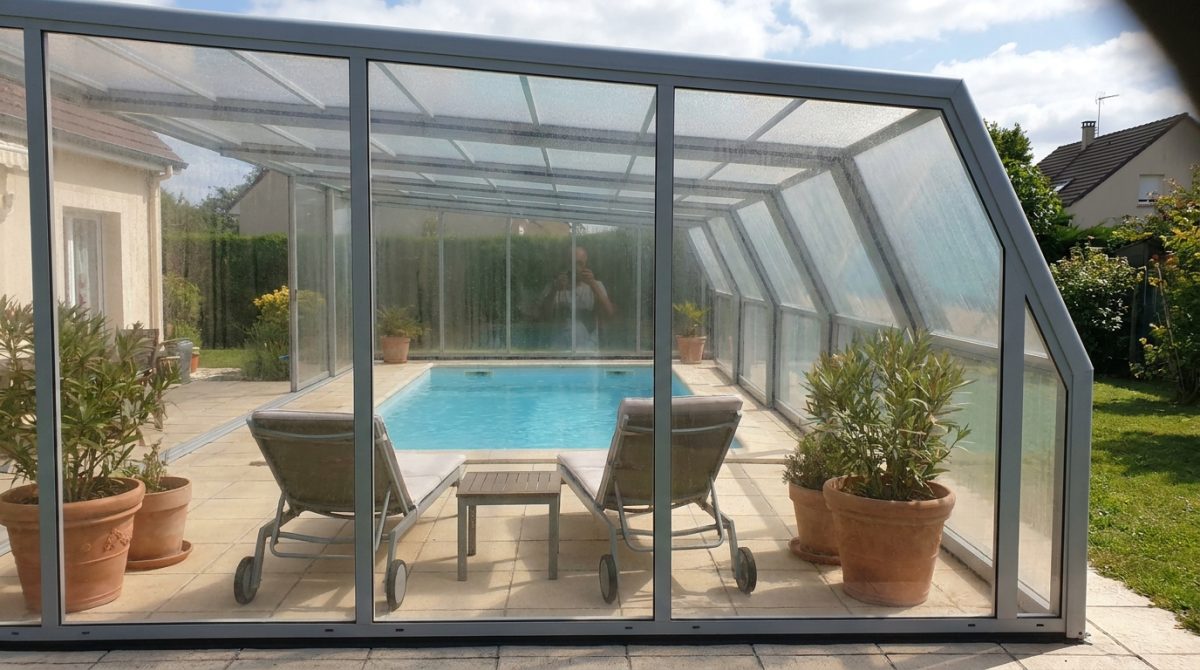
Full-height enclosures
Full-height enclosures create a genuine indoor pool environment. Headroom is sufficient for diving boards, full mechanical plant rooms, changing areas, and in some cases mezzanine-level viewing. These structures are standard in commercial installations, leisure centres, and hotel spa facilities, but they are increasingly specified for high-end domestic builds where the pool is a central feature of the property rather than a garden amenity. The cost and planning implications are proportionally higher, but the resulting asset is a different category of improvement entirely.
Telescopic and retractable designs
Telescopic enclosures are built on a modular sliding track system, with individual sections that can be moved independently of one another. XL Pools in Kent, for example, partners with Venus Enclosures, one of Europe’s leading manufacturers, to supply and install telescopic designs that allow partial coverage depending on weather and preference. On a still September afternoon you might slide three sections back and swim in open air; on a cold February morning the same pool is fully enclosed and heated to a comfortable temperature. This flexibility is what makes the telescopic format so appealing to homeowners who want the option of outdoor swimming without committing entirely to one mode.
Fully automatic retractable designs take this further by removing the manual effort altogether. A motorised system opens and closes the enclosure at the touch of a button or via a smartphone app. The additional cost over a manual telescopic is real, but so is the lifestyle difference. For households where the pool is used daily, the friction of manually repositioning heavy panels becomes a genuine deterrent over time. For occasional swimmers, the manual option is perfectly adequate and represents a meaningful saving.
Framing the budget correctly
Enclosure costs vary considerably depending on pool size, enclosure height, glazing specification, and whether the design is fixed or retractable. The mistake many homeowners make is treating this as a standalone expenditure and asking whether the enclosure itself is worth the price. The better question is what the combined figure looks like when set against pool heating costs saved per year, the extended season that removes the need for expensive resort travel, and the uplift to the property’s market value at point of sale. Framed that way, the calculation changes significantly. The next section addresses that in detail, but the principle holds from the moment you are choosing your format: the right enclosure for your budget is not necessarily the cheapest one, it is the one that delivers the best combined return across all three measures.
For a deeper look at how different enclosure styles integrate with specific garden layouts and house styles, the guide to pool enclosure design integration covers the architectural decisions in detail.
Planning Permission, Building Regs, and the Questions Homeowners Always Ask
Planning and compliance are the parts of any home improvement project that generate the most anxiety, usually because the rules are more layered than a simple yes or no. With pool enclosures, the picture is actually more favourable than most homeowners expect, provided the structure is specified correctly from the start.
Permitted development rights
In England, most pool enclosures are classified as garden structures and fall within permitted development rights, meaning full planning permission is not required. This is the default position for a large proportion of domestic installations. The conditions that can push a project out of permitted development are height, site coverage, and the status of the property itself. A structure over 2.5 metres in height will typically require a planning application. Similarly, if the enclosure combined with other outbuildings covers more than 50% of the total garden area, permitted development no longer applies.
This is one reason low-profile enclosure designs are engineered specifically to the dimensions they are. Keeping the ridge height within the 2.5 metre threshold is not just an aesthetic choice; it is a deliberate compliance decision that removes the need for a formal planning application and the associated cost and delay.
Listed buildings and properties in designated areas such as Areas of Outstanding Natural Beauty or National Parks sit outside the standard permitted development framework regardless of height or coverage. If your property has any of these designations, a pre-application conversation with your local planning authority is the right first step before specifying anything.
Building regulations
Building regulations apply to pool enclosures regardless of whether planning permission is needed. This is a point worth being clear on: the two regimes are separate. A structure that qualifies as permitted development still needs to comply with structural safety requirements and glazing standards. Specifically, any glazing at low level must meet the impact resistance requirements under Part N of the Building Regulations, and structural calculations must demonstrate adequate load-bearing capacity including wind and snow loading.
A reputable manufacturer addresses this through the supply of CE-marked aluminium profiles and polycarbonate or safety glass panels, accompanied by full structural certification. Arch Enclosures provides design support and full technical documentation as part of the specification process. This matters practically because it transfers the compliance burden away from the homeowner. Rather than commissioning separate structural engineers and preparing documentation from scratch, the homeowner receives a package that is designed to satisfy building control requirements directly.
The conservatory misconception
One of the most common assumptions homeowners bring to early conversations is that a pool enclosure will be assessed under conservatory building regulations. It will not. A pool enclosure is not a conservatory under the Building Regulations definitions, and the specific rules around conservatories, which include requirements around thermal separation from the main dwelling and limits on heating, simply do not apply. This removes several compliance hurdles that homeowners assume they face. It is worth confirming this with your local building control body if there is any uncertainty, but the principle is consistent across England and Wales.
Insurance
Adding a permanent structure over a pool changes the rebuild value of the property, and this needs to be declared to your buildings insurer. In practice this is a straightforward notification rather than a complicated negotiation. Insurers are familiar with pool enclosures as an improvement category and the adjustment to premiums, where any adjustment is made at all, is typically modest relative to the value of the asset being protected. What you want to avoid is failing to declare the improvement and finding that an insurer reduces a claim settlement on the basis that the rebuild value was understated. A brief conversation with your broker when the installation is complete is all this requires.
Making the Investment Work: Costs, Savings, and the Realistic ROI Calculation
Any home improvement that costs as much as a pool enclosure deserves a proper financial framework, not vague reassurances about adding value. The honest version of the ROI calculation has three components, and each is specific enough to be estimated before you commit.
Energy savings
UK pool heating costs during cooler months, roughly October through April, run to several hundred pounds per month for a typical domestic pool depending on pool size, heating system, and ambient temperatures. An enclosure with polycarbonate glazing addresses this in two ways. It traps solar gain during daylight hours, pre-heating the water passively, and it dramatically reduces evaporative heat loss, which is the dominant route through which a heated pool loses energy to the atmosphere. The combination of these two effects can cut heating demand materially over the season. Precise figures depend on the specific enclosure specification and the pool’s existing heating setup, but the direction is unambiguous: a well-specified enclosure costs less to heat than an open pool.
Reduced debris ingress also cuts the workload on the filtration system and reduces chemical consumption. Algae requires sunlight to establish, and UV exposure degrades pool surfaces over time. An enclosure moderates both. Over five to ten years of ownership, these maintenance savings accumulate into a figure worth including in any honest cost-benefit analysis.
Extended season value
According to 360iResearch’s 2026 to 2032 market analysis, the telescopic pool enclosure sector is growing precisely because buyers and facilities operators increasingly expect year-round usability from their pool assets. That shift in expectations is not limited to commercial operators; it describes the direction the domestic buyer market is travelling too. A pool that is usable for twelve months rather than four or five represents a fundamentally different asset, both in terms of everyday lifestyle and in terms of what a purchaser is willing to pay for it.
The financial proxy for this extended season value is the cost of the leisure it replaces. A family that would otherwise book a late October half-term break or a February half-term at a resort with pool access is making a direct substitution. Those breaks cost real money. Over several years of ownership, the cumulative value of school holiday swims that fall outside the British summer, half-terms in October, Easter breaks, and even the longer Christmas holiday, represents a return that is easy to undercount because it is distributed rather than lump sum.
Property value uplift
The property valuation component is where the numbers become less precise but no less real. Pool enclosures contribute to the broader pool-related uplift that industry data and estate agent experience consistently identify, and the enclosure specifically converts a seasonal amenity into a year-round one, which is a qualitatively different selling point. A pool you can use in February is not the same as a pool you drain in September. Buyers understand this distinction, and it is reflected in offer behaviour on comparable properties.
The honest caveat here is important. ROI is highest when the enclosure is specified at the same time as a new pool installation, where the two costs can be planned together and the combined result is presented to the market as a finished, coherent leisure facility. It is also strong when the enclosure is added as a deliberate pre-sale renovation to a well-maintained pool. What limits the return is retrofitting an enclosure onto a pool that has been neglected. Potential buyers and surveyors will assess the whole package, and an immaculate enclosure over a pool with tired tiling, ageing plant, and unclear water chemistry will not achieve the valuation that a properly prepared asset would. Address the pool first if it needs attention; the enclosure then becomes the finishing layer rather than a distraction from underlying problems.
Getting to an actual number
The most useful thing any homeowner considering this investment can do is get a site-specific proposal rather than working from market averages. Pool sizes, garden configurations, planning constraints, existing heating infrastructure, and aesthetic preferences all affect the cost and the specification, and those variables compound each other in ways that generic guidance cannot account for. Arch Enclosures offers initial design consultations where all of these factors are worked through to produce a concrete specification and cost before any commitment is made. That conversation is the point at which the ROI calculation stops being theoretical and starts being yours specifically, based on your pool, your garden, and what you are trying to achieve with the property. It is the only version of the calculation that is actually worth acting on.
