
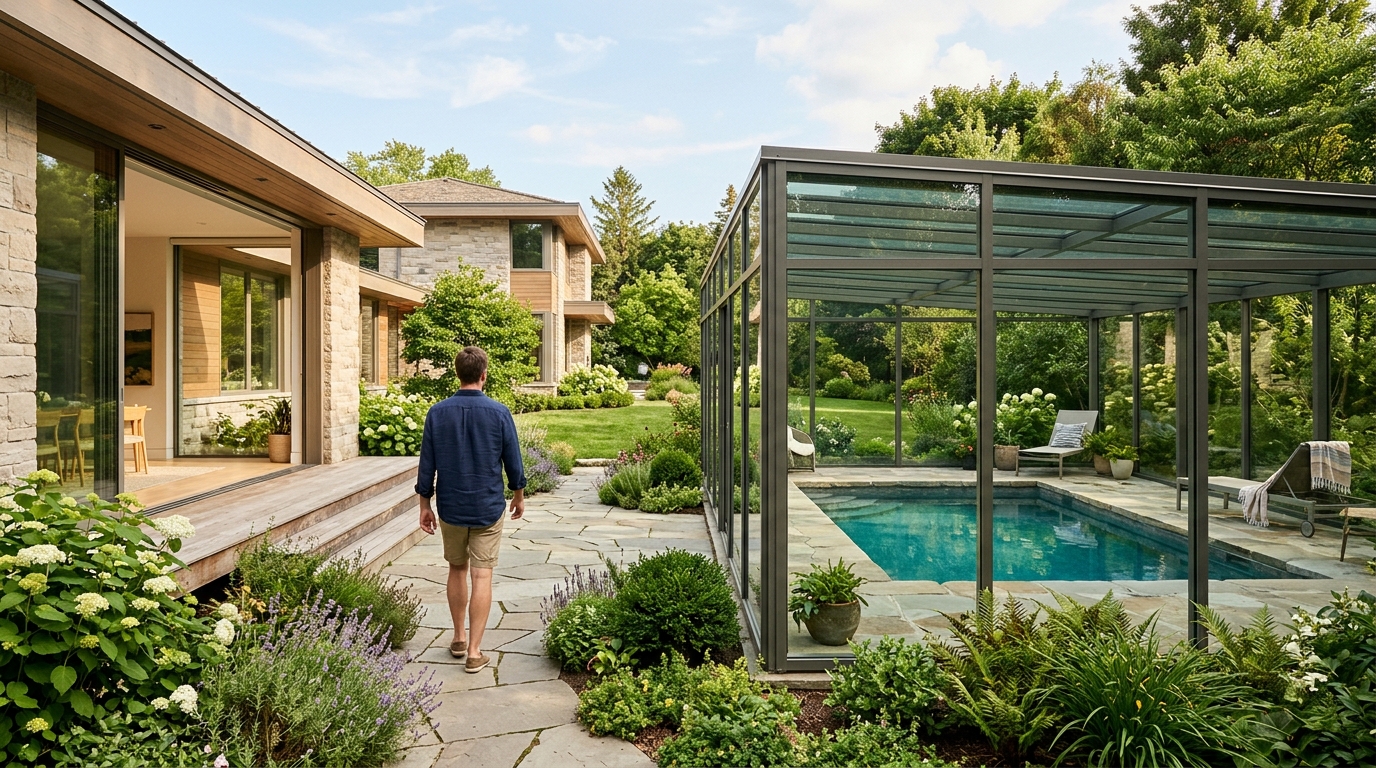
When homeowners invest in a pool, the instinct is often to treat it as a standalone feature. A rectangle of water, a few sun loungers, perhaps some screening. But the most successful pool installations we work on at Arch Enclosures are the ones where the pool and its enclosure are considered as part of the wider picture: the home’s architecture, the garden layout, and how the family actually uses the space day to day.
Think about how contemporary home extensions are designed. The best ones use large glass walls, clean sightlines, and a clear visual connection between inside and outside. The goal is a space that feels generous even when you’re not physically in the garden. A pool enclosure, done well, follows exactly the same logic.
The Enclosure as an Architectural Statement
An aluminium pool enclosure is a structure. That sounds obvious, but it’s worth pausing on. It has a roofline, a footprint, a relationship with the house behind it and the garden around it. Treat it as an afterthought and it will look like one. Design it carefully and it becomes the defining feature of your outdoor space.
At Arch Enclosures, we work with homeowners and architects to make sure the enclosure sits naturally within the property’s style. For a modern home with a flat or low-pitched roof, a low-profile telescopic enclosure with slim aluminium frames mirrors those same proportions. For a more traditional property, a higher arched profile can echo period architectural details without looking out of place.
Colour choice matters too. Our enclosures are available in a full range of RAL powder coat finishes, so matching the frames to existing window frames, cladding, or fencing is straightforward. Small details like this are what separate a structure that looks considered from one that looks dropped in.
Sightlines and the Connection to the Garden
One of the most important things a well-designed home extension achieves is the sense of bringing the garden inside. Frameless or slim-framed glazing, low thresholds, and carefully positioned openings all contribute to this. A pool enclosure should do the same thing in reverse: it should let the garden in.
This is why we use high-transparency, toughened glazing panels as standard. From inside the enclosure, you want to feel the garden around you, not stare through a frame at it. The swimming experience changes completely when you can look across a lawn, into a landscaped border, or towards a tree line rather than at an opaque wall or a fence.
Sightlines from the house matter just as much. If your kitchen or living room overlooks the pool area, the enclosure you choose will become a permanent part of that view. A cluttered or visually heavy structure diminishes the outlook. A clean, slimline design frames the pool as a feature and keeps the garden feeling open beyond it.
Connecting the Enclosure to the House Itself
For many homeowners, the ideal arrangement is a direct connection between the house and the pool enclosure, so moving between them requires no change in level and no exposure to the weather. This is entirely achievable and, for families especially, it transforms how frequently the pool actually gets used.
Practically, this means thinking about a few things early in the planning process:
- Where does the enclosure connect to the house, and does it align with existing doors or a new opening?
- Is the pool deck level with the interior floor, or does it step down into the garden?
- Can the glazing panels on the house-facing side open fully to remove the boundary between indoors and the pool space?
- Does the roofline of the enclosure need to tie into the house fascia, or does a small visual gap work better for the building’s proportions?
Getting these details right at design stage avoids expensive corrections later. We offer full site surveys precisely because every plot is different and standard dimensions rarely tell the whole story.
Working with the Garden Layout
A pool enclosure occupies a significant footprint. In most residential gardens, it will be the largest single element in the outdoor space. That makes the landscaping around it critical, not optional.
The enclosure should feel embedded in the garden rather than sitting on top of it. Planting at the perimeter softens the base of the structure and draws the eye outward rather than stopping it at the glass. Low-maintenance planting works best immediately adjacent to the enclosure because access for cleaning and maintenance needs to remain easy. Further away, bolder planting, water features, or a secondary seating area can create a sense of depth and destination beyond the pool itself.
Paving or decking material is another consideration. Using the same material inside and outside the enclosure, where possible, creates visual continuity and makes the overall space feel larger. This is the same principle that makes an indoor-outdoor kitchen extension feel like a single room rather than two separate ones.
Year-Round Use Changes Everything
One thing that consistently surprises homeowners after installation is how much the year-round usability changes the way they think about the space. A pool without an enclosure is a summer asset at best. An enclosed pool is a room. It gets used on a wet Thursday in October. The children swim before school in January. Guests drift in and out of it during a winter dinner party.
That shift in usage frequency is what justifies designing the enclosure with the same care as any other room in the house. It earns its place architecturally because it earns its place practically.
If you are at the stage of planning a pool installation or looking at how an enclosure might work with an existing pool, we would encourage you to bring the enclosure into the conversation early. The best results come from treating it as part of the home, not an addition to it. Our design team is happy to work through options with you, from initial concept to final installation.
