
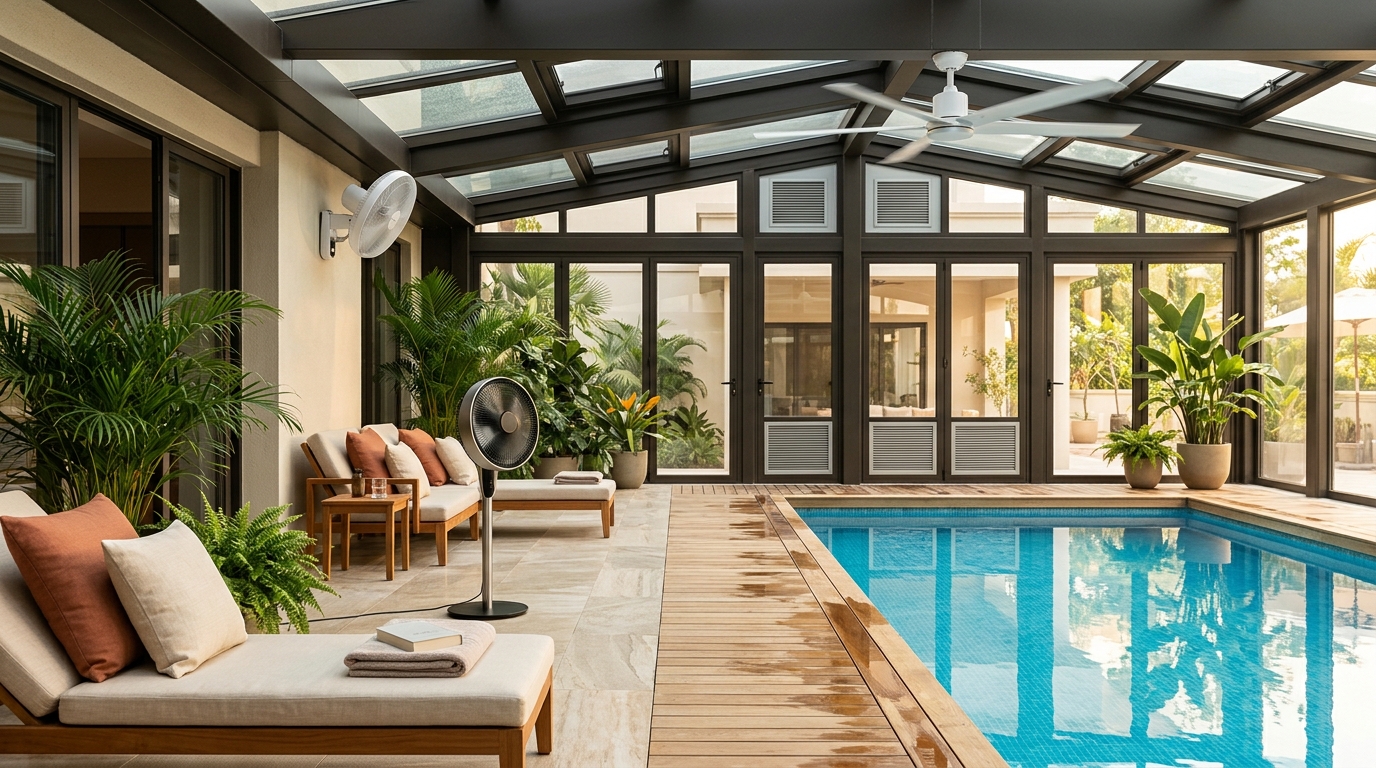
A pool enclosure transforms your outdoor space into a year-round retreat. But anyone who has spent time inside a glazed aluminium structure on a warm afternoon knows the challenge: heat builds up fast, humidity can climb, and without the right airflow, comfort suffers. Getting the climate right inside an enclosure is not just about luxury. It is about protecting the structure, preserving water quality, and making sure you actually want to use the space.
The good news is that there is now a wide range of ventilation solutions and air circulation technology that are well suited to enclosed pool environments. Some are built into the enclosure design itself. Others are standalone additions you can retrofit. Here is how to think about it.
Why Air Circulation Matters More Than Cooling
In a standard living room, a fan simply keeps you cool. Inside a pool enclosure, the job is more demanding. Evaporating pool water constantly adds moisture to the air. Without sufficient circulation, that humidity settles on glazing panels, aluminium frames, and any furniture or equipment stored inside. Over time, persistent condensation accelerates corrosion and creates conditions for mould.
This means the priority is not just temperature reduction. It is moving and renewing the air continuously. A well-ventilated enclosure should be exchanging its internal air regularly, drawing warm humid air out and pulling fresher, drier air in. Cooling is a secondary benefit that follows naturally from good ventilation design.
Built-In Ventilation: The Foundation
The most effective approach starts at the design stage. Arch Enclosures structures include integrated ventilation panels and operable roof sections that allow passive airflow when the weather permits. On milder days, simply opening the right combination of panels can create a natural chimney effect, where warm air rises and escapes through the roof while cooler air enters at lower levels.
For domestic enclosures, this passive system is often sufficient across spring and autumn. During peak summer, or in particularly humid climates, you will want to supplement it with active circulation. This is where fans and mechanical ventilation come in.
Choosing the Right Fan for an Enclosed Pool Space
Not every fan is suited to a poolside environment. The key criteria are different here compared to choosing a bedroom fan or home office model. You need to think about:
- Moisture resistance: Fans rated for damp or humid environments are essential. Look for IP-rated models where possible, or at minimum fans from manufacturers who specify humidity tolerance.
- Consistent airflow at low noise: Pool spaces are social and relaxing. A fan running at a roar defeats the purpose. Models like the Dreo Smart Tower Fan Pilot Max S, which Forbes Vetted named a top overall pick for 2026, deliver 12 fan speeds and run notably quietly, making them a strong candidate for enclosure use.
- Oscillation range: A wide oscillation arc distributes air across the full width of the space rather than creating one cold tunnel and leaving the rest stagnant.
- Smart controls: Timer functions, app connectivity, and auto modes let you schedule the fan to run during peak heat hours without manual intervention. For a pool enclosure you may not visit every day, this is genuinely useful.
Tower fans work particularly well in enclosures because their vertical form factor moves air across a tall column, which helps counteract the tendency for warm air to stratify at roof level. The Dyson Pure Cool TP07, reviewed by CNET as a comfortable and steady performer, adds HEPA air purification to the mix, which can help manage any airborne pool chemical particles in a sealed environment.
Mechanical Ventilation: When You Need More Than a Fan
For larger or more permanently glazed enclosures, passive ventilation and portable fans may not be sufficient on their own. A mechanical heat recovery ventilation (MHRV) system is the next step up. These units extract humid internal air while recovering most of the heat from it before exhausting it outside, then supply fresh filtered air back in. The result is controlled humidity, good air quality, and minimal heat loss.
MHRV systems are well established in pool hall design for commercial leisure centres, and scaled-down domestic versions are increasingly accessible. They are typically wall-mounted, relatively unobtrusive, and can be integrated into an enclosure during installation or retrofitted later. If you are swimming daily and the enclosure is closed for much of the year, the investment pays back in lower corrosion maintenance and a consistently more comfortable environment.
Managing Temperature as Well as Humidity
Once airflow is sorted, temperature control is the next consideration. For most UK enclosure owners, the goal is not aggressive cooling but moderation: preventing the space from becoming uncomfortably hot in July and keeping it usable into October without excessive heating bills.
A few practical approaches that work well alongside good ventilation include:
- Thermal glazing panels: Specified at the build stage, these reduce solar heat gain without compromising light transmission significantly.
- Retractable shade: Internal or external blinds on south-facing panels can cut peak afternoon temperatures noticeably.
- Pool covers: Keeping the pool surface covered when not in use reduces evaporation and therefore reduces the humidity load on your ventilation system, which in turn reduces the amount of work your fans need to do.
- Supplementary heating: Infrared panel heaters or small electric radiators can extend the comfortable season into winter without the complexity of ducted systems.
A Practical Checklist for Getting It Right
If you are planning a new enclosure or upgrading an existing one, here is a sensible order of priorities:
- Confirm that the enclosure design includes adequate passive ventilation openings at both low and high levels.
- Add at least one good quality tower fan or ceiling-mounted circulation fan for active airflow during peak use periods.
- Consider an MHRV unit if the enclosure will be heavily used or closed for extended periods.
- Use a pool cover consistently to manage the humidity source at its origin.
- Review glazing and shading options if solar heat gain is a problem in your specific orientation.
Getting the climate inside an enclosure right is not a single product decision. It is a layered system where each element supports the others. The enclosure structure provides the foundation, ventilation manages the humidity, fans distribute the air, and shading handles peak solar gain. Put those pieces together and you have a space that is genuinely comfortable to swim in through twelve months of the year, not just the three or four when the weather cooperates.
If you would like advice on ventilation specifications for a specific Arch Enclosures structure, our team can walk you through the options as part of the design consultation process.
