

Most pool enclosure buyers spend their time choosing panel configurations, roof profiles, and powder-coat colours. That is entirely understandable. But the systems that will determine whether your enclosure is still performing well in fifteen years are the ones you cannot see once installation is complete: sealants, drainage pathways, and the material specifications that govern how every component handles sustained moisture.
Getting these right is not a luxury detail. In a poolside environment, water is present constantly, in multiple forms. You have condensation on cold nights, splash from the pool itself, UK rainfall on the roof and sides, and groundwater pressure at the base. Each source attacks different parts of the structure in different ways. A waterproofing strategy that addresses all of them is the difference between an enclosure that ages gracefully and one that begins failing long before it should.
The Case for Aluminium as a Starting Point
Waterproofing is not only about sealants applied at the end of a build. It starts with the base material. Aluminium frames are the right foundation for a pool enclosure precisely because aluminium forms a natural oxide layer that resists corrosion without any additional coating. Unlike steel, which requires paint or galvanising to survive a humid poolside environment, aluminium handles continuous moisture contact without structural degradation.
The grade specification matters enormously. Marine-grade aluminium alloys, commonly 6063 or 6061 series, contain magnesium and silicon in proportions that deliver both strength and corrosion resistance. A frame profile with inadequate alloy specification will pit and weaken over time regardless of how well the rest of the waterproofing system is designed. This is one area where material specification is worth serious attention from the outset.
Polycarbonate and tempered safety glass panels also play a role here. Both materials are inherently water-resistant, but their performance depends on how well they are retained and sealed within the aluminium frame. Loose or poorly fitted glazing creates small gaps where water enters and sits, accelerating frame corrosion from the inside out.
Sealants: The Unsung Workhorses
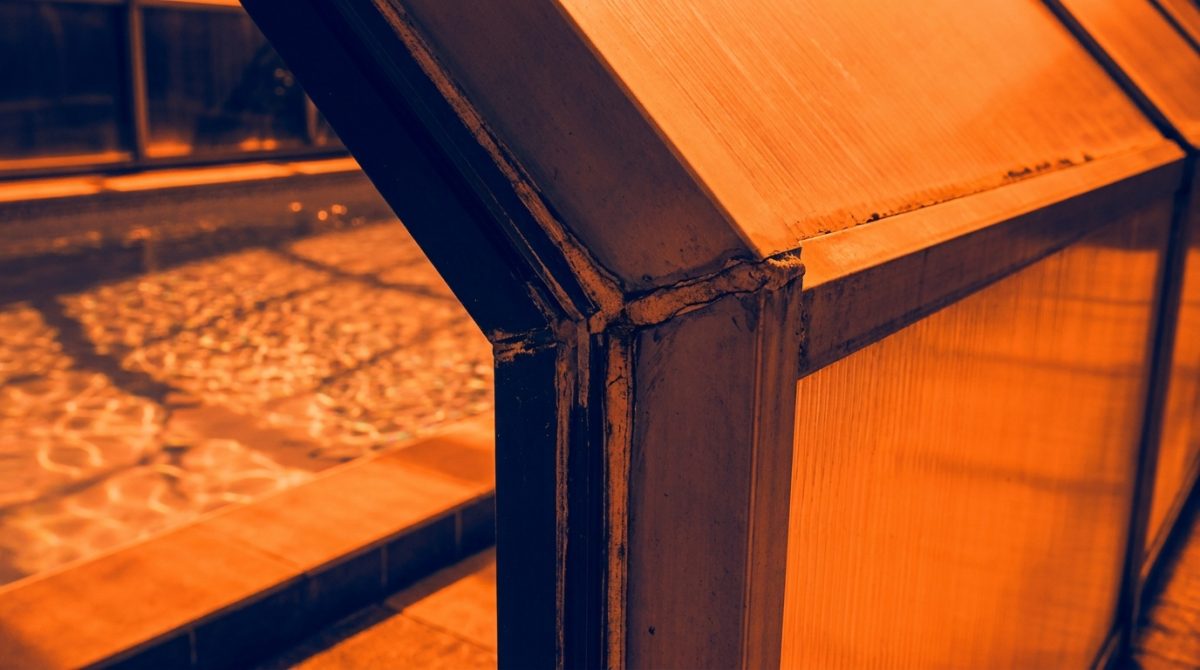
High-performance sealant is applied at every joint, every penetration, and every interface between dissimilar materials in a well-built enclosure. The chemistry matters. Neutral-cure silicone sealants are the standard choice for aluminium-to-glass joints because they remain flexible through thermal cycling. An enclosure heats and cools significantly between a sunny July afternoon and a January night. A rigid sealant will crack under that movement; a flexible one accommodates it.
Polyurethane sealants are sometimes used where there is higher mechanical load at a joint, such as where a sliding track section meets a fixed upright. They offer better adhesion to porous substrates and are more resistant to abrasion, though they tend to be less UV-stable than silicone over the long term. In practice, a professionally designed enclosure may use both types in different locations based on what each joint is expected to endure.
The LATICRETE technical guidance for sealant use in pool environments emphasises that movement joints between dissimilar materials require sealants that can handle both differential thermal expansion and tensile stress. This principle applies directly to pool enclosures, where aluminium frames, glass panels, and base fixings all expand and contract at different rates.
Sealant failure is gradual and easy to miss. It typically starts as hairline cracking rather than obvious peeling. Regular inspection of all joints, particularly at corners and at base plates, catches this early enough to remedy with a simple re-application rather than structural remediation.
Drainage: Managing Water Actively, Not Passively
Expecting water to simply run off an enclosure surface without a designed drainage path is not a strategy. In heavy UK rainfall, water can accumulate on roof panels, back up at base channels, and find any joint or gap to penetrate. A well-engineered enclosure treats drainage as an active system.
Roof drainage in a pool enclosure typically involves a combination of roof pitch angle and integrated guttering within the aluminium profile itself. A pitch of at least three to five degrees is standard to encourage run-off rather than ponding. When water sits on a polycarbonate or glass panel, it puts sustained pressure on the seals at the perimeter of that panel. Even high-quality silicone sealant will eventually lose adhesion under constant hydrostatic pressure if drainage is inadequate.
At ground level, the base channel where the enclosure meets the pool surround is a critical point. This junction needs a clear path for water to exit, not a sealed pocket where it can sit against the fixing bolts and base plates. Some enclosure designs incorporate a small drainage slot or weep hole at regular intervals along the base channel specifically for this reason. It looks like a minor detail but it prevents localised corrosion at the most structurally loaded part of the frame.
The Role of Below-Grade and Base-Level Protection
The base of a pool enclosure is where groundwater pressure, surface splash, and cleaning water all converge. Construction engineers working on below-grade waterproofing systems consistently identify the base zone as the area with the greatest potential for water ingress, because it faces pressure from multiple directions simultaneously. The same logic applies to a pool enclosure’s base fixings.
Anchor bolts and base plates embedded in or fixed to a pool surround need either stainless steel specification or marine-grade aluminium, with no exceptions for cost-saving. Carbon steel fixings with powder coating may look fine for a few years, but chlorinated splash water is aggressive enough to degrade standard protective coatings. Once corrosion begins at a fixing point, it is hidden beneath the base channel and may not be visible until the fixing has already lost significant load capacity.
Isolation tape or thermal break materials between the aluminium base plate and the concrete pool surround serve a secondary waterproofing function. Concrete is porous, and capillary action will draw water up through it and into any metal component in direct contact. A simple isolation barrier stops this process entirely.
Condensation Control and Interior Moisture
Pool enclosures create an internal microclimate that is consistently more humid than the surrounding garden. Warm, moist air from the pool water meets cooler surfaces on the glass and aluminium, particularly overnight in autumn and winter, and deposits condensation across internal surfaces. If this condensate has nowhere to drain, it pools on the internal faces of base channels and sliding track sections, the same areas already under pressure from external water sources.
Ventilation plays a direct role in managing this. Designed ventilation openings, positioned to create airflow without allowing wind-driven rain to enter, reduce internal humidity enough to cut condensation substantially. Some Arch Enclosures structures incorporate ridge venting along the apex of the roof profile for exactly this reason. The thermal benefit of an enclosed pool is well established, but that thermal performance needs to be balanced with enough air movement to keep internal surfaces dry. For more on how enclosures manage internal climate as part of year-round swimming, the relationship between structure and thermal management is worth understanding in detail.
Maintenance That Keeps the Systems Working
Even the best-specified waterproofing system requires periodic attention. The key maintenance tasks are straightforward, but they need to happen on a schedule rather than only when a problem becomes obvious.
- Inspect all sealant joints annually, looking for cracking, shrinkage, or loss of adhesion at the edges.
- Clear drainage channels and weep holes of debris each autumn before the wetter months arrive.
- Check base plate fixings for any surface rust or paint lifting that would indicate moisture penetration.
- Examine glazing retention beads for cracking or loosening, especially after periods of high temperature variation.
- Re-apply sealant to any joint showing early-stage deterioration before water ingress makes the repair more extensive.
None of these tasks require specialist tools or significant time. Catching a failed sealant joint in its early stages costs a tube of silicone and thirty minutes. Leaving it for another season invites water into the frame profile, where repair becomes structural rather than cosmetic. The hidden systems that protect a pool enclosure are only as effective as the maintenance routine that keeps them functional.
Waterproofing is not a single product choice. It is a system of decisions made in the design stage, carried through in material specification and installation practice, and maintained through the life of the structure. When those decisions are made carefully, the enclosure performs exactly as it should: a dry, protected space where the pool remains usable regardless of what British weather decides to do outside.
